Short story 4 min read 19+
Burner: Night Recovery and the Pilot Who Won't Fold
Propane reaches me before the field does — sweet, mineral, the ghost of every flame the day carried. Then the wet nylon, spread wide on the grass, silvered with dew, letting go of its heat one degree at a time.
I kill the headlights and let the dark settle. Recovery has a shape. Chase lights, a borrowed field, a basket cooling in the fescue like a hearth nobody lit. Load it, zip it, drive home while the radio murmurs other people's landings. Nights like this end one way only: fold it, truck it, call it a pack-out and never look back at the field.
Dew soaks through the seams of my boots in three steps. The grass gives with a sound like a breath held all evening, released. I walk to the envelope.
The fabric is still warm. I lay my palm flat and the panel gives the heat back like a flank, like something that was alive an hour ago and may not be finished. Warm nylon gathers. Cold nylon fights. So you fold before the wind takes the warm, and you don't stop for anything.
I count gores under my breath. Six. Nine. Twelve. Sixteen, seventeen — and somewhere in there, past the wind, Gyuri's voice cuts a word in half and doesn't finish it.
She's at the basket. She has been at the basket since we dropped the crown line.
“Just fold the envelope,” she says, without turning around.
Gyuri. Thirty-four. Pilot of the ship whose skirt I'm dragging through wet grass, ground crew for her husband's outfit on paper and something else out here where the paper doesn't reach. Her jumpsuit is zipped to the collarbone and no further, sleeves peeled and knotted at her waist. Windburn has her cheeks redder than the burner lamp ever managed, and at night, thirty-four looks like a rumor of a younger woman — someone the daylight keeps off its books.
Glove marks sit in pale lines around her wrists. She has worked since noon.
She is still holding the igniter.
“It's dead,” I say. “You shut it down on final.”
“I know exactly what I shut down.”
She locks the valve. The spring clicks. A minute later her thumb finds the igniter anyway and clicks it once more — a dry, hopeful, stupid sound, spark with no gas behind it, a flame that already isn't there.
Nothing lights. Only her palm is hot. I can tell from three meters away, the way heat stands off skin.
The radio on the basket rim crackles — her husband's crew, three fields over, calling load counts, a man's voice reading numbers that belong to a life she isn't standing in tonight. She reaches over without looking and turns the volume down until it's a fly under glass.
Not off. Down.
That's the part I should think about. I think about her hands instead.
Here the envelope fights me, because I let it cool. Half folded, half a fallen parachute, half an excuse. Wet nylon clings to my forearm — cold on the outside, and where my palm has rested, warm. The whole night is that fabric. One temperature at the surface and another underneath.
On the clipboard in the truck, the recovery list waits with my name slot empty, because I never signed in. Signing makes it work. Unsigned, this is only two people in a field, and the field is only the two of us.
Faint gas threads from a tank valve she hasn't capped. The sweetness settles on my tongue like candy taken from somebody.
And she waits. Igniter in her fist, envelope half-folded, and every second she doesn't order me back to work is a word in a sentence I already understand.
Continue this scene in Burner →
“Gyuri.” My voice does something I didn't authorize. “Your husband's crew—”
“Is folding a field I'm not standing in.” She turns, finally, and the wind slides straight through the open collar of her jumpsuit, and her body answers the cold in a way that has nothing to do with cold. She doesn't hide it. She doesn't name it. She bites down on her back teeth. “So ask me to fold it. Go on. Ask me, and I'll do it, and we'll drive home with the heater running, and this field never happened.”
The igniter hangs off her finger by its lanyard. Slowly she peels one leather glove off with her teeth. Left hand. Thin gold on the ring finger, catching the last amber glow off the tank.
She doesn't take the ring off. She just wants me to know she thought about it.
Dew has soaked through both my knees. The envelope lies between us, half a wing, her knee print still pressed into one panel from when she knelt at the mouth of it — a shape that will be gone by morning and is not gone now.
“I won't ask you to fold it,” I say. “This one's yours to call.”
She crosses the wet grass the way she flies — no wasted input, all decision — and stops close enough that I catch propane, nylon, and beneath both, skin that has been out in the wind all day. Her bare hand comes up. Flattens against my chest, reading my pulse like pressure on a gauge.
Hot. Both of us. Only one of us still pretending.
“The envelope's still out,” she says, low, almost the pilot voice.
“It'll keep.”
“It never keeps.”
Her fingers close on my collar and pull once — gentle, a heading, not a demand. The radio murmurs under its glass about a field I'm not standing in. That is the last thing I log before the dark takes the stick: her mouth an inch from mine, open, and behind us both, the igniter clicking one more time.
Empty spark. Dead flame.
Hot palm.
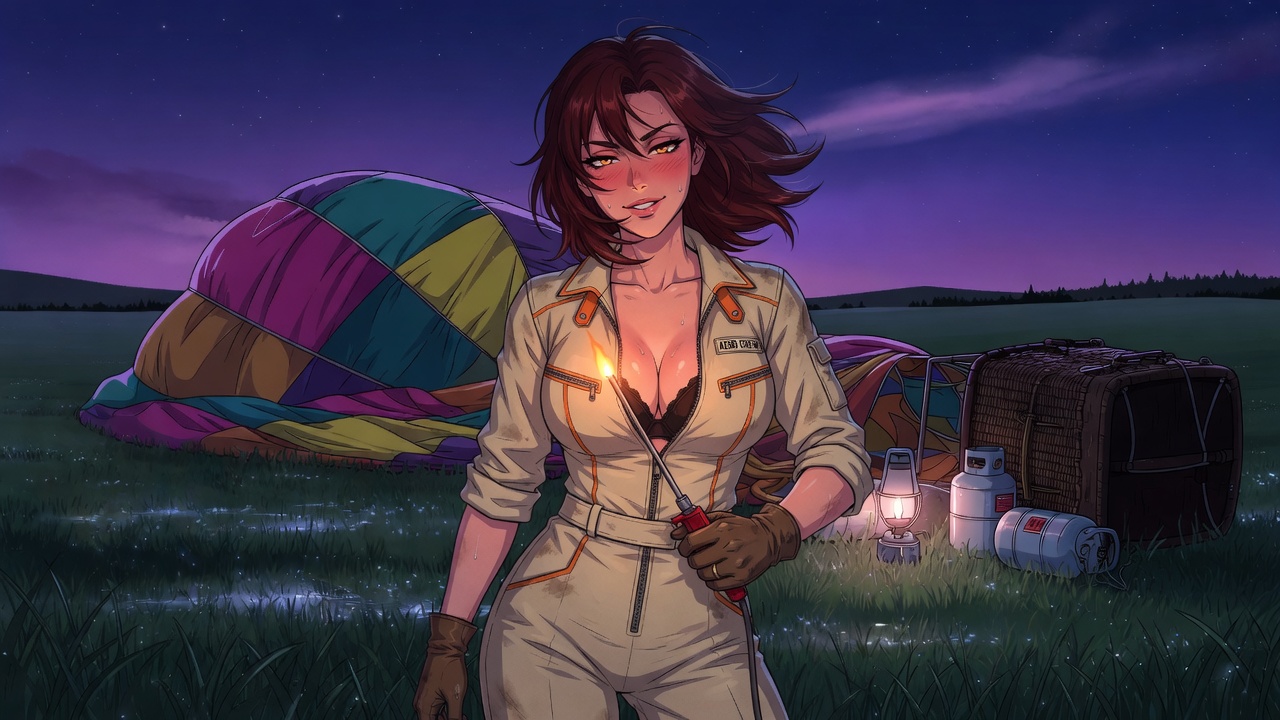
Burner
Night recovery packing, a hot air balloon retrieval field. Gyuri will not let go of the burner igniter. “Just fold the envelope.” Get in the recovery truck here and it is just pack-out.
Every story is completely free to read. No paywall, no account.