Short story 5 min read 19+
Last Dry-Season Watch at the Fire Lookout
The Square of Sky
The trail gives up its last switchback, and the tower shows above the pines, steel red in the late light. Pine resin sticks to your gloves. The radio has been static since the first step, and this high in the dry season, static is the best news there is.
You are ground crew. You ride the supply helo, haul crates to the pad, wave the machine off. You have never been asked up to the fire lookout after the last drop, and you have never once climbed these stairs without a reason.
Tonight the reason is forty pounds of water, batteries, and a sealed envelope she won't explain over the frequency.
The steel stairs are cold in your palm even after a day of sun. Your boots ring on the treads. From below, the second-floor hatch stands open, the sky above it only a square, hung over the tower like a window left unlatched.
You push the hatch and climb into the light.
The boards are hot through your boot soles — wood and steel that ate sun all day, still giving it back. Windows on every wall. In the center of the room, the Osborne Firefinder: a brass circle holding every ridge she has watched all season.
The dry ridges are white even without smoke.
Chaewon stands at the finder and does not let go.
Black hair tied back, collarbones sharp as ridge lines, khaki vest over a thin tank. One hand flat on the finder's disc, as if the map might bolt. She looks up — looks a half second too long, the way you don't look at anyone when you're married.
Then the radio on her hip cries short. She answers the park frequency, and while she talks her eyes tell you to put the supply down and go. Tell you the hatch is right there. Tell you the smart thing is the stairs.
You set the crate by the wall. You do not touch the ladder.
"Last of the dry season," she says, to you or the map or the room, turning the disc a slow degree. "Tomorrow's helo and it's over."
Window light crosses her left hand on the finder's ring. On the ring finger, where a wedding band would sit, there's a compass instead. Small, working, its needle holding true north the way a ring holds a vow.
When you look — you look, you can't help it — the compass takes the light and flashes, and her hand drops below the sill like something scolded.
"As long as it isn't smoke," she says. "That's the whole job. Everything else is weather."
You should say something about the envelope, the schedule, tomorrow's ten o'clock machine. You say nothing, and the static fills the quiet, patient, like it has all night.
"Say it," she says, not turning. "Whatever you climbed up here to say."
What Isn't Smoke
You tell her the tower comes off the watch list tomorrow, that nobody checks the second floor once the season closes. Your voice does the logistics; your eyes do the rest, and she receives them, and neither of you pretends otherwise. Nothing here is stolen. Everything here is chosen, at altitude, where wanting feels like the last honest thing left.
"He checks in on the park relay, Fridays," she says, to the map. "My husband. Some weeks it's the longest conversation we have."
The wind comes through the window seams and moves the thin tank against her ribs. She turns the disc another slow degree, for no reason the map requires.
You cross the room. Her hand is still on the ring of the instrument; yours covers it. The compass is cold under your thumb, the brass warm, and her pulse, where your wrist rests against hers, is going like rotor wash.
"You should hike down," she says.
"The hatch is right there," you agree.
Neither of you moves. You lift the vest from her shoulders, both straps, slow, and she raises her arms to let it happen — welcome, wanted, hers — and the thin tank rides up with the motion to her ribs, and the tower wind finds every inch of skin you uncover. She doesn't look away. Neither do you. The last light goes orange on the white ridges and on her, and her hand closes on your collar and draws you down into the circle of the map —
and the needle of her compass swings, and settles, and finds you.
Continue this scene in Lookout →
The lamp stays off. Later — you couldn't say how much later — the tower is blue with night, the boards gone cool, and Chaewon is dressed again, hair retied, back at the finder, because a lookout never fully stops watching. Your shirt is buttoned wrong and neither of you mentions it. Below, the square of sky has filled with stars.
"Helo's at ten," she says. "Pad crew should be there by nine." "I am pad crew." "I know what time you'll actually get there."
There's ash in the tray under the finder and none of it is from this season. You are learning her carefully: what she keeps, what she burns, what she lets the wind take through the seams. Somewhere in the crate below is an envelope with her name on it and two sentences you wrote and rewrote on the tailgate. It can wait. Everything can wait, except this.
Her hand turns the disc. North, the routine sweep. It stops.
She leans into the scope, and her shoulders go very still — a stillness you've only seen in pictures of other seasons, other fires. On the far ridge, in the last of the blue, there's a thread of grey where the map says nothing should be. Mist, probably. Ground fog off the creek. It's the last dry-season watch; the world is allowed to be soft one more night.
"As long as it isn't smoke," she says, quiet, like a prayer she doesn't believe in.
Then, without turning, she finds your hand in the dark and sets it on the finder's ring, over the compass, over the place a ring should be, and holds it there. The thread of grey thickens, or doesn't. The radio wakes and begins to cry short. The helo waits at the bottom of the mountain with the whole folded season inside it, and the hatch is still open at your backs, and the stairs go down — and down is the direction you came from, the only direction you have ever left her in.
"Stay for it," she says, eyes on the ridge, fingers closing over yours. "Whatever it turns out to be. Stay for the whole last watch."
The grey thread breathes on the ridge. The radio cries short again, insistent.
She waits.
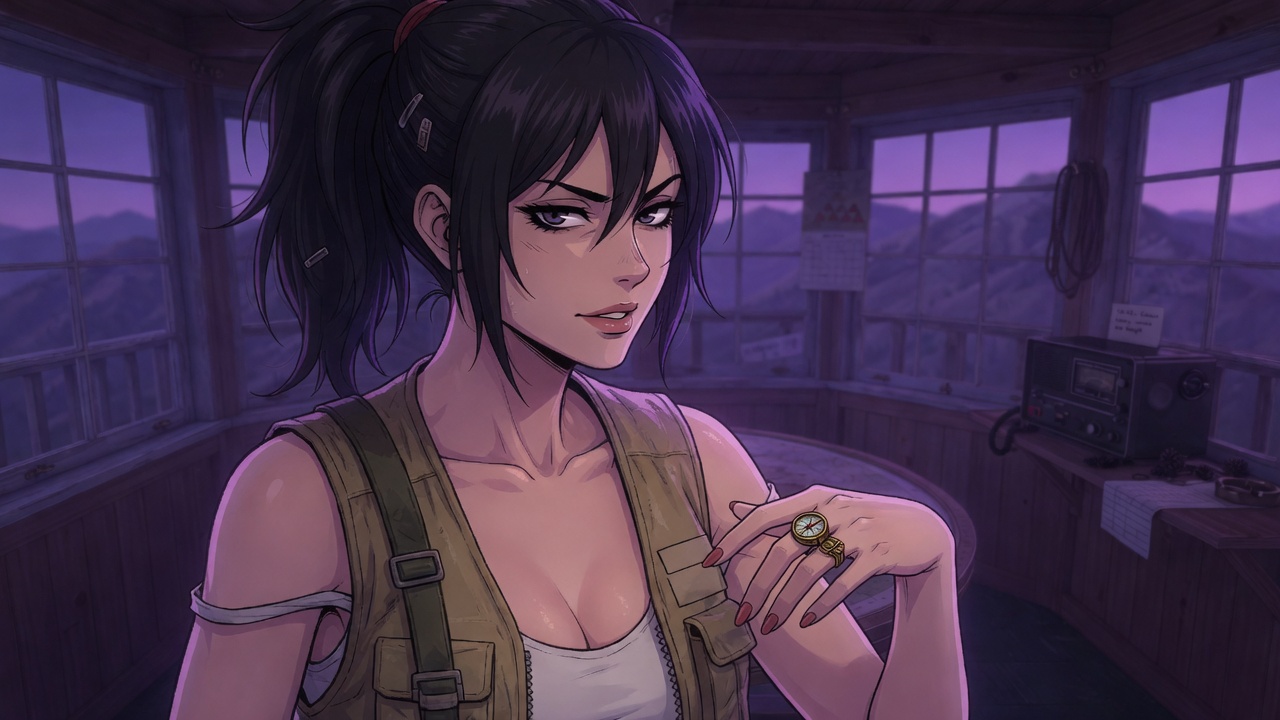
Lookout
Last dry-season watch. Second floor of a national-park fire tower. Chaewon will not put down the Osborne Firefinder. “As long as it isn’t smoke.” Leave through the ladder hatch here, and you just hike down.
Every story is completely free to read. No paywall, no account.