Review 4 min read 19+
My Brother's Wife — Review: The Night the Latch Stays Undone
The hook
Some visual novels try to seduce you with spectacle. My Brother's Wife does it with a latch — specifically, with the small sound a latch never makes. By the time you are standing at the end of a dark hallway in a countryside house that smells of incense and dish soap, you realize the entire game has been an education in one hinge.
The memorial is over. The relatives' cars took the gravel road back toward Seoul an hour ago, taillights going out one by one. What is left in the yard is smoke leaning over the jar stand and a silence so complete you can hear the kitchen light buzzing. Inside, the memorial food sits under plastic wrap — pancakes going stiff, namul darkening at the edges — beside a soju bottle with two cups next to it, and nobody has cleared any of it.
Then the phone buzzes. The brother, already on the highway for a dawn meeting: In Seoul before dawn. Put Hajun to bed.
Hajun. That is our narrator. Twenty-six, and being sent to bed by his sister-in-law as if he were still small enough to carry. The line is a kindness, a dismissal, and a dare all at once, and My Brother's Wife never lets you forget which of the three is doing the talking.
Because Hyejin has already said the other sentence. She went in first. She left the latch undone.
The characters in close-up
Hyejin is twenty-eight and drawn with terrible specificity. No formal mourning clothes at this hour — just the white blouse from the ceremony, sleeves damp from the dishes, slipping off one shoulder above a plain black skirt. She does not fix it right away. That interval — a second, maybe two, in which the fabric simply stays where it fell while she keeps scrubbing a bowl — is the whole game in miniature. Nothing happens. Everything is decided.
Hajun is written as a man performing the role of younger brother while his eyes keep failing the audition. He offers to dry the dishes. He says he will take the guest room, really, it is fine, do not worry about the heating. He means it. Mostly. The prose keeps a running ledger of the difference between what he means and what he does, and that ledger is more gripping than anything the genre usually stages.
The brother, meanwhile, never appears. He exists as taillights, a text message, a company that needs him at dawn. It is the smartest decision in the script: you cannot resent a man you never see. You can only misplace him, the way the house is already misplacing the memorial — incense cooling, cups going dry, a family held together for one more night by politeness and floor heating.
The tension engine
Here is the fork, and the game treats it with surgical patience. Walk to the guest room, and the night stays what it was when the relatives left: simply the day after a memorial. Dishes dried, lights off, nothing happened and nothing ever will have. That path is written fully and kindly — it is not framed as failure, but as choosing which man you are.
Stop at the other door and nothing lurches. There is no crude prompt. There is a doorframe under your hand, a rectangle of warmer dark, and a question asked from inside the room that is not quite a question. Then the game does the thing this site's best writers do: it steps back, closes its own door, and lets the morning do the telling. The fade is immaculate. What you fill in is richer than anything that could have been shown.
The sensory design deserves its own word. Sound carries the seduction: water shutting off, a refrigerator humming, the tick of a cooling floor, bare feet on wood two rooms away. The point of view stays welded to Hajun's skin, so desire arrives flavored with guilt the way the kitchen air is flavored with sesame oil and old incense.
Best enjoyed when
The hour matters. Take this past midnight with the lights low, because half the game's information arrives through darkness and audio. Come for slow-burn atmosphere rather than event — it is roughly a ninety-minute read with perhaps ten minutes of escalation, and it trusts you to feel the other eighty. It pairs beautifully with our sleet-night story, another study in weather, loneliness, and one door that should probably stay closed. If you want your NTR where the betrayal happens mostly inside one man's chest, this is that rare thing: an infidelity story told from the exact midpoint between refusal and ruin.
Final call
An easy recommendation, and one of the quiet standouts of the season. The writing respects every party in the triangle, including the absent one; the choice at the door genuinely splits a man in two — the one who remains a brother-in-law, and the one who remains in the night — and both routes deserve a walk. If the premise pulls at you, it is short enough to finish before dawn, which is, given the material, the only correct reading hour. And once you are done standing in your own dark hallway, the wider shelf of NTR visual novels will show you how rarely this kind of restraint is even attempted. Not every night should be just the day after a memorial. This one is.
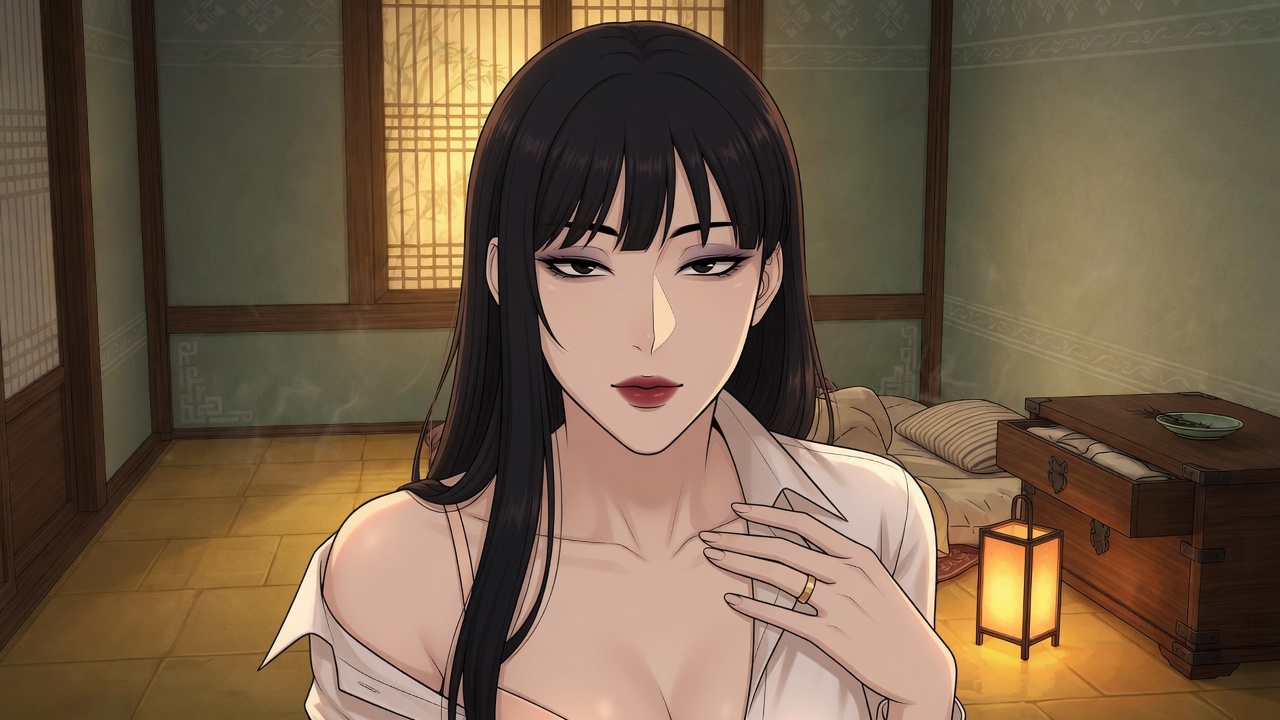
My Brother's Wife
After the memorial, the countryside ancestral house is empty. My brother drove back to Seoul for a dawn meeting. Only his wife stayed. “The inner room is warmer.” She leaves the latch undone. Go to the guest room and that night is just the day after a memorial.
Every story is completely free to read. No paywall, no account.