Short story 6 min read 19+
Last Cycle: Until the Last Dryer Finishes
The rain quit around midnight, but Second Avenue kept its shine. Tuesday, one in the morning, and the East Village has that rinsed look — gutters running, traffic lights bleeding green into wet asphalt, a cab somewhere hunting for a fare it won't find. Nobody is out but you and a bundle of sheets that needed hot water more than you needed sleep.
You dropped the sheets in at midnight, went out for a walk you didn't need, and came back when the drum was the last thing moving on the block.
The 24H sign hangs over the laundromat like a promise nobody tests. Its neon drips down the wet asphalt in long red letters, and behind the glass there is nothing lit but the fluorescents — that flat, institutional white that makes one a.m. look like a rumor of morning.
You push the door.
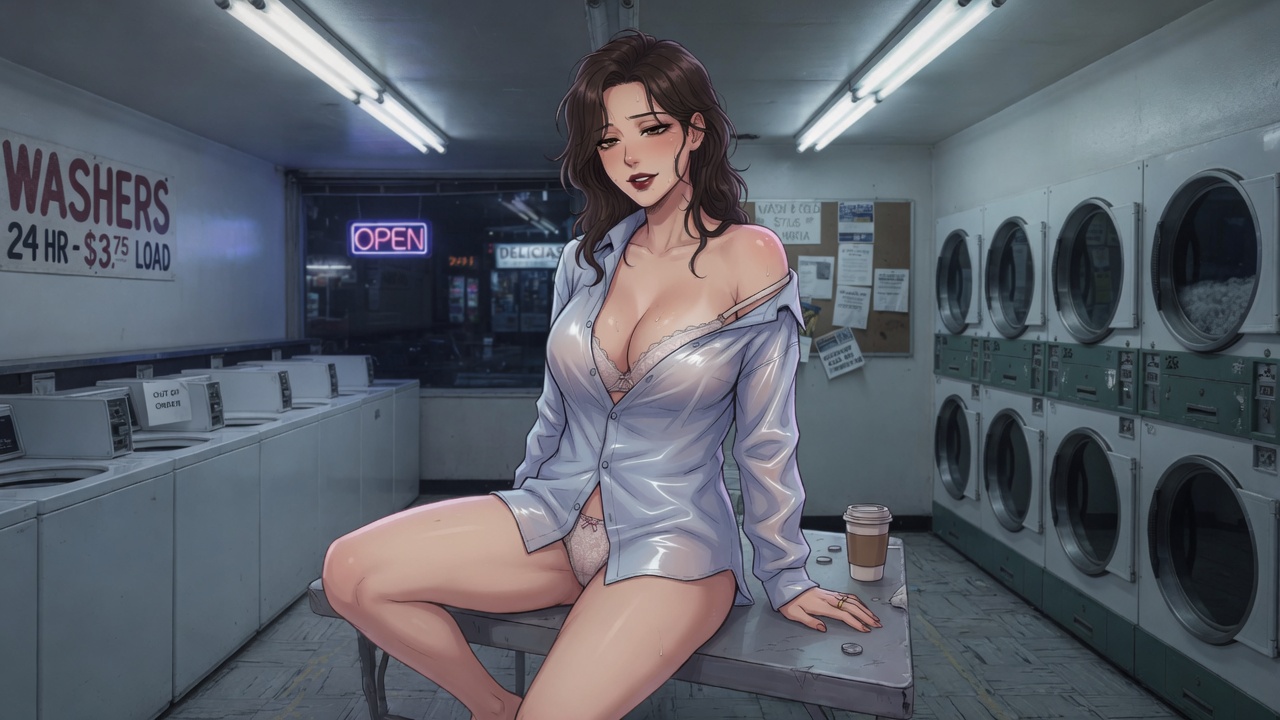
Detergent hits first, then the heat: that thick, soft-walled warmth only coin laundries have, air that has been through ten thousand dryers and never once left the room. Machines fill both walls, every one of them dark and asleep. The plastic chairs along the window are empty. All except one dryer on the far wall, still turning.
Your sheets are in it. The night has narrowed down to that drum and the sound it makes.
Someone else is here.
The Woman at the Dryer
She stands with one hip against the machine, reading the tumbler the way other people read weather. Twenty-seven, you'd guess, though fluorescents flatten everyone. Dark brown waves pushed behind one ear. A face that is unmistakably adult — no softness left in the jaw, a small tired line at the corner of her mouth that isn't unhappiness. It's just late. It's Tuesday.
She's wearing a men's shirt, pale blue, big enough that the hem hangs to mid-thigh. The collar sits open, two buttons undone, and her legs are bare beneath it, pale under the lights. When she taps the dryer's little window — a habit, keeping time with the drum — a gold band catches the light on her left ring finger and throws a coin of it across the machine.
On the folding table sits someone's basket. Broken handle, half full of towels. Not yours.
You take the chair by the door, which is a lie, or the chair near her, which would be another one. You take the one in the middle and pretend the difference matters. The dryer knocks its load over, again, again — a slow heart keeping time for the room.
Forty-Two Minutes
“You're going to sit there and watch your sheets the whole time?”
She says it to the glass first, then turns her head just enough to include you. Her voice is low, a little hoarse from the night, amused in a way that costs her something.
You tell her the sheets are the responsible part of your evening. She laughs — short, real, one hand coming up over her mouth as though the room were smaller than it is.
Talk arrives the way it does at one in the morning: sideways, half-asleep. The rain. The price of the big machines. How this place smells like everyone's Tuesday at once. She offers, unprompted, the way people offer things they've already decided you should know, that her husband works nights — a kitchen downtown, Marcus, twelve hours on his feet. “He gets home around four,” she says, watching the tumbler turn. “I do laundry on Tuesdays. The house is too quiet, and these machines are honest.”
The band turns on her finger while she drums it against the steel. You keep your eyes on the dial. You are a stranger, which is a kind of politeness. You are also still here, which is not.
The Hem
Her load finishes first. The buzzer makes you both flinch, then laugh at flinching. She pulls warm towels out by the armful and folds exactly two before her hands go still, and she looks across the room at the last dryer — yours, forty minutes still on the dial.
Then she crosses to you. No hurry anywhere in it. She stands close enough that the dryer's heat seems to come off her instead, and she reaches down and tugs the hem of your shirt. Two fingers. Light as lint. A question and an answer in the same small gesture, held one second longer than accident allows.
“Until it finishes,” she says. “That's all I'm asking. Just until it finishes.”
Continue this scene in Last Cycle →
The neon is still sliding red down the glass when she walks to the front door and pulls the roller shutter down over the window — halfway, like she's thinking about it, then all the way. The letters go out. The room contracts to fluorescent white, detergent, heat, the two of you. She sets the basket on the floor, lays one hand flat on the folding table, and looks at you the way people look at things they have already decided.
You get up. The chairs are empty. The drum keeps knocking. The night is only laundry now, and the folding table has stopped being one.
Buzzer
The heat in that room could be blamed on the dryers. It wouldn't be true, but it could be blamed. What happens under that shutter belongs to the two of you, chosen twice over — once by her fingers on your hem, once by you not walking to the door. The dryer talks the whole time, patient and constant, like it has seen this before and kept every secret.
It rings out at ten of three.
Afterward there is folding, because there is always folding. She does your towels in perfect thirds and hums while she works, and the ring is back on her finger where it never wasn't. Her phone lights up on the table — kitchen's dead, heading home — and she smiles at it, small and private, then lays it face down, and the night lets her have that.
There's a moment near the end when she holds one of your pillowcases against her chest and asks your name — not because she needs it, but because the machine is nearly done and one of you should owe the other something that small. You give it to her. She repeats it once, like checking change, and doesn't write it down, and somehow that is the most honest transaction of the night.
She leaves first. Sneakers at the door, the shutter rattling up half a foot so she can slip under it, out into the wet street that has already forgotten her. You learn her name the way you learn weather after it passes. Dana. A soft word for a hard decision.
The folding table goes back to being a folding table, one towel at a time. By the time the last of it is in your bag there is no evidence left in the room except the smell of heat and a single dryer sheet on the tile, curled like a spent match.
Your sheets are warm. The 24H sign keeps burning over an empty chair for no one at all.
Some Tuesdays only happen once. This one stays in the drum, still turning, in Last Cycle.
Last Cycle
One a.m., East Village 24-hour coin laundry. A married woman tugs the hem of a man's shirt in front of the last dryer. “Until it finishes.” After the shutter comes down, the folding table is no longer a place to fold.
Every story is completely free to read. No paywall, no account.