Short story 5 min read 19+
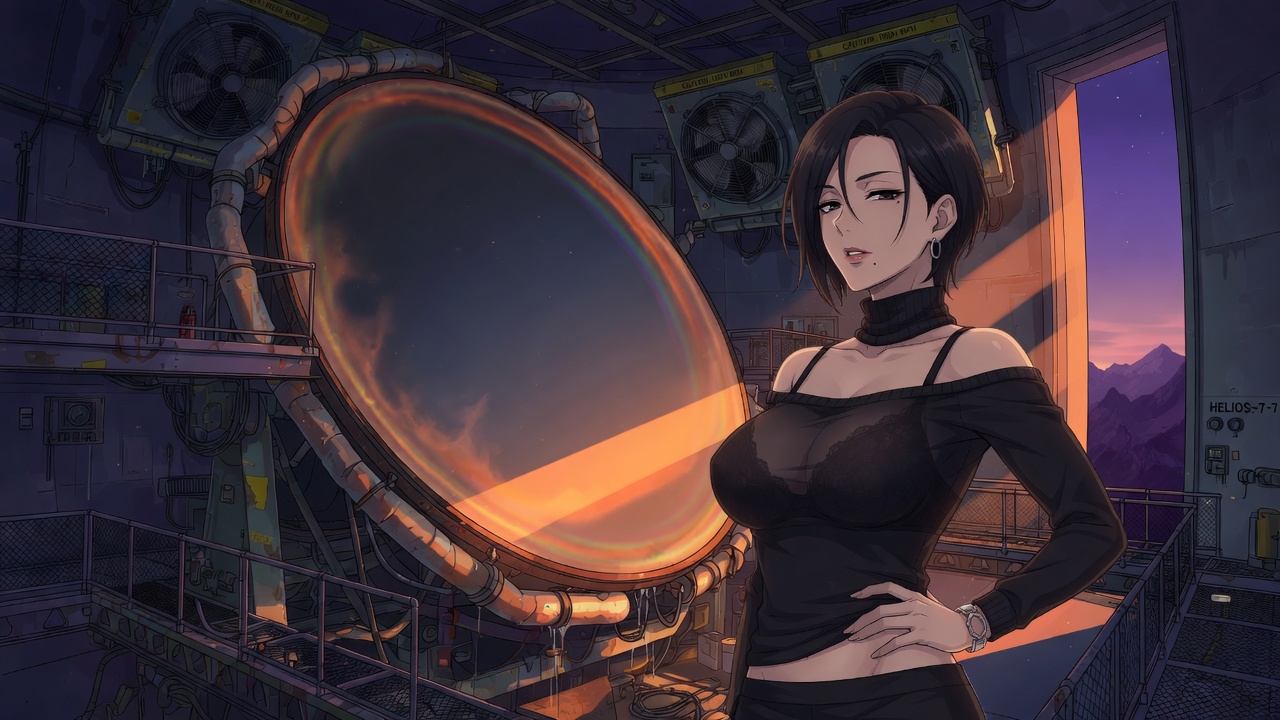
Helio — Dusk in the Heliostat Room
The road up here announces the altitude early. My ears pop on the last bend before the parking court, and dusk comes down in a specific order: first the ridge takes the sun behind it, then the high road turns the color of cooling iron, and finally the observatory shells — the great dome, and beside it the low white housing of the solar telescope — catch the last red on their shutters like instruments being put away for the night.
The air is thin enough that the evening feels thin with it, let out of some pressurized cabin. I've drawn the night-check tonight — lights, alarms, doors, a slow sweep making sure the mountain behaves — and by the time I reach the solar building, the only warmth left in the world seems to be coming from inside it.
A warning plate is bolted to the heliostat-room door. I've read it a hundred times and read it again: DAYTIME OBSERVING ENDED. PRIMARY MIRROR COOLING. In this light the letters sit flat and administrative, and the door handle underneath holds a little of the day's heat, which feels like a confession.
The room that still remembers the sun
The fans reach me first. Before the light, before the smell — a wall of warm moving air as the door swings in, layered and industrial, like the building breathing out a long shift. Then the smell itself: hot metal, dust singed somewhere deep in the ductwork, and under it that faint mineral scent of glass that has stood in sunlight for ten straight hours.
Today's sun is still in the room. That's the thought that arrives, unscientific and certain. It's in the optics, in the air, in the long amber patch the heliostat still lays across the floor like something spilled and not yet wiped up.
The primary is cooling yellow. I stop at the threshold and look at it — the big mirror lying face-up in its cell, giving off the last color of the day, a slow amber with nowhere to go. The cover that should be over it sits folded on the floor beside the cell. Unfurled. Waiting. Nobody has put it on.
Somebody is standing next to it.
Doyeon, at the mirror
She's the solar observer — the one who spent all day feeding sunlight into this room piece by piece. A bob cut short to the jawline, black turtleneck with the cuffs pushed once and forgotten, a silver bracelet at her wrist that the cooling light keeps finding. She hears the door and doesn't startle. She just lowers her voice to fit the room and says my name like a fact being entered into a log.
Doyeon. Married — I know it the way you know things about colleagues, from the edges of other conversations. Her husband is a week into a two-week trip, a detail she mentioned this afternoon with a shrug I have apparently been carrying around since.
"Not yet," she says, when I glance from the mirror to the cover. "Give it a little longer. It's still coming down to night."
It isn't a technical objection. The cover is right there. I say something about closedown, about doing it by the book, and she doesn't move, and the fans go on listening to the two of us not moving.
Here is the honest arithmetic of the next minute. There's a handle on the far wall — the emergency exit — and the night it opens onto is simple. Cover on, fans down, stairs, the drive through the pop of my own ears. A night that ends the way observatory nights are built to end, tidy and dark and unwritten.
Or there's this room. The heat. The yellow going slowly out of the glass while the only audience either of us has left is machinery.
Continue this scene in Helio →
She turns the bracelet once around her wrist, then again — an orbit that doesn't hurry. The amber in the mirror has dropped a shade since I came in, the way a voice drops. On this mountain, closedown is a promise everybody keeps, and I've always liked being someone who keeps it. She knows that about me. I suspect that's why she hasn't touched the cover herself.
What the fans hear
If you've never stood in a room built to hold sunlight after the sun has gone, I can't fully explain the acoustics. The fans flatten everything. Footsteps, breath, the small honest noises of a body shifting its weight — all of it goes under, and what remains is a privacy you can't find at sea level. Whatever gets said in here travels at the same frequency as the fans. Nothing carries. Nothing reports.
So we talk the way people talk when the words are the least important part of the sentence. About the seeing. About the optics. About her flight home next month, about nothing. Her shoulder ends up a hand's width from mine at the rail above the mirror cell, and neither of us adjusts it.
I should put that cover on. The cover exists so a mirror can give up the day cleanly, so tomorrow's light lands on a clean surface. Tonight the glass cools slowly, reluctantly, holding its color like a held note, and I understand that the two of us are cooling on the same curve.
The handle, the room
Minutes pass, or an hour — the fans make it impossible to say. Then she says the thing that decides it, quietly, eyes on the glass, and I feel the sentence land somewhere under my ribs.
Whatever I answer, I'll answer with my feet. Toward the emergency exit, and the mountain keeps this evening out of its logs forever. Toward her, and the night-check goes unticked, and a silver bracelet is the brightest object left on the mountain.
Helio is an encounter story that runs on precisely this current — the long minute before the choice, the heat a day leaves behind in its machinery, and what two adults decide to do with a room that keeps its own secrets.
Helio stays open after dark. So, as it turns out, do I.
Helio
Dusk after daytime observing. High-altitude heliostat room. Doyeon will not set the primary-mirror cover. “Just wait for the mirror to cool.” Take the emergency-exit handle here and the night is only closedown.
Every story is completely free to read. No paywall, no account.