Short story 4 min read 19+
South Gate — The Night the AC Died
The AC in my truck quit somewhere outside Kerrville, and the night didn't mourn it. Hill Country roads are better with the windows down — you can hear the ranches thinking, cicadas stacked so loud the radio gave up an hour back and I let it go. Limestone fences turn white in the headlights and vanish behind me, mile after mile of somebody's patience made permanent.
I was driving to Cole's place for one night: a couch, a fence line to look at, a friend I'd been circling for years without landing. We'd sat next to each other at A&M — animal science, terrible coffee, his laugh always arriving one second ahead of his jokes. I'd met his wife Hailey exactly once, at the wedding, where she shook my hand like she was memorizing it and then went back to being a photograph on his desk. Four years of that photograph. It had aged well, which I tried not to think about while driving.
Cole wasn't there. Livestock auction in Houston, he'd said — a late one — and he'd call from the motel until morning. Leave it to him to set the terms of an absence that precisely. The south cattle gate came up out of the dark with its chain already off, coiled on the post like something asleep, and a pickup sat dark on the gravel beyond it.
The person pushing the gate the rest of the way open was not Cole. Dirty-blonde braid over one shoulder, flannel with the sleeves rolled, bare feet in the gravel like it was carpet she'd gotten used to. A gold cross at her throat caught my headlights first. The wedding band found the light a half second later, and I registered the order of that the way you register thunder before lightning.
“You made it,” she said. “Cole said he'd be late out of Houston, so I just left the gate open.”
Up close, the years hadn't done to her what years usually do. She hadn't stood this near me since the wedding — since she was somebody's brand-new wife and I was the roommate with a handshake. Dusty cutoffs, the deep even tan of a woman who runs her own fence lines, and when she shifted her weight, gravel clung to her soles like she'd stopped noticing it years ago. I was noticing for both of us.
The news came lightly, the way ranches deliver news. The casita's AC had died sometime that afternoon, gone out with a warm, dignified sigh; the repair guy from Fredericksburg would come sometime, a word that out here means weather rather than schedule. Behind her, up the slope, the main house kitchen burned a single yellow window into the dark.
She walked toward the guest casita first, to show me in, and I followed, and the whole walk was arithmetic I didn't want to do. Cole's friend. Cole's wife. Cole in Houston until morning, calling between lots on somebody else's phone. Her ten steps ahead, barefoot on ground she'd worked longer than the ring had been on her hand. My headlights still on the both of us like something that couldn't mind its own business.
At the casita step she stopped and half-turned, and the night offered me its two shapes at once. Take the guest house and be what I came as — a visit, a couch, a fence line, a handshake four years late. Or follow that one yellow window up the slope and let the gravel road stay empty until morning. The cross was lit. The band was lit. She looked at me the way people look when they've already decided something and want to hear you say it out loud.
Continue this scene in South Gate →
That half-turn is where South Gate earns its keep, and where lesser stories in this genre lose their nerve or their soul. This is a slow-burn NTR visual novel that understands its real engine was never shock. It's the long, honest minute where old loyalties get weighed against something unmistakably alive, and every person in the triangle stays a person while the scales move.
Hailey is the proof. She's written as a rancher in her own right — the gate she opened, the stock she'd checked at dusk, the repair guy she'd been chasing by phone since two. Nothing about her is a prize or a plot device. If the night tilts, it tilts because she chose the kitchen light over the lock, and the story never once treats that choice as anything but hers.
Cole isn't a villain either, which is the harder trick. He's an absence with good intentions — a man who will call at six sharp from a motel outside Houston and mean every word of it. The POV makes you complicit in a very specific way: you arrived as the friend, and every step toward that yellow window is a step you take with your eyes open. The writing never lets you off the hook and never raises its voice, not once.
And the craft is all temperature. A dead AC unit doing more suspense work than any thunderstorm could. Gravel on bare soles. Cicadas loud enough to hide a heartbeat, or expose one. The fade-to-black discipline is absolute and the story is stronger for it — the camera stays outside on the gravel, and everything that matters happens in the length of a shadow across a kitchen floor, or in the space between two people deciding not to close it.
Morning comes either way. Cole calls at six, the AC guy shows whenever he shows, and the south gate stands open for whatever you decided to be, back when one kitchen window was the brightest thing in the county.
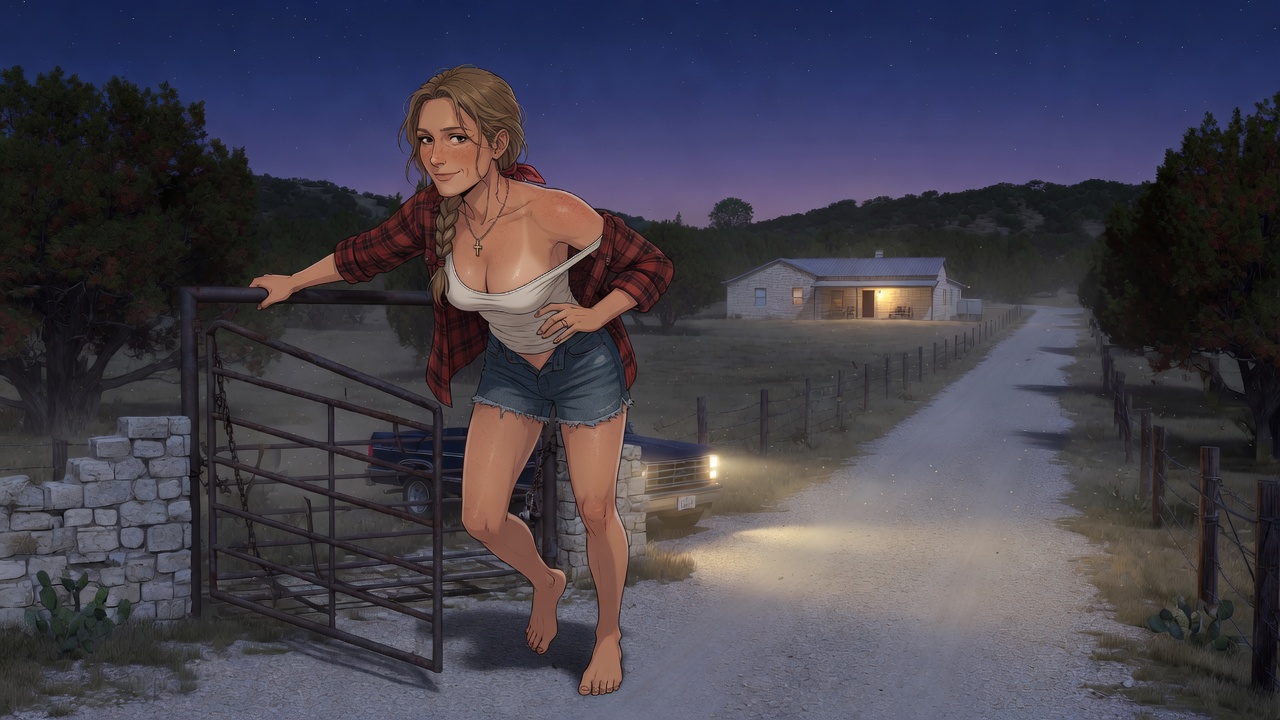
South Gate
A Texas ranch. A married woman opens the south gate. “The casita AC is dead.” Sleep in the guest house and the night is only a visit.
Every story is completely free to read. No paywall, no account.