Review 3 min read 19+
Pull the Arrows Review: Eighteen Meters to the Target
The applause is gone before it reaches the parking lot. What Pull the Arrows keeps instead is everything the applause used to cover: the smell of fletching and waxed string, wax still tacky on your palm, and the particular quiet of an indoor range after a league has packed up all its noise and left.
First impressions
You count the lanes the way you would check your own pulse. Eighteen meters, indoor, night-membership hours. Lanes one through three are already dark. The scoreboard is switched off and still somehow warm, still not knowing how to cool down — the game's best line, and it gives it to the scenery. The bows were unstrung a while ago; that sound died somewhere behind you. Now only your footsteps travel up and down the lane, and only lane four is still white with light.
In that light: Dahee. The coach. Night hours suit her badly, or perfectly — the game has not decided, and neither have you. Down in the judges' row, the chairs are empty. The folding seat that should have held a judge for today's league has been put away. Her husband's absence is rendered as furniture, which is colder than any phone-call scene could manage.
“Just pull the arrows.”
Five words, and suddenly the whole night is a chore with a door in it.
What makes it work
Archery, used as grammar. Anchor point, hold, release — the romance is mapped onto the mechanics of shooting so cleanly that every look becomes aim and every decision becomes a let-off. Pulling arrows is, quietly, the most intimate routine act in the sport: you walk downrange together, past the safety line, to touch the thing you both spent the evening aiming at. The game builds its central choice on that line of floor tape. Cross the safety line now, alone, and the gym simply closes — another night member walking out to the lot. Walk down to the target with her, and practice stops being practice.
It also matters who holds the whistle. Dahee is the coach; she sets the range, the order, the ends. Nothing in this story is talked out of her. She decides when the range closes, decides who pulls arrows, decides — with terrifying calm — that the two of you will walk the eighteen meters together. Desire here is mutual because it is assigned, patiently, by the person with the most to lose.
Where it bites
The silence between ends. This is the slowest and cruelest of the stories I am covering this month, in the best sense: touch is scarce, so touch is enormous. For a long middle stretch the game's only contact is wax passing from her palm to yours as she hands you a handful of carbon arrows, and it landed harder than anything explicit could have. The empty judges' chair sits in the corner of your eye like a splinter that never gets pulled. And the scoreboard matters — tomorrow someone reads it, records stand, a league happened here. The bite is the knowledge that a night like this leaves scores.
Heat level
Three out of five heat, five out of five ache. Nothing explicit, ever; the fade to black arrives at the target line with lane four's light still burning, and the story is content to let restraint do the work. What you get instead is atmosphere you can smell — wax, carbon, the dusty hum of a wall heater — and a tempo taken from the sport itself: draw, hold, and hold, and hold. If you want heat as combustion, pass. If you want heat as pressure, this is near the top of the site.
Should you play it
Yes. For anyone who likes their married-lead slow burns disciplined, adult, and a little sad in the way that all chosen things are, Pull the Arrows is the release to beat this season. It respects the sport, respects the choice, and refuses both villainy and excuse. Afterward, the fencing salle story is the natural next bit of footwork — different blade, same after-hours discipline — and if night-membership atmospheres are your weakness, the gym shelf holds more lit lanes.
My quibble is small: one flashback to the league could be trimmed, and the husband could stand to be one absence instead of two. But when Dahee finally kills the light on lane four and the dark takes the range, this last-lit lane lands its shot clean. Follow-through included.
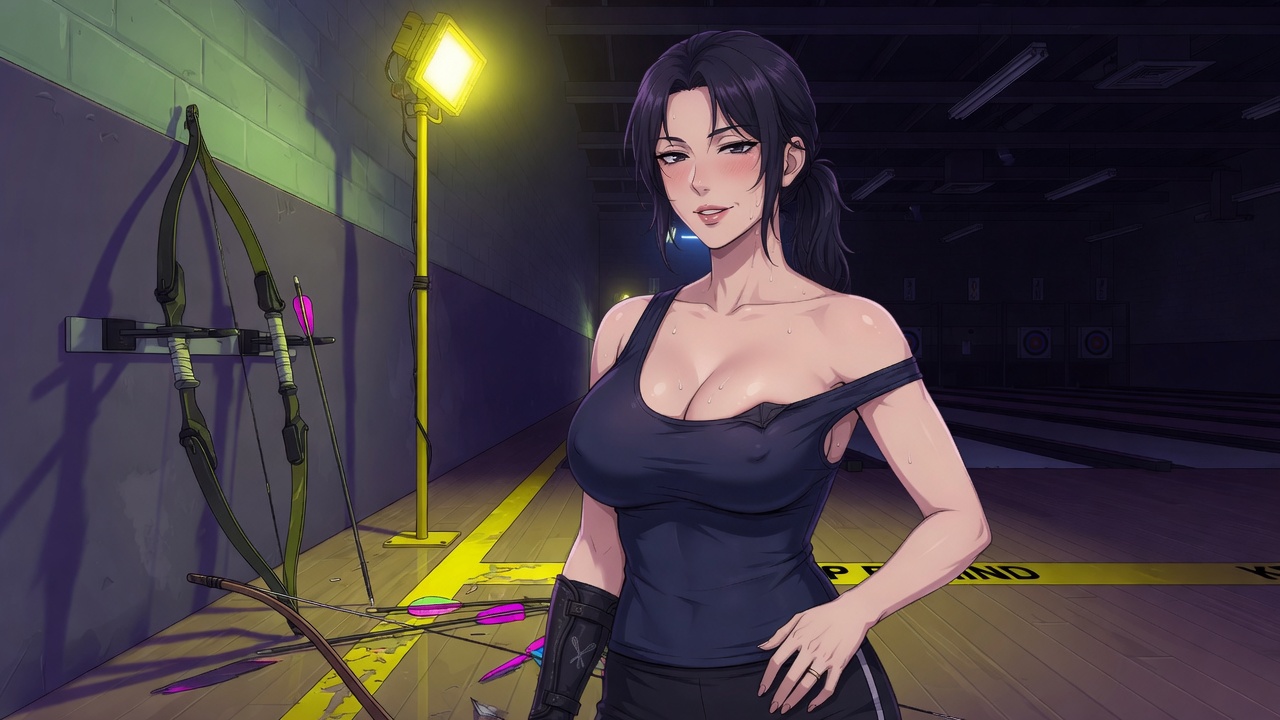
Pull the Arrows
After the league, an indoor 18-meter range. Dahee won't let go of the carbon arrows. “Just pull the arrows.” Walk out past the safety line here and the gym just closes.
Every story is completely free to read. No paywall, no account.