Short story 5 min read 19+
Don't Take the Mask Off: A Late-Night Fencing Salle Affair
En Garde
The last touch is still lit. At the far end of the piste the scoring box blinks red, red, red — her point, low under your shoulder blade, the one that closed the night at 5–4 — and nobody has cleared it, because everybody has gone home. Night rental. The club members filed out an hour ago with their bags and their cold excuses, and the salle has settled into the kind of quiet that only exists after the wall clocks stop mattering.
There is a version of tonight where you are only the responsible adult. You stayed to stack blades, coil the reels, lock up — every late-night rental at the salle ends that way, with a mask hung and lights out and a normal drive home. The weapon cabinet is still open behind you. Remember that. It is going to matter.
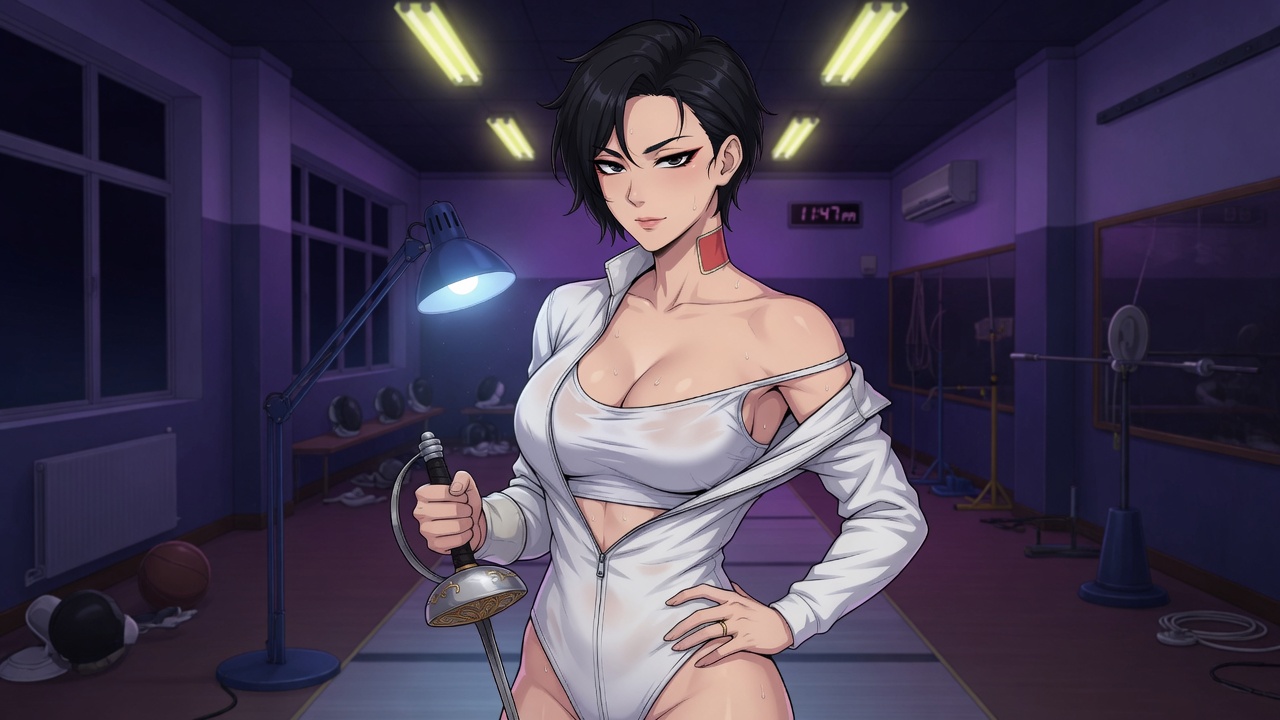
Sujin stands on her en garde line in the white jacket and has not taken it off. Short sport hair, dark at the temples. Sweat has drawn the collar of her jacket a shade darker, and her neck shines above it — except where the mask sat. There the skin is pale, a stripe of untouched country ringed red where the pad pressed. You have spent forty minutes not looking at her neck. You are losing.
Her epee is still up. Guard toward you, point steady at the second button of your jacket, and she will not put it down. Not resting on the piste, not propped in the rack, not hung with the others. The point looks at you the way it looked at you all evening — patient, interested, unhurried.
You are still wearing your mask. You notice it the way you notice a heartbeat, late and all at once. The inside of it smells of steel and floor wax and the whole long night, and through the mesh she softens into fine dark dots, and it occurs to you that neither of you has been in a hurry to end this. You stayed as an adult club member helping a coach close up. That title is gone. You can't say when — somewhere around the third bout, or the first time she called your name across the strips without the honorific.
She peels off her left glove, one finger at a time. Underneath, on the fourth finger, a thin ring. You have seen it a hundred times at club nights and never once in a bout; now you know where it lives. She rolls it over her knuckle and drops it into the bell of her epee, where it rings against the steel — one small clean note, a scoring box of its own — and goes quiet.
A bell sounds once beyond the wall. One stroke, from the next hall, where the late pool is still running and a referee in a grey jacket is calling touches for strangers. Her husband's hall. The door between is shut. The sound arrives anyway, patient as a called touch, and she doesn't turn her head. Not a flicker. You watch her not-flinch, and you learn something you can't give back.
Don't take the mask off, she says.
Your breath fogs the mesh.
If you take it off, I have to see your face. And then it isn't a bout.
She lets that sit in the wax-and-metal air. The red light touches the pale stripe of her neck with every blink. Two doors out of tonight: the cabinet behind you, cold steel, hooks, dark. Or the piste under your feet, which has stopped being a piste and started being a distance — and distances are the one thing fencers are trained to close.
Continue this scene in Keep the Mask →
Corps à Corps
You stay on the piste. Your feet answer before your pride can vote.
She comes down the strip without en garde. Point lowered now, blade dragging a thread of light off the overheads, and she stops at extension distance. Then closer than that. In epee there is no right of way, no ritual of priority — the whole body is target, and whoever touches first, scores. She knows the rules better than you do. She wrote half of yours.
Her bare hand comes up and lies flat against the mesh over your mouth. Sweat-cool, steady, small calluses earned from years of teaching the lunge. Her forehead tips forward until it nearly meets yours, and there is only the mesh between you, and her breath comes through it warm, doubled, closer than any touch all night. She can't see your face, and you can't fully see hers, and that is the mercy of the mesh and the lie of it at once.
Corps à corps, she says, and you can hear the smile in it. That's a penalty, you know.
You don't step back. She doesn't either. Her epee lowers to the floor with a care that is somehow worse than a throw — the ring inside the bell giving its small note again, the marriage set down gently beside the reel bag — and then both her hands are on the mask, one at either side of your jaw, holding it on. Keeping her own rule. Her thumbs rest at the mesh line beneath your chin, and the red of the scoring box blinks over her shoulder, counting a touch that nobody recorded.
The wall timer gives out at midnight exactly. Old building, old mercy. The piste lights die in one clean cut, and the dark comes down soft as chalk dust, and the little red box is suddenly the only color left in the world.
Don't take it off, she says in the dark, nearer than the mesh now. Not even now. Especially not now.
You don't. The dark takes the piste, the cabinet, the shut door, the whole next hall with its bells and strangers, and leaves you this: warmth coming through steel mesh that isn't only your breath. Her hands at your jaw. Somewhere at your feet, faintly, the ring settles against the bell of a blade that is never going to be hung up tonight.
Past the wall, another bell rings. Neither of you moves.
Keep the Mask
After the last bout, night rental at the fencing salle. Sujin will not let go of the epee guard. “Don't take the mask off.” Leave through the weapon cabinet here and it's just lights out.
Every story is completely free to read. No paywall, no account.