Short story 4 min read 19+
After Ice — Chelsea Piers, Ten at Night, the Lights Going Out
Ten o'clock at Chelsea Piers has a sound, and if you have ever stayed to the last whistle of public skate you already know it: gates latching, laces tearing free of eyelets, the HVAC wind pushing off the Hudson and rolling across two hundred feet of used ice. The session wrote itself onto the surface — every stop, every wobble, every kid's fall carted away in white arcs. The rink keeps its history on the floor.
Your calves still hold the last lap. Everyone else is in the lobby untying, and you left your guards on the bench and took one more circuit instead, because the ice was empty and empty ice is an argument that is very hard to lose. Now the player gate sits half open. The stands are bare to the glass. Down at the far end, the resurfacer corridor glows a flat institutional yellow, the only light in the building that isn't asking anything of anybody.
The announcement said ice is closed ten minutes ago. You are the last skater, which makes you leftover too.
The Woman on the Blue Line
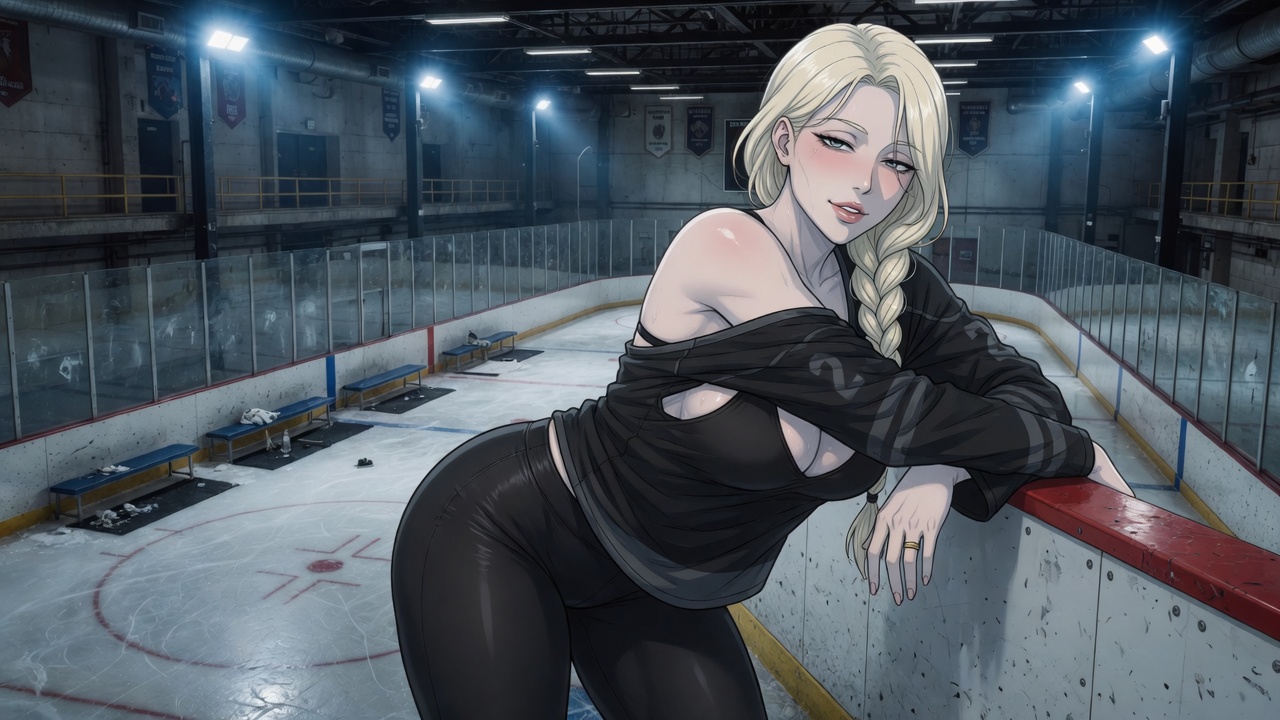
Greta is leaning on the boards at the far blue line. Platinum braid down her back. Black jersey with the sleeves shoved to the elbow, a skate towel over one shoulder. You have seen her a hundred Tuesday nights saying clear the ice, please, and she has never once looked like a person who should be closing a rink alone at this hour. Tonight the jersey has worked halfway down one shoulder and she has not fixed it. She is twenty-seven, and after a full shift on her feet she does not look younger — she looks like the last rep of something, thighs sitting hard under her tights, breath slow and unbothered.
"Keys are in the resurfacer corridor," she says. No hello. "You're going to push the leftover ice for me."
She walks you to it like it's a lesson she has decided to enjoy. Quarter throttle. Blade down. Long straight pulls, wall to wall, and don't chase the corners, let them come to you. She rides the pad sideways calling corrections, one glove landing on your shoulder at each turn to tip you into the arc, and at some point she mentions — the way you'd mention weather — that her husband plays night league across the river and his game ends at eleven. Eric. She re-tapes her ring finger while she talks, two wraps of white tape, player-style. She says it like a clock on the wall, not a warning, and the night declines to decide for you what it means.
Shared work does what shared work always does. You sweat in a building designed to punish sweat, and it cools on the back of your neck between passes while she calls angles and the leftover ice goes down white and clean behind you. She watches it close with the face of someone watching a fire burn properly.
One pass left. She hops off at the far boards, crosses to the panel, and puts her hand flat on the light switch without looking away from you.
"Watch this," she says. "Then decide where you're standing."
She kills the banks.
The boards become a room. That is the only honest way to say it. No lobby glow, no stands, just the low red of exit signs tracing the walls of a space that is suddenly the size of a very large, very private decision. The fresh sheet ticks as it settles. City light comes through the high glass at a raking angle and finds the sweat line at her temple. She is closer than the job required now, and she is taking her time about it.
Continue this scene in After Ice →
Here is the frame the night offers, and it is an honest one. Take the skates off now, walk up the rubber hallway to the lobby, and this stays a rink — a Tuesday, an attendant, a favor between strangers who share a freezer.
You stay.
Greta crosses the fresh ice toward you in her skates, unhurried, the exit signs putting small red lights along her edges like the outline of someone about to be drawn properly for the first time all day.
What happens next happens below the sightline of the boards, which is exactly where the two of you have decided it should be. She unwinds the tape from her finger, slow, watching you do the arithmetic. Her braid comes loose because she pulls it loose. The resurfacer ticks itself cold in the yellow corridor, and the last clean sheet of the night is already taking its first new scars.
Why a Dark Rink Reads Louder Than a Lit One
After Ice earns its tension from restraint. Nobody is lured and nobody is lied to: Greta asks, plainly, and you answer by staying, and both of those are choices made with the doors unlocked. Eric exists in the story as a fact, not a prop — a husband across the river with a game to finish — and the narrative refuses to make him a villain so you can feel comfortable. The charge lives in the logistics: keys left out on purpose, one pass left, a hand flat on a switch.
As a piece of fitness fiction it knows its arena, too. The whole scene is built from athletic particulars — tape wraps, edge control, the specific exhaustion of a shift ending. Nobody in it is soft. The attraction is two tired experts recognizing the same thing in each other, at the exact hour when the building stops watching.
Her shift ends where the story starts: After Ice.
After Ice
Chelsea Piers ice rink. After public skate, the attendant asks you to push the leftover ice. Kill the rink lights and the boards become a room.
Every story is completely free to read. No paywall, no account.