Short story 5 min read 19+
Just the Roll Screen: Night Patrol on the Women's Floor
After Cutoff
The lobby keeps one light burning after cutoff, the way a hallway keeps a lamp on for someone who hasn't come home. Humidifier mist drifts at ankle height and thins against the glass. Outside, the street has gone to that late hush where even taxis sound apologetic.
Last night of the work trip. Your bag has been packed since noon; your train leaves in the morning. One more capsule night between now and home. You came in at ten fifty-eight for an eleven o'clock cutoff and watched the desk clock swallow the last minute while you stood there, breathing like the building was listening.
"The men's floor is already closed," she says from behind the counter.
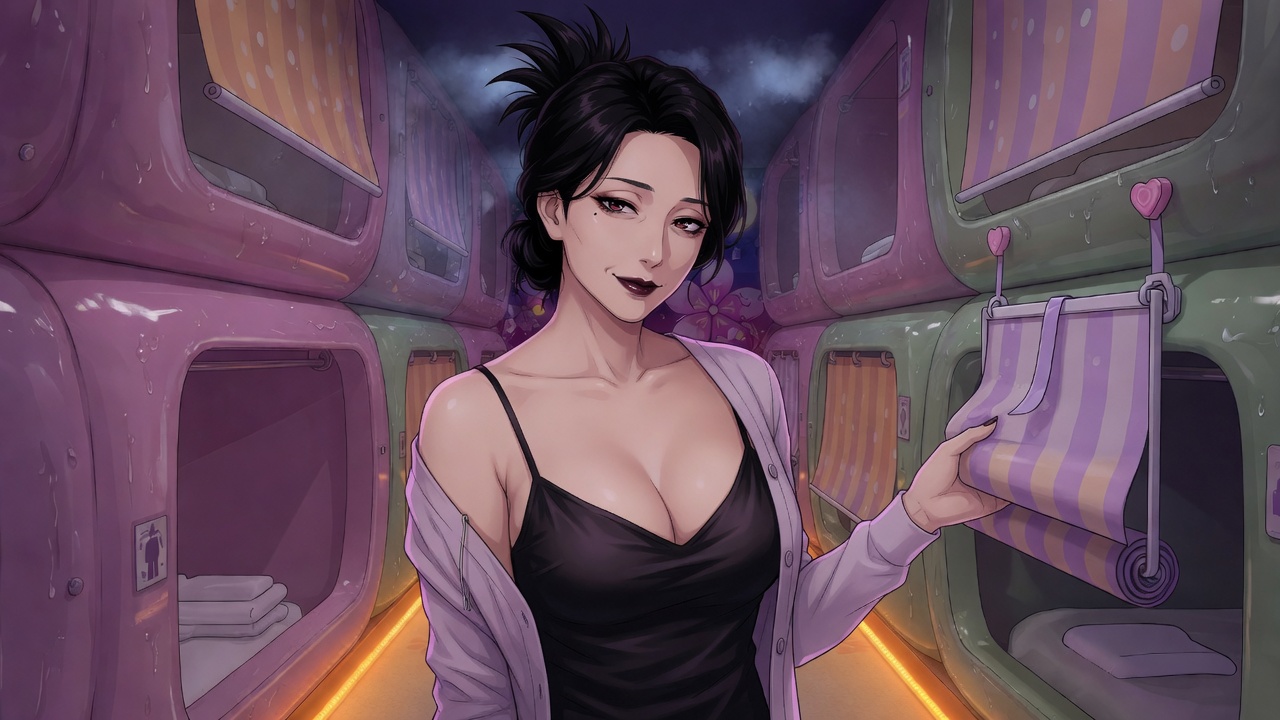
The night aide checks your reservation against a paper ledger even though the system has already chirped its approval, as if paper is the only thing that still answers at this hour. Low bun, loose at the temples. Indoor slippers, soft-soled, going nowhere. A thin cardigan, unbuttoned, and under it the strap of a slip — a pale line where collarbone turns to shoulder, there and gone as she leans to stamp the log.
"You're the only guest tonight. I still have patrol on the women's floor, so… I have to walk you up."
She recites it like a rule, then slides a spare keycard across the counter. Her hand rests a half second over yours, and her ring catches the card's edge — a small gold sound, a light glancing off something.
"I'm Jeong-eun," she adds, as if the name matters more now that the rule has been said.
Stairs, Plastic, Mist
The stairwell smells of plastic warming. The capsule shells upstairs exhale it all night, she says, because the humidifier never stops — it's bad for the doors to dry out. Her voice does something soft in the enclosed air, close even from three steps below. On the treads you watch the shadow of her hems. The slip stops at her thigh. The cardigan covers nothing it isn't asked to.
The women's floor: capsules line both sides of the corridor, a double row of shut mouths. Most of the roll screens are already down, sealed with the soft click of magnets, little doors asleep. Behind one panel a phone charges; behind another, no one is awake to know the building holds two people.
Her slippers brush the corridor plastic with every step, a sound like pages turning. She walks the patrol without hurrying — a glance into the washroom, a fingertip along a rail to be sure a screen is seated. At your capsule she stops. It is the only open mouth in the row.
"Just the roll screen," she says. "Then I'm done, you're in, and that's the whole night."
She holds the screen's magnet pinched between two fingers. A small silver disc, harmless. She toys with it — turning it, offering it to the rail, taking it back. Not sticking it on.
The corridor is narrow enough that not touching her becomes a technique, something you perform on purpose: shoulder turned, eyes on the rail, breath rationed. Mist has settled on her cardigan; the thin cotton goes translucent in a stripe across her back where she is warm. Hotel soap, and under it, skin that has been on shift for nine hours.
"My husband is on a jobsite this month," she says — to the rail, not to you. "Regional. He calls when the signal allows."
"You didn't have to tell me that."
"No," she agrees. "I didn't."
The magnet hovers a centimeter off the rail. Close enough that you can feel the pull in the air between disc and metal — the way two things made to click can hold back only so long.
"If I put it on," Jeong-eun says quietly, "this is patrol. You go in, I walk down, the log says done. Nobody asks a night aide what the last hour looked like."
The disc turns once more between her fingers. On her other hand, the ring is very still.
"And if I don't put it on — if you step out of those shoes, and we're both still standing here when the humidifier cycles off—"
She doesn't finish. Her eyes come up to yours for the first time since the stairs, and whatever the rulebook of this building says, it is not in that look.
"Just the roll screen," she says, a third time — but the words have changed shape. They aren't about the screen anymore.
Continue this scene in Capsule →
The humidifier cycles down, a long slow breath of mist along the corridor, and then, briefly, silence — the kind that makes the smallest sound enormous. Her slipper shifts half a centimeter on the plastic. The disc tilts toward the rail and away, toward and away, a pendulum with two futures. You think about the morning train. You think about nothing at all.
"There's a door through the shared shower," she murmurs. "If you take it, patrol ends tonight the way it's supposed to. Clean. Empty. Done."
She lets that sit. The corridor lights are on their lowest midnight setting, and in the amber her bare collarbones look like something you could be graded on. Her fingers open. The disc rests on her palm now, offered and withdrawn at once — like everything else she has given you tonight, the keycard, the name, the rules.
"Or," she says, "you stay."
The word takes up the whole corridor. You feel it in your chest before you decide anything, and she must feel something too, because her breath goes shallow and she doesn't step back. She steps in. A hand-width of air between you, warm, smelling of mist and laundry starch, and her eyes drop to your mouth and come back up as if they were never gone.
Somewhere below, a vending machine hums and stops. Somewhere in a regional town, a phone rings in an empty room and nobody who matters hears it. Here there is only the rail, and the disc, and the two of you deciding in real time what kind of night this will have been.
Above your heads the screen rail waits, empty. One small click and the night becomes nothing anyone would ever write down. No click, and it becomes a thing the two of you will carry for years, quietly, like contraband.
Her knuckles brush the rail. The disc trembles at its edge, held there by nothing but her choice, and her choice is taking far longer than any patrol in the history of night shifts.
Downstairs the desk light stays on. The log lies open to tonight's page. The word done has not been written in it — and standing this close to her, this far from the morning train, you already know it may never be.
Capsule
After check-in cutoff, night duty on the women-only capsule-hotel floor. Jeong-eun will not set the roll-screen magnet down. “Just the roll screen.” Walk out through the shared shower here and the patrol is done.
Every story is completely free to read. No paywall, no account.