Review 4 min read 19+
Last Roll Review: A Darkroom VN Developed to Perfection
"You made it," she says, not looking up from the counter. "Fair warning — the roll never made it into the tank."
That is how Last Roll greets you, and the line is doing double duty from the first second. On paper, you are a customer on a weeknight errand: walk to the lab, collect an envelope, sign, leave. In practice, this is a study in how a basement room in Brooklyn can redesign an ordinary night while you stand perfectly still.
The hook
The descent is the overture. The block has gone dark except for one neon sign at the corner, humming like it owes the night money. Iron stairs lead down to a red EXIT bleeding over the door, and acetic acid reaches you before any human voice does — the smell of work still finishing itself. You don't have to ring. The door is already a little open. Inside, the front lights are off and the drying rack holds nothing but clips: the day's labor done, the night's intent not yet declared.
Last Roll builds its architecture out of that threshold. The front of the lab is the world as scheduled — receipts, envelopes, a pickup that stays a pickup. The darkroom in back is the same room with the safelight on, which is to say a different planet. The game's central choice is one hallway long.
The characters in close-up
Nora is twenty-seven, a printmaker whose studio lives in the back of this lab, and the game sketches her in darkroom grammar: one rubber glove on, one hand bare, and the bare hand wearing a gold ring that introduces her marriage before she says a word about it. The apron is tied on one side, hastily, like the day ended mid-sentence. Mark, her husband, is a night editor, which means his absence on weeknights is structural rather than dramatic — a shift schedule wearing the costume of a plot device. The game never turns him into a villain, and it is smarter for that.
The narrator is you: customer, courier, technically on nobody's clock. Both roles here are voluntary, and the game is scrupulous about it. Nora locks the darkroom herself, with the roll still out of the tank, and looks at you while the bolt slides home — a question asked in hardware, answerable either way.
The tension engine
Structurally, the game develops like the process it borrows from. Developer: proximity under a single red safelight, which turns skin into rumor and every glance into overexposure, while the enlarger timer clicks down like a second clock nobody agreed to. Stop bath: talk — about prints, about chemistry, about Mark's shift ending at two and her show coming up in spring — conversation as a respectable way of standing very close for a long time. Fixer: the decision, the part that makes an image permanent.
That mutuality is the engine's real fuel. Every escalation arrives as an offer before it is an act. She says what is left is only chemistry — the roll, the night, take your pick — and the writing holds both meanings in suspension until the red light makes choosing feel physical. Nothing is rushed, because this story knows undeveloped film is most interesting exactly one moment before the tank.
Best enjoyed when
Late, obviously. This is a headphones-and-low-lights piece, best after everyone else in the building has gone to bed. It suits players who like their heat implied rather than diagrammed: no explicit content anywhere in the runtime, everything carried instead by wet cotton, red light, and a timer counting down for an audience of two. Fans of the encounter format will recognize the skeleton — one location, two people, one decision — and admire how much atmosphere gets hung on so few bones. If you liked the way the life-drawing session story turned a studio into a slow fuse, this is its darker-room cousin. Rain outside improves it, but is not required.
Final call
Last Roll develops slowly, stops exactly when it should, and fixes one image you won't rinse out: a married printmaker in a single glove, a safelight doing the work of a hundred adjectives, and a roll of film that was never the point. The fade to black lands like a print dropped into the tray — image first, meaning arriving a half-second later, both of them staying.
Some nights are pickups. Some are processes. The difference is whether you carry the envelope out or let the latch click behind you.
For a weeknight errand that turns into the warmest room in Brooklyn, Last Roll is an easy recommendation — and this basement lab is the strongest case the encounter category has made all year.
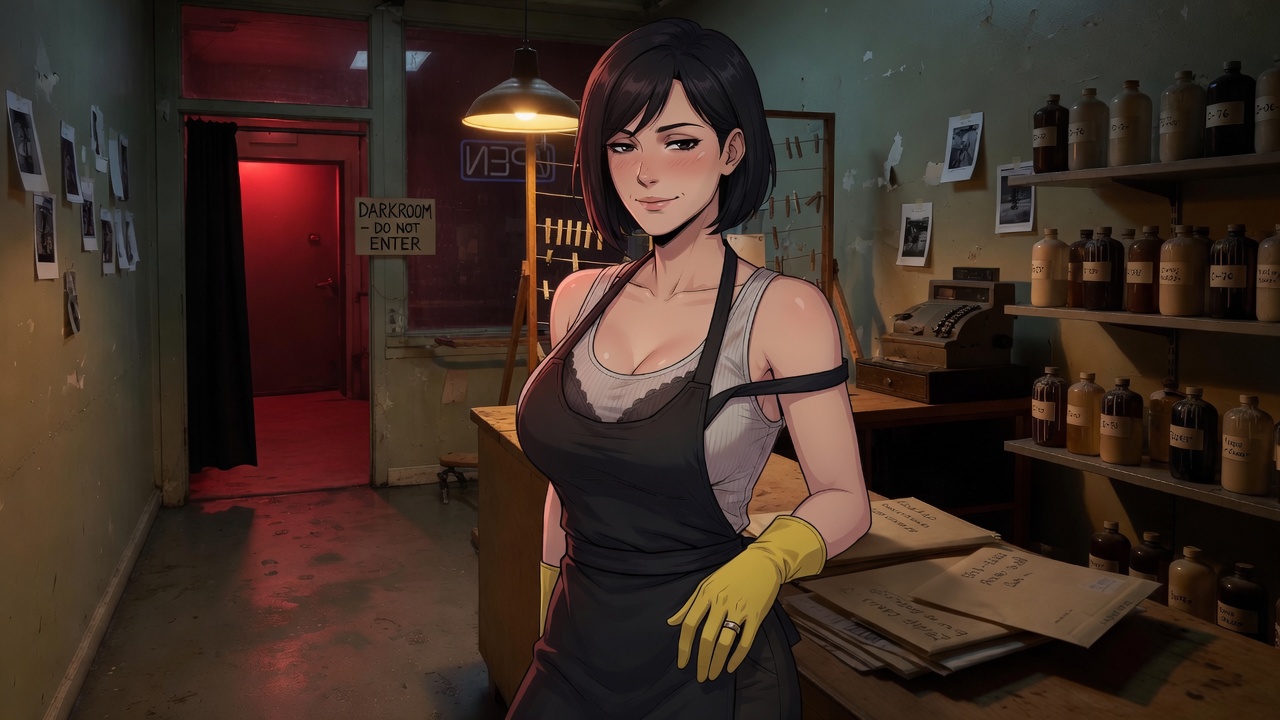
Last Roll
A Brooklyn photo lab. A married printmaker locks the darkroom with the last roll still out of the tank. “Only the developing left.” Take the envelope and that night stays a pickup.
Every story is completely free to read. No paywall, no account.