Review 4 min read 19+
Last Booth Review: Three A.M., One Booth Left
Three in the morning is when a diner stops performing. The pie case glows for nobody, the coffee has gone from fresh to honest, and anyone still on this stretch of Queens has a reason they aren't saying out loud. Last Booth understands that hour completely. It builds an entire romance out of a closing time that refuses to arrive.
The hook
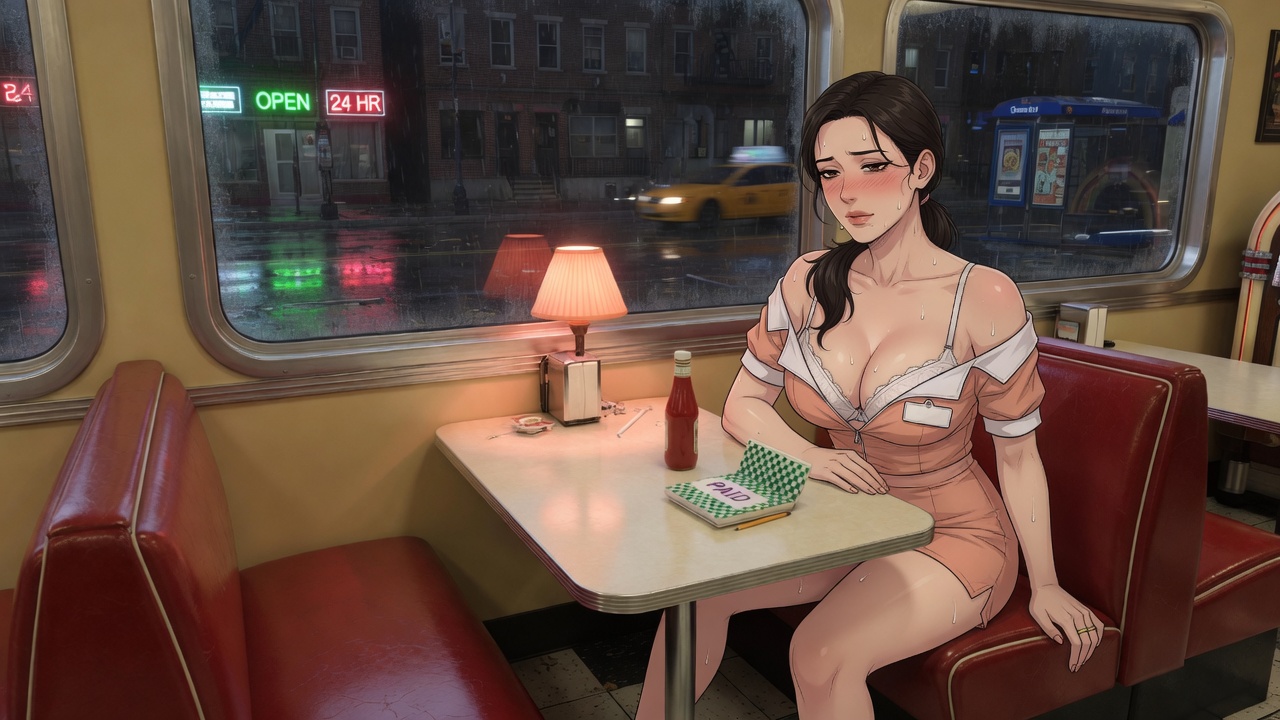
The neon outside still swears OPEN 24 HRS, but the kitchen is going down. The cook has his apron folded over one arm, the shutter is rattling toward the floor, and every counter stool is empty because every sane customer went home hours ago. You are the last one, in the window booth you always take, and the vinyl is still warm under you, like the seat was holding your place.
Helen sets the check pad face-down next to the ketchup. That is the entire offer, and it comes with a line instead of a smile: Kitchen's going down.
Take the check, settle up, and the night ends the way nights are supposed to — wet asphalt, delivery vans, sleep. The game hands you that fork without dressing it up, then makes the choice genuinely hard, which is the trick most short encounter pieces fumble. There is no puzzle here, no stat to raise. There is only a bell over a door, a fluorescent hum, and a woman deciding whether to stop wiping tables.
The characters in close-up
Helen is twenty-eight, a night waitress, and a married woman, and the game is refreshingly unhurried about all three facts. Her peach uniform has a zipper already down a hand's width and a nametag tilted like it gave up arguing around midnight. Her husband, Mike, is out on a delivery run to Little Neck — mentioned, never seen, a pair of headlights you keep half-expecting in the window.
What keeps her from being a tagline is how she talks. The dialogue is pure diner dialogue: refills, the register sticking, the cook's moods. She never breaks character to become a romance object; she stays a waitress the whole time, which means every unguarded half-second — a glance held one beat long, a hand on the booth's edge instead of the table — lands with real weight.
You, the narrator, are a regular. That detail does more work than it sounds like it should. This is not a stranger meeting a stranger. It is months of fifteen-second conversations finally left alone together, with nobody left to interrupt them.
The tension engine
Two pressures squeeze the scene, and the game alternates between them like a hand kneading a shoulder.
The first is time. The kitchen dies in stages, and Last Booth tracks the death with obsessive care — the grill scraped, the pass lights going dark, the back door thudding shut on the cook. Every sound is a countdown, and the sound design knows it.
The second is place. This is still, technically, a public room. The door could open. The neon is right there in the glass, advertising the diner you are both supposed to be inhabiting. That thin film of public-ness makes every inch closer feel faintly trespassing, and the writing leans into it instead of waving it away.
And when you cross the line, the fade is handled exactly right. The shutter finishes its descent. The yellow booth light becomes the only light left in the world. Then the bell over the door rings once — and the game never tells you which way it was swinging. Nothing shown, everything suggested, all of it chosen by both of them.
Best enjoyed when
Play Last Booth late, ideally with actual rain somewhere in earshot, because the soundscape — fluorescent hum, coffee machine sigh, one van passing — does half the seduction on its own. It is short, but this three-in-the-morning story is built for a second run: the check route is not a failure state so much as its own small melancholy, and comparing the two endings is where the writing shows its craft.
If the after-closing pull of this arcade story about the last customer of the night worked on you, this sits comfortably on the same shelf. It is also a gentle on-ramp to encounter VNs generally — one location, one companion, one decision, all of it adult, mutual, and unhurried.
Final call
Last Booth is a small machine for making you complicit. It knows you will stay — the title told you — so it spends the whole runtime making the staying feel like your idea, arrived at honestly, with a woman who chose it right back.
The check or the booth. The game's answer is obvious. Its talent is making you want to hear Helen ask.
Verdict: 8.6/10 — the best bad decision on the menu.
Last Booth
Queens, three in the morning. A 24-hour diner. When the kitchen shutter comes down, only the last booth is left. The married waitress's peach uniform zipper is already slipping. “Kitchen's going down.” Take the check and the night is over.
Every story is completely free to read. No paywall, no account.