Short story 5 min read 19+
Last Booth: When the Kitchen Shutter Falls at Three A.M.
The Wet Street
The rain had quit an hour ago, but the asphalt outside still shone like something recently confessed to. Three in the morning in Queens, and the only living thing on the block was the sign — OPEN 24 HRS, one letter flickering like it had a question. Delivery vans went by. Nothing else ever came down this street at this hour except delivery vans, and him.
Helen wrung the rag over the bus tub and watched the gold band flash on her finger, the tan line under it going pale under the fluorescents — a thin white stripe of married that showed every time she twisted her wrist. Twenty-eight years old, five years married, and her feet ached in the deep, forgiving way that meant the shift was almost over.
Almost.
The cook had his apron folded over his arm already, pretending not to hurry. The pie case hummed its one yellow note. Every stool at the counter stood empty, and for the better part of an hour Helen had felt the diner's air on her spine — the zipper at the back of her peach uniform had slid down a hand's width, skin cool between her shoulder blades, and she hadn't fixed it. She told herself it was the long night.
She told herself that twice.
The bell over the door rang once.
He came in stamping off rain that wasn't there, a habit, and the pie-case light found his face the way it always did. A year of nights like this one. He didn't scan the room. He went to the window booth he always took — the vinyl still holding warmth, his or hers from her wipe-down, she'd stopped asking which — and slid in like the booth had been keeping his shape for him.
Helen killed the counter tubes one switch at a time and left the booth lamp burning, yellow through the glass, over the last booth on the strip of linoleum that was still, technically, a diner.
“Kitchen's going down,” she said.
Which was true. It was also a door held open.
He looked up — at her face first, which was a thing about him she had never recovered from — and then, briefly, at the nametag tilted on her chest. HELEN, the letters leaning because the uniform fit like it had opinions. She never straightened it anymore.
“One more coffee?” he said. “If I'm not throwing you out of your own place.”
“You couldn't throw me anywhere. I have the keys.”
Her own voice surprised her — low, welcome-mat warm. She turned to pour and felt the zipper slip another inch, and let it.
Face-Down
The check pad had sat by the ketchup since midnight, face-down. That was the ritual. She left it there, he took it, and the night closed like a book neither of them minded ending. Take the check. Say goodnight. Go back to being a waitress and a customer and a wife and a man driving home with the radio low.
She set the cup down in front of him, the last of the pot, and her fingers met his at the handle — not an accident, and not a grab. A held note.
“Check's there when you want it,” she said.
He didn't look at the check.
Behind the counter the cook let himself out the back, and the shutter came down with a sound like the whole building lowering its shoulders. After that the diner made a different noise — smaller, closer. The pie case. The lamp. Two people breathing in a circle of yellow light while delivery vans carried other people's nights past the wet glass.
Helen sat down across from him.
She didn't decide to. Her knees simply bent, the vinyl took her weight, and the check lay face-down between them like a card neither would turn. Mike was somewhere out by Little Neck with the van's heater rattling, hours yet, and the thought of him passed through her gently, without weight, the way you think of a town you once drove through.
“Booth's out of service,” she heard herself say.
Continue this scene in Last Booth →
His palm turned up on the table between them. An open page.
She put her hand in it. Of course she put her hand in it. His palm was warm — warmer than the coffee, warmer than the vinyl, the exact temperature of chosen — and her breath went shallow in a way she recognized from a long time ago.
Mike never looked at her like anything anymore, she thought, and it wasn't grief; it was inventory. Mike looked at her tired, at her kind, at her with his cheek already against her hair and half asleep. No one had looked at her in a year the way this man was looking now — like she was the last lit thing on a wet street, and not the woman who refilled.
His thumb crossed her knuckles once. A question, in a language she had never stopped being fluent in.
A year of nights she'd called it nothing — the extra cream in his to-go cup, the way she saved the window booth, the two minutes longer she took clearing his table. Nothing, nothing, nothing. She'd been saving all of it up without once saying the word.
“Tell me to take the check,” he said. “And I will.”
Helen looked at the pad, face-down by the ketchup. She could take it. Ring it up, wipe the booth, lock the door, go home, sleep until two, do the whole honest thing again at midnight. A life with every hour accounted for.
Then she thought about the gap in her zipper, and the hour she'd let it stay.
“Kitchen's closed,” she said. “The booth's not.”
He came around the corner of the table without a word. When his palm settled warm at the small of her back, right in the gap where the whole shift had been working at her, Helen closed her eyes and reached behind herself to meet it.
“Together,” she said — or thought she did.
The lamp hummed. Outside, the neon finished asking its question. And the check lay face-down by the ketchup, and neither of them ever touched it again.
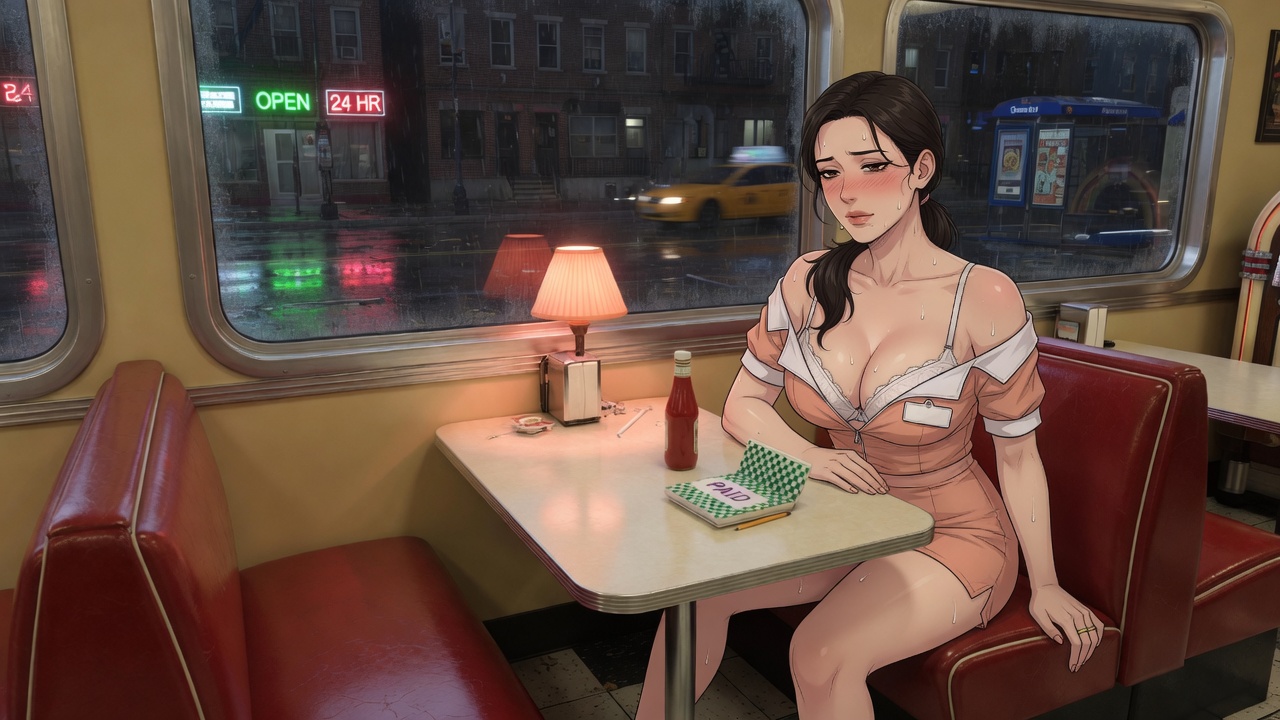
Last Booth
Queens, three in the morning. A 24-hour diner. When the kitchen shutter comes down, only the last booth is left. The married waitress's peach uniform zipper is already slipping. “Kitchen's going down.” Take the check and the night is over.
Every story is completely free to read. No paywall, no account.