Short story 5 min read 19+
Wing — she won't let go of the canopy lock
“Leave the canopy shut.”
Five words, and my hand stops on its way to the frame. It isn't the words. It's that she doesn't let go of the lock — thumb still riding the latch, knuckles against the curve, holding on the way you hold a rope you haven't decided to climb.
The last winch let go an hour ago and the airfield still doesn't feel finished. The cable lies slack across the grass like something asleep. Where the launch point was, the ground is still warm — all of today's takeoffs stacked in the soil like heat in a stone. Down the strip: dust, the ghost of avgas, nothing else. The winch truck's lights died a while back. Her husband drives the winch. He clocked out at sunset and took the lights with him.
That's the part I keep circling. Not that he left — drivers leave — but what he left behind: a married woman, a work lamp, and a canopy latch nobody needs to touch at this hour.
I came the long way, along the hangar rail — the route the club map calls parking and Wing calls a choice. The hangar mouth is half open, its rail wearing rust gone white at the joints, like the building has been clenching its teeth all year. Inside: one lamp on a stand, and the gliders with their covers still off. Wing cloth, bone-white under the lamp, breathing a little when the wind leans on the door — a slow swell along the fabric, as if the airframe is still up at four thousand feet and not ready to admit the day landed.
The airfield night is darker than the city ever manages. No spill, no haze. The stars come down close enough to make the strip lights look embarrassed, and everything smells of cut grass cooling, warm aluminum, fuel. Avgas is in the cloth of everything, my sleeves included. By morning it will be in my hair. I stopped pretending I minded weeks ago.
Seah is thirty-six, instructor, mechanic, married, and she runs her thumb along the canopy edge instead of latching it. The lock clicks half a tooth and stops. Her hands are a mechanic's hands — a scrape of grease at one knuckle, a bandage gone gray at the edges — and they are very still, which, from her, is louder than talking.
“Daily's signed,” she says. “Controls. Tyres. Tow hitch.” A litany. “Go over it if you want.”
“I believe you.”
“You should check anyway.” The lamp buzzes. “Club rules.”
Neither of us has moved toward the door. The canopy stays shut under her hand — smooth, curved, holding the whole hangar in it upside down: the glider, the rail, the small yellow eye of the lamp, me, her, all of it bent and floating like weather in a bottle. I watch the reflection instead of her. In the canopy, I'm allowed to be that close.
“Everyone's gone,” I say. Which is not an observation, and we both know it.
“Yes.” The lock ticks another half tooth. “He sets the alarm for five. The winch wants an early start.” Her thumb hasn't moved. “So he went home.”
“And you stayed to put the covers on.”
“And I stayed to put the covers on.”
Wind shifts the door in its track — an inch of night sliding in, cold air walking over our ankles. The wings breathe. Somewhere out on the strip, the slack cable taps a stake, patient as a clock.
“Leave the canopy shut,” she says again, quieter. Then, not looking at me: “You can close the hangar, though. If you're staying.”
Here it is, then. The rail. Stay on this side of it and the night is still parking — two club members, one lamp, a signed-off aircraft, a door that rolls. Pull it shut and the rail is only a line on the floor, and the airfield stops being an airfield and becomes whatever two people agree a locked hangar is for.
Her hand finally, finally eases off the latch.
The door takes both hands and more strength than it should. The track complains. The night narrows to a bright seam, then a thread, then gone, and the lamp makes a small warm room out of all that steel, and the bone-white wings hold the light like a held note.
She doesn't look at me. She looks at the canopy — shut, whole, fogging faintly along the curve where her breath found it — and I look at the rust line on the floor, and I step back over the rail, because the rail is hers to cross or not. I have exactly one rule tonight: everything after this has to be chosen by both of us.
“We'll never get these covers on,” she says, “if you keep standing there.”
So I stop standing there.
After that, the details belong to the hangar: the door creaking in its track when the wind tests it and gives up, the lamp's small circle of gold, her laugh against my collar when the covers turn out to be the wrong way round, my hand at the small of her back, her hand deciding it likes being there. None of it needs writing down. All of it got remembered anyway.
The lamp goes off at some point. I'd like to say it was late; it was. I'd like to say it was careful; that too. What I remember exactly is the cloth of a wing moving once under my hand like a breath, avgas on both of us, and the whole dark airfield outside keeping our secret the way the dark keeps everything — completely, until morning.
By morning the dew is on the canopy and the covers are on the wings, both jobs finished properly, latches checked twice. Her husband's truck is a sound on the far road, getting closer. The hangar is a hangar again. The rail is only a rail.
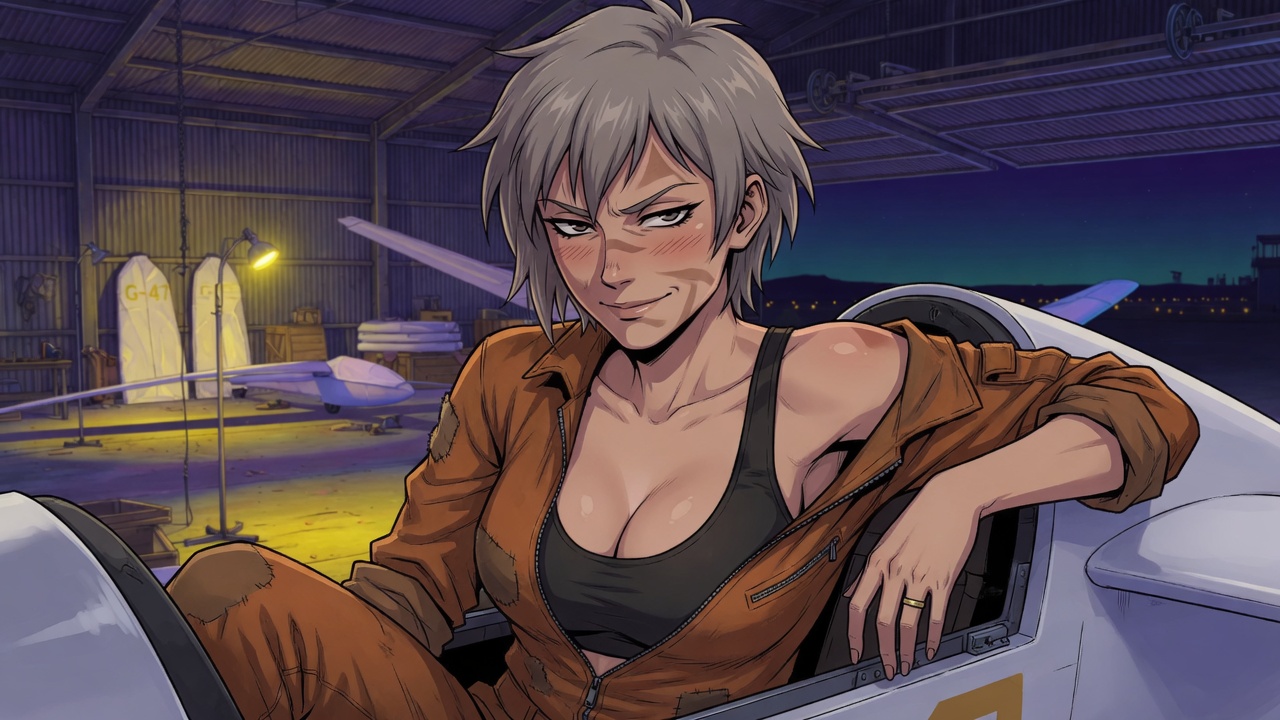
Wing
After the last winch, the airfield hangar. Seah will not let go of the canopy lock. “Leave the canopy shut.” Walk the hangar rail here and it's just parking.
Every story is completely free to read. No paywall, no account.