Short story 5 min read 19+
After Stacks: One Call Number, One Unlocked Cage
The marble stair gives you one long look on your way out of Butler — pale stone, columned, final. On Tuesday, a few minutes past official close, I was the last patron in the building, going the wrong direction for a man who ought to be home. By morning, Columbia has forgotten you completely.
This is about the other Tuesday — the one that starts with a cage door left open.
The Green Lamp
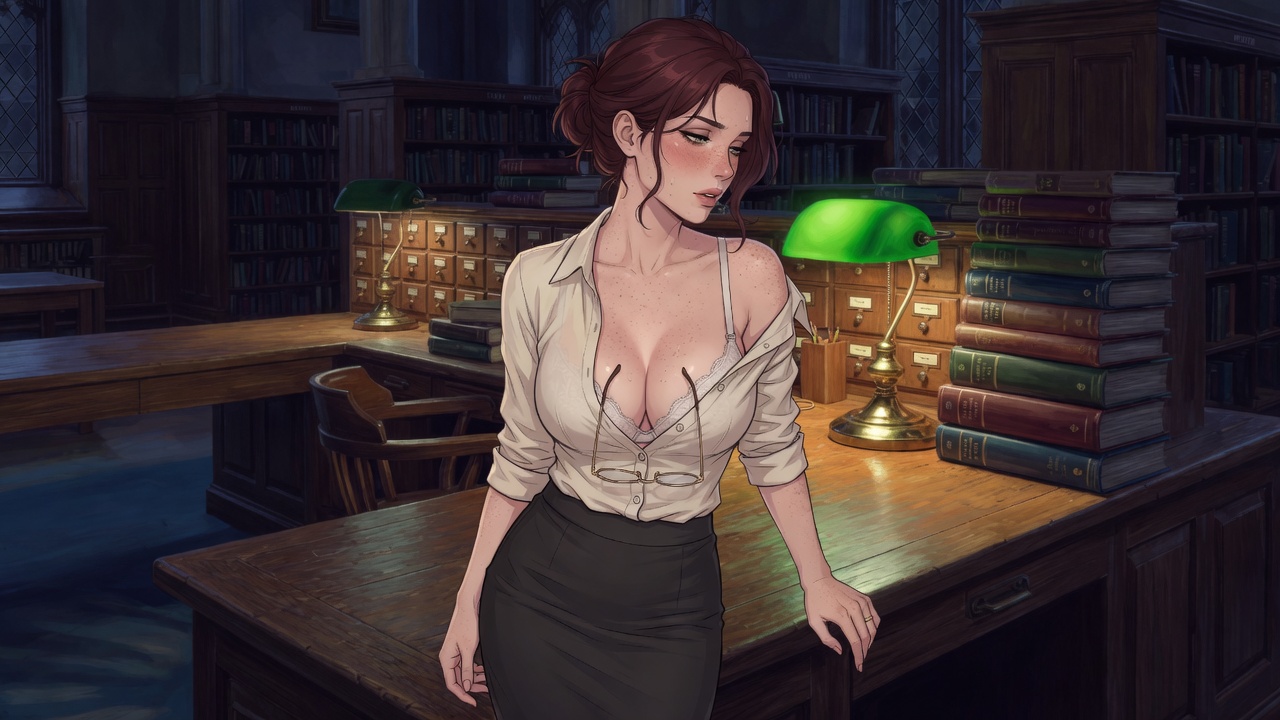
The reading rooms were black, but over the oak circulation desk a banker's lamp still burned, its green shade throwing a small island of light across the return cart. The cart was half empty. Someone had been working it slowly, the way you do when you're in no hurry to reach the end of a shelf — or an evening.
A call slip was taped to the cart handle. I leaned under the shade to read it.
PR605 .R8 — compact stacks, inside the cage. Last one of the night. — M.
Behind the Cart
Margaret was behind the cart, reshelving with the unhurried economy of a woman who has put away ten thousand books and thought about something else through every one of them. Night librarian. Cream blouse, sleeves rolled once, a button missing near the middle — not torn, just absent, as if the evening had started making its own decisions.
Her glasses hung from a gold chain, and when she bent to a low shelf they swung forward and came to rest in the gap where the button used to be. She left them there. The ring on her left hand clicked once against a steel shelf — a small bright sound, like a period at the end of a sentence.
Everyone who works nights on this campus knows everyone else's business. Married. Husband downtown at a faculty gathering, drinking the department's warm white wine and telling colleagues his wife loves the late shift — says it keeps her calm.
She caught me watching. She didn't startle and didn't scold; she held my eyes a beat longer than the circulation desk would allow, the way librarians can, and went back to the cart. The late shift does something to people. Slows them down to the speed of the building.
“You're the last patron,” she said, without looking up. “Front doors locked ten minutes ago.”
“I can come back tomorrow—”
“One more call number,” she said. “It's already in my hand.”
The Cage
The compact stacks live at the back of the level, behind a cage of cranked steel and rolling shelves, the kind of place where the lights hum instead of shine. The motor in the stacks ticked somewhere in the dark, cooling. Dust hung in the aisle light like it had been waiting all night for an audience.
She walked ahead of me with the slip held between two fingers, and the aisle lamps woke in front of her and died behind her, so that following her felt less like walking and more like being permitted. Her heels made almost no sound on the steel. Mine made all of it.
At the cage she set the slip down, unhooked the rubber wedge from its nail, and toed it under the door. Then she stood a moment with her palm flat on the frame, glasses swinging, looking at nothing in particular — the way people look at a decision.
Upstairs, the phone at the desk buzzed once against the counter. Faculty drinks. Car service at ten. A man downtown checking the time against his watch and deciding not to call.
Margaret turned her ring half a revolution, the way you turn a dial you've decided to leave unlocked.
“One more call number,” she said, quieter this time. “That's the story we're going with. If anyone asks, the cage door was heavy, and it stuck.”
Continue this scene in After Stacks →
After
What happens past the cage belongs to the game, not to a summary — the way she lifts the lamp's shade to kill the light; the way rolling shelves can be cranked together until two people share a single foot of aisle while the whole campus turns into a rumor. After Stacks keeps its promise: suggestive, never graphic. The tension does the work. The fade does the rest.
Here is what I know now that I didn't know at seven o'clock: a library after close is never empty. It's full of held breath — every aisle a sentence somebody stopped in the middle of. The difference between the patron who leaves and the one who stays is about four steps and one wedge of rubber.
But I can tell you what Tuesday felt like from the exit stair, later, when I finally took it. The night was exactly what it had promised to be — overdue books, the smell of old paper riding on my sleeves like evidence, a wedge of rubber someone would find at dawn and hook back onto its nail without asking why it was ever out.
At the desk, the return cart stood a shelf richer. Her phone had gone dark. Somewhere downtown a car service idled at the curb, and a man would come home to a bed that smelled faintly of dust and vanilla and not ask about that either, because the story was airtight: one more call number.
By Wednesday the lamp is off, the wedge is back on its nail, and the compact stacks keep the secret the way libraries keep everything — in order, by number, available to anyone who knows how to ask.
The cage door was closed when I left. It was not locked. Between those two words, a marriage and a graduate career both turned a page — and on this campus, after close, that isn't a scandal. That's a call number.
After Stacks is the rest of Tuesday, told in first person, at the pace of a held breath.
After Stacks
Columbia's library after official close. A married night librarian keeps the cage door on a rubber wedge. “Just one more call number…” Take the exit stair and the night is only overdue books.
Every story is completely free to read. No paywall, no account.