Review 4 min read 19+
After the Last Seminar Review: Lights Out at Nine
The whiteboard ink is still wet.
That is the first thing After the Last Seminar teaches you to notice, and it is a better opening move than any prologue could manage. Someone drew those small, careful circles minutes ago and walked out; you arrived in time to miss her by almost nothing. From there the game never raises its voice. It builds tension out of a wet marker, crooked fold-out chairs, and a projector fan that is the only thing in the graduate building still turning. Plenty of visual novels manufacture atmosphere with thunderstorms and string swells. This one uses silence with the hum left in.
The premise fits on an index card. Weeknight, nine. The last seminar is over, and you are the TA who stayed behind because the HDMI cable on the table is nobody's job but yours tonight. Then After the Last Seminar hands you a single line of dialogue and lets it carry an entire route.
"Come turn the light off."
The hook
Hayoon is twenty-seven, a married lecturer, and she is standing in the doorway with her office key held out on the finger that wears the ring. Five words, and the whole game snaps taut like a cable. Read literally, it is an instruction about lighting. Read any other way, it is an invitation — and the hook refuses to tell you which sentence you actually heard. You spend the rest of the runtime deciding.
The elevator afterward is the hinge. Mirrored doors, her reflection doubled, floors counting upward while the night quietly stops being campus. By the time the doors open on her floor, cancelled class has stopped being a description of the evening and become a cover story for it.
The characters in close-up
Hayoon is written with a restraint that borders on tenderness. The game never lets you forget the ring — it stays in frame, it holds the key — but it also never turns her husband into a villain. He is at a conference. He is mentioned and set aside, gently. That refusal to weaponize him keeps the affair from curdling into melodrama; this is a story about want, not about cheating on a straw man.
Her details are characterization rather than decoration. The silk blouse shines as if the fluorescent light soaked into it, which is the game telling you she is the brightest thing in a room designed to be emptied. Her circles on the whiteboard look drawn by a hand that wears a ring: precise, domestic, present even in her absence.
The narrator is a presence rather than a personality — the right call. POV done this way means you supply the longing yourself. The game hands you chores, and you discover that every chore is a decision about her.
The tension engine
The clever part is that every choice is phrased as logistics. Coil the cable now, or leave the AV work for morning. Lock the outer door, or hold it a moment longer than necessary. Finish the TA work you came for, or follow her down a corridor that stops being campus the second you do. this slow-burn campus affair never shows you a button labeled desire. It keeps asking whether the work can wait, and you keep learning things about yourself by how fast you answer.
The fade to black at the office threshold is the engine's masterstroke, not a limitation. Everything the game wants to say, it says in the seconds before the cut: the fan noise, the key, the held breath. And the closing image — the classroom empty again, a class that was never officially held — reframes the whole night as something that, on paper, never happened.
Best enjoyed when
Late. Headphones, one lamp, phone face-down. The sound design is almost entirely quiet — projector fan, elevator hum, the particular scrape of fold-out chairs nobody straightened — and it deserves a dark room. Rain outside helps, though it is not required.
It is also best in one sitting. The runtime is short, the pacing deliberate, and the pauses do as much work as the dialogue. If you have ever lingered after class for no reason you could defend out loud, this game is a mirror; handle accordingly. When you want a follow-up, our story about another key left deliberately out pairs with this one almost too well.
Final call
Branch count is modest and the choices lean toward flavor over consequence — nobody should come here for route maps. But as atmosphere, as craft, as a study of a half hour two adults decided not to explain to anyone, it is close to flawless. It trusts silence. It trusts the reader. It never once mistakes suggestion for withholding.
If you already browse campus-set visual novels, this goes at the top of the stack. Verdict: play it with the light off. That was always the instruction.
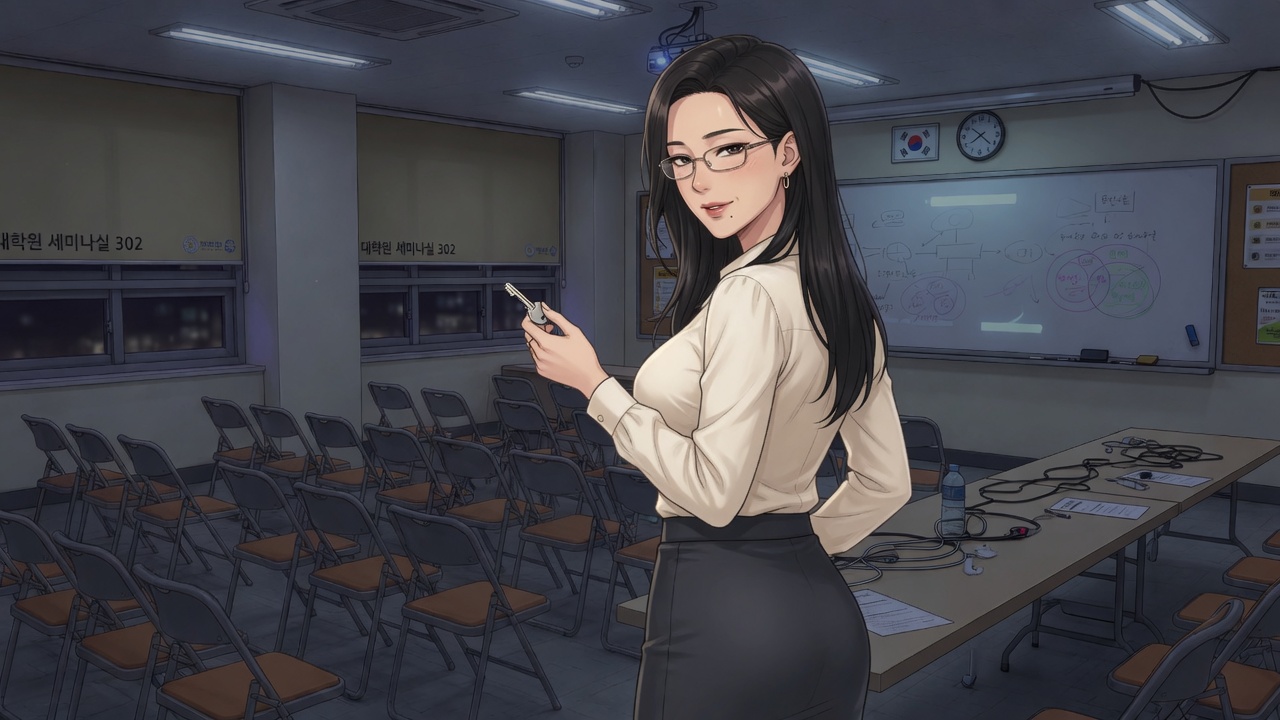
After the Last Seminar
The last seminar is over. A married lecturer sets down the lab key and turns. “Come turn the light off.” Take the elevator and the night is just an empty classroom.
Every story is completely free to read. No paywall, no account.