Short story 4 min read 19+
Practice Room: The Recital Ends; B-12 Doesn't
The applause followed me down two flights.
That's the thing about a recital ending — the sound refuses to end with it. It clung to the stairwell, kept tempo in my ears the whole way down: the second floor still cheering an encore, perfume and program paper, a hundred people deciding, slowly, to go home.
I was going home too. Except the Chopin wasn't.
I'd left the score in practice room B-12 — the nocturnes I'd sight-read before my slot, dog-eared, fingered in pencil, mine since September. A conservatory teaches you to be careless with paper, and at ten o'clock, bowing to a half-full hall, I had been exactly that.
Below the recital floor, the building changes species. Marble gives way to concrete, perfume to acoustic foam. The stairwell is engineered for silence and achieves it; my own footsteps came back sounding like mistakes, swallowed before they could learn to be sound.
A row of soundproof doors, lettered and numbered. Eleven at night, recital night, every one of them dark. Practice rooms empty the way theaters do, all at once, the moment the applause finds somewhere better to be.
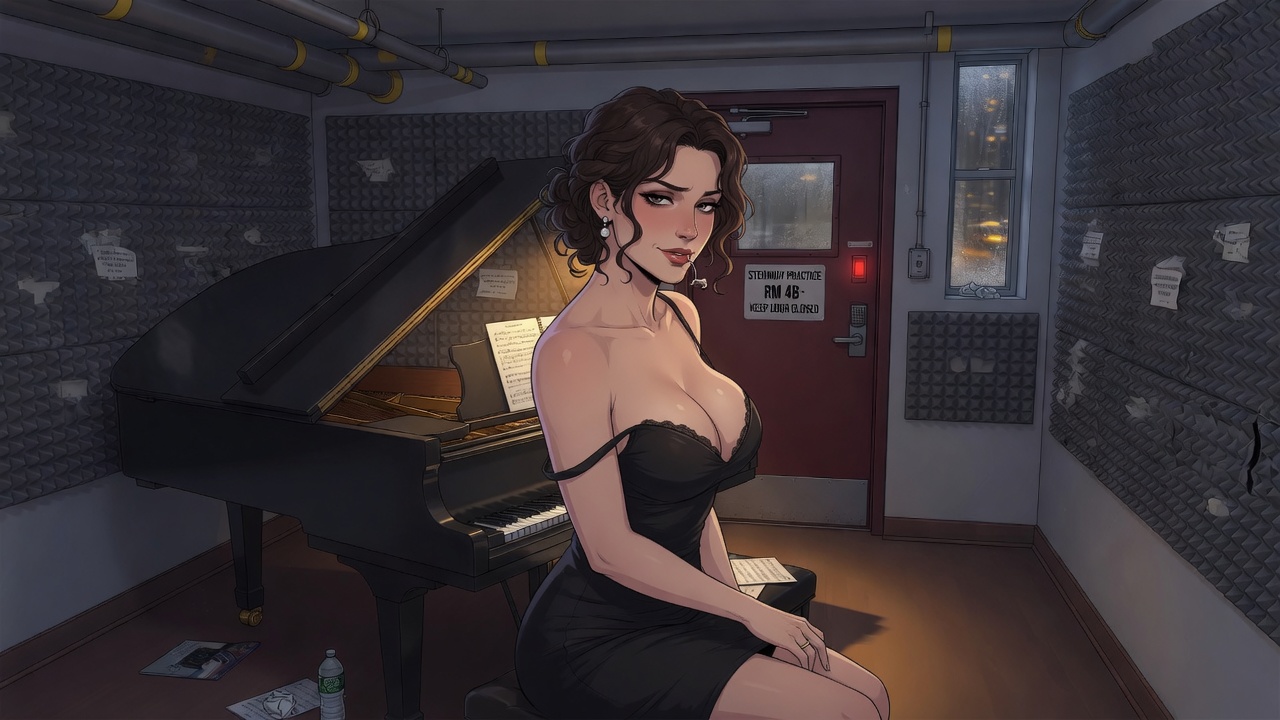
Except one. At the end of the row: a seam of lamplight under a door. B-12.
I reached for the handle braced for the small refusal of a lock, the click the front desk keeps on a ring of a hundred keys. There wasn't one. The door was open.
Elise Moreau sat at the grand piano in the black dress she'd worn on stage, the stand lamp the only light, the rest of the room kept in shadow like an orchestra waiting on a cue. Pearl earrings. Heels abandoned behind the bench — bare feet on the pedal, a small, human surrender. The gold ring caught the lamplight when she reached out to still a string.
She didn't startle. Instructors never do; they've heard every possible version of a student entering a room. She looked at the score under my arm, then at me, and the lamplight did most of the talking.
Chopin, she said, like a diagnosis. Another night in a hallway and the custodians would shelve him under miscellany. Nobody picks him up. They never do.
Everyone at the conservatory knows two things about Elise Moreau: that she plays Chopin like a grudge and forgives him by the coda, and that her husband — a cellist — has been on tour with a Midwest orchestra since October. The pearls were stage pearls. The ring was not.
She nodded at a canvas tote on the second bench: stray scores, a metronome, her gloves. The lost-and-found run. Take the bag upstairs, and tonight stays what it was — a lesson I owe you anyway. You rush the third page, in case nobody's told you.
Or. She lifted the lid over the keys, an inch of felt and lamplight. Or you close that door. The soundproofing down here is the one honest thing the school ever bought. From the hallway, B-12 is just a room with the light left on.
Upstairs the applause had finally thinned. Through a foot of engineered silence I couldn't hear it at all anymore, and somehow that was the loudest thing in the building.
I'd like to say I weighed it. I didn't. There are doors you open for a reason and doors you close for the same one, and my hand was on this one before the thought finished forming.
The lock made a sound like a page turning.
Continue this scene in Practice Room →
What happened in B-12 belongs, by contract, to the people in it. I'll tell the rest in the only language the room allowed. There was a nocturne in it somewhere — started twice, abandoned twice, laughed over, then played properly, slower than the edition asks for. There were long stretches of nothing but the lamp, the closed fallboard, and the felt hush of a piano nobody was playing yet.
At some point she found the metronome in the tote and set it going, sixty to the minute, a heart rate for whatever the room had decided to become. Neither of us turned it off.
Near dawn she put the night away the way musicians put away instruments, each piece in its case, nothing left out to be questioned. Her hand — ring and all — penciled a fingering into my score, decisive, straight through the third page. Slow down here. It was about tempo. It wasn't only about tempo.
We took the stairs separately, her first, two minutes between us, professionals. Upstairs the hallway had forgotten the recital entirely: custodial lights, a wheeled cart, the particular innocence of a building before its people arrive. In the landing window the sky was doing its cheap grey magic, and she looked smaller inside it and entirely unregretful.
The Chopin rides in my bag now, marked in her handwriting, and I practice the third page slower than I have ever practiced anything. The conservatory believes nothing, because there is nothing to believe. She is a married woman whose husband sends postcards from Omaha. I am the last student who stayed. From the hallway, B-12 is just a room with the light left on.
Everything else is still behind that door — Practice Room, locked from the inside.
Practice Room
Manhattan conservatory basement. After the recital, the last student stays for leftover sheet music. Elise is a married piano instructor. Her husband is on orchestra tour. Lock the soundproof door and the hallway is still the recital.
Every story is completely free to read. No paywall, no account.