Review 4 min read 19+
Dough: The Night the Dough Refuses to Proof
The shutter comes down and the sign goes dark, but the alley keeps a little of the day behind — flour dusted across the concrete in someone's footprints, catching the one working lamp like unseasonal snow. Dough begins in that hush and never really leaves it. This is a visual novel about the half hour after a handmade noodle kitchen closes, when the only sounds left are the broth pot breathing to itself and a rolling pin that will not be put away. It is about what it costs to stay and watch someone work — and what it costs to be watched working.
The setup
In Dough you play the closing helper, the extra pair of hands a place like this pretends it doesn't need and secretly can't run without. The last customers are long gone. The window over the sink has turned to black glass. On the wooden board sits a lump of dough that never made it to the proofing shelf — dried on the outside, still warm at its center — and beside it the rolling pin, angled like a sentence somebody stopped halfway through.
Gangi hasn't left. She stands more like a noodle maker than a closer, sleeves folded back, knuckles floured to the second joint. Her husband works the dawn market, which means the marriage runs on ships passing: he leaves before she's home, she sleeps before he's back, and the apartment between them is mostly a place where two separate exhaustions get stored. The game is patient about this. It lets the domestic logistics do the aching.
Everything funnels into one soft fork. Stay by the board, and "Dough's still left" quietly stops being inventory talk.
The cast and the chemistry
Gangi is written with the specific dignity of someone good at her work and tired of being admired for it. She corrects your grip more often than she looks at you. The chemistry here isn't sparks — it's proximity, the slow accumulation of shared weight. You learn to test the dough by its sound against the pin. You learn that she hums, barely, when the broth is right. Flour and broth stick in your throat thicker than they did at midday, because at midday there were witnesses.
The husband is more rumor than man, and the script is honest about that. It doesn't make him cruel or careless; it makes him early. Lives built around a dawn market run on opposite clocks, and loneliness assembled from logistics cuts deeper than any argument. When Gangi mentions him, she checks the rice like it might be listening. When she mentions nothing, the rolling pin answers for her.
How hot does it get
Think steam, not flame. The heat is thermal and moral at once: a broth pot still steaming into a black window, an oven-warm center to a dough that missed its shelf, two people in a kitchen built for a dozen. The game is sly about hands. Every touch is justified by the work — a corrected wrist, flour brushed from a forearm, a palm laid flat to check the proof — and every justification gets thinner as the night gets later.
Nothing on screen is explicit, and the writing is prouder of that than any scene could make it. The payoff of staying is a fade to black handled with real care, arriving exactly where restraint would otherwise have to break. The pin keeps its rhythm up to the last second, and the game trusts you to keep hearing it after the cut.
"Dough's still left."
Three words. By the final act they have stopped meaning anything about noodles at all.
Who it's for
Slow-burn readers first, without apology. If you need heat by the second scene, this kitchen will frustrate you on principle. But if you like desire that has to argue with itself — a married woman who chose her life and is now, at midnight, choosing again — this is careful, adult work, and it belongs near the top of the shelf for encounter visual novels that treat an affair as a decision rather than a plot device. Nothing happens between these two that they do not, quietly, both allow. That is rarer than it should be, and it is why the tension holds.
The verdict
Proofing hours — and worth every minute of them. The writing is tactile without showing off, the POV stays respectful of both characters, and the central choice — back door or board — lands harder than a story this quiet has any right to expect. My complaints are small: the husband never quite escapes being a metaphor, and one broth-side reflection runs a scene too long. Neither dulls the aftertaste.
When this flour-quiet kitchen story ended, I sat in the dark a while, which is the highest compliment I pay. And if the after-hours mood is what you came for, walk one door down to a brewery that never quite closes — different trade, same hour, same question about who stays behind.
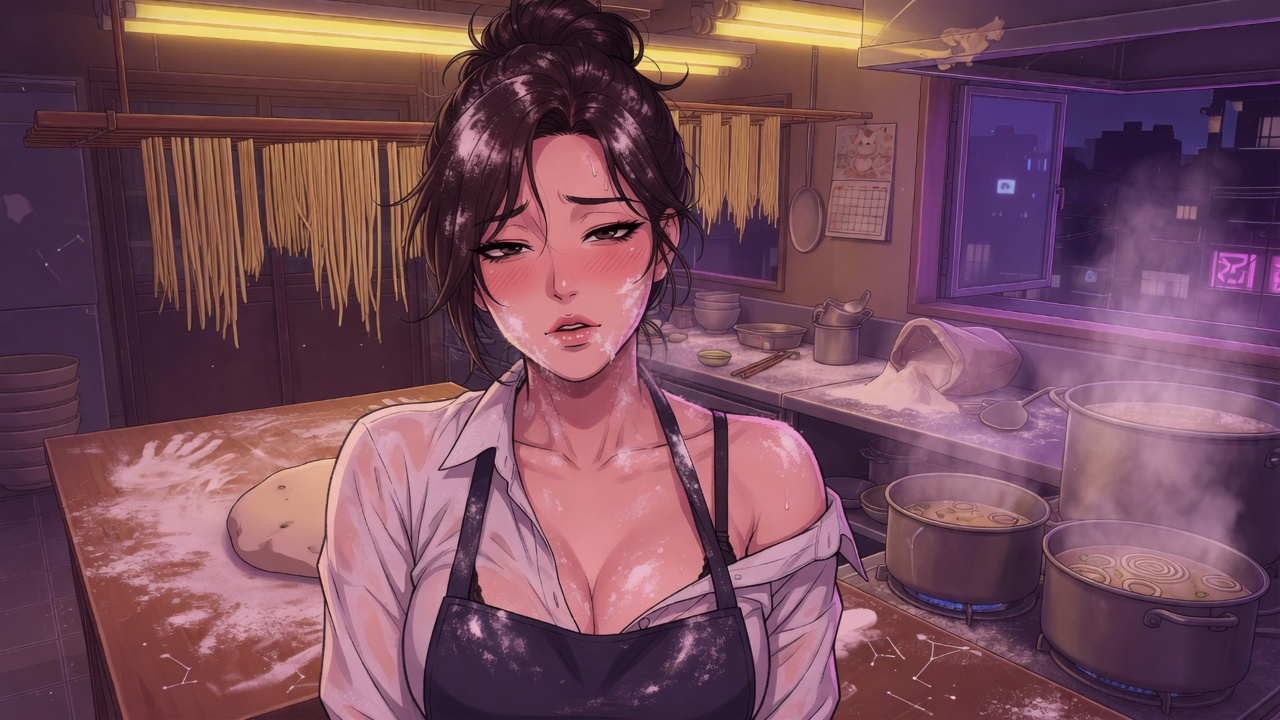
Dough
Closing dough. A handmade noodle kitchen. Gangi will not put the rolling pin down. “Dough's still left.” Walk out the back door and it's only proofing.
Every story is completely free to read. No paywall, no account.