Short story 4 min read 19+
Dough: A Married Noodle Maker and the Dough That Won't Rest
The sign dies first.
I flip the breaker at half past eleven, the neon loses its hum, and the alley takes the shop back. Flour lies ground into the concrete out here — a whole day of it carried out on our shoes, pale under a streetlamp that has been flickering since summer.
Inside, the first thing I see is not her. It's the rolling pin.
It lies across the board the way she leaves knives: aligned, deliberate, still warm from a palm. Gangi stands behind it, sleeves folded twice, forearms white to the elbow. Her ring hangs on a string at her throat — dough and gold don't mix, she told me my first week.
She does not look like a woman closing a restaurant. She looks like a woman starting one.
The broth pot on the back burner disagrees — leftover, uncovered, still breathing steam into a room the window sealed at nine. The glass over the sink has been black for hours; the kitchen doubles itself in it: board, lump, woman, and me in the doorway with my jacket half on.
The air down here is flour and broth, thicker than it ever gets at noon. It settles in the throat. I swallow. It stays.
By the time the last bowl went back on the shelf tonight, the night had already missed its window for proofing — and so, it appears, had we.
The lump sits center-board where she has been turning it all evening. The skin has dried to paper. Crack it open and the middle would still be warm, still working. Outside dead; inside refusing.
She presses two knuckles into it and reads it like a pulse.
"Dough's still left," she says, like an apology owed to no one in the room.
"That's not an answer to anything I asked."
"It's the only answer this kitchen has." She wipes her hands on her apron and misses most of the flour. "Hwan-seok loads the truck at three. Dawn market. He won't call before six."
I know the schedule. She knows I know it. She says it anyway, most nights lately, the way you'd mention weather — and the weather keeps landing heavier, like something she's rehearsing her way out of.
"Then I'll stay until the dough is done," I hear myself say.
Her eyes come up. In the steam-light they are all pupil.
She doesn't hand me the pin. She hands me the dough.
"Turn it. A quarter each time." Her hands close over my wrists to show me — flour to flour, fingers cool from the tap, her weight tipping into my space the way it never does at noon with the shutters up.
The board knocks a slow rhythm against the wall. Fold, quarter, turn. Under the rhythm the breathing changes, and I keep my eyes on the dough, because looking at her mouth would be a decision.
"It never made it to proofing," she says, nearer my ear now, guiding without guiding. "Outside dried. Inside still warm. You know what becomes of dough like that."
"It gets worked anyway."
"It gets chosen." Her hand is still on my wrist. Neither of us moves it. "By somebody willing to stay late."
She reaches past me to kill the last fluorescent — close enough that the steam off the pot curls between us — and what remains is the burner: low amber, the room exhaling into the dark.
"Stay by the board," Gangi says, "and it stops being proofing."
Continue this scene in Dough →
What happens after that belongs to the dough: heat, patience, and the moment something soft finally gives and rises anyway — late, against every instruction it was ever given. The pot keeps its low boil. The window keeps its black. The rest is flour on skin and a rhythm that slows until it isn't kneading anymore.
Neither of us says the word for what the night has become. The kitchen has a word for everything else — proof, rest, fold — and we leave all three lying on the board.
Much later the dough sits under a cloth, risen the way it was told not to, and Gangi leans against the board with her hair coming loose and laughs once, quietly — at the state of the floor, maybe, or of us.
"It'll overproof," she says, without moving. "Leave it till morning and it collapses on itself."
"Then we won't leave it till morning."
She looks at me a long moment and decides whatever she decides with her whole face, not just her mouth.
At four she stands at the back door in the cold, ring back on her finger, flour rinsed to the elbows, apron folded over her arm like a flag nobody salutes. Across the river the dawn market is waking up for Hwan-seok — crates, headlights, a husband who measures his days in things sold before the city stirs.
"Some dough never rests," she says, not looking at me. "It just gets made into something else."
The door swings. Cold air, white floor. I flip the breaker on my way out, and the sign stays dark until morning, when it hums back to life over a shop that smells — faintly, impossibly — of everything that rose in the dark.
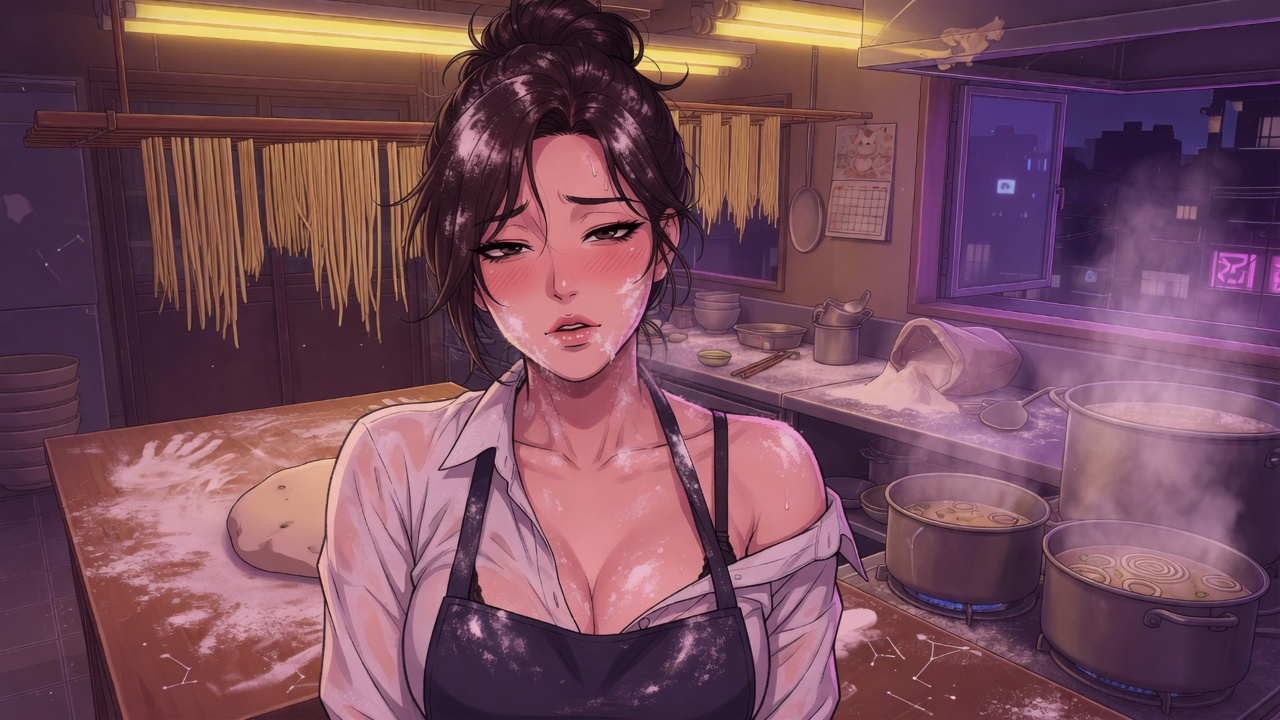
Dough
Closing dough. A handmade noodle kitchen. Gangi will not put the rolling pin down. “Dough's still left.” Walk out the back door and it's only proofing.
Every story is completely free to read. No paywall, no account.