Review 4 min read 19+
Last Course: Eight Empty Seats and One Light Still On
"This is the last piece."
It is, and it isn't. Last Course builds an entire affair out of that small, professional lie. The alley is dark, the noren still swaying from the last guest's wake, and above the omakase counter a single hinoki lamp keeps one pool of light on eight empty seats. In Last Course, after last order is not an ending. It is the first honest hour of the day.
First impressions
The sensory checks pass inside ten minutes. The noren is still moving when you arrive, breathing with wind off the departed customer. You step up out of your shoes and the wood floor is still warm from a full service. Wasabi and hinoki sit in your throat all night, and the soundscape leans on small, wet, precise things: a cloth wrung out, rice pressed, a blade finding its angle somewhere beyond the counter.
The staging tells you everything before dialogue does. All eight seats are empty. Only yours still has a knife out — the deba, laid where a regular's place is set — and one lamp lays a long stripe down the hinoki, the only light in the room under which work still exists. Everything outside that stripe has been put away for the night, including, you begin to suspect, certain versions of Haneul. It is a stage built for two, and not one corner of it goes to waste.
What makes it work
Haneul, thirty-four, white jacket, short hair neat as a cleaved line, is the whole engine — and she will not put down the yanagiba. That is the masterstroke. While she works, the counter keeps its shape: chef and customer, the one clean distance a married woman and her regular are permitted. The knife is craft and border at once, and the game lets you ache each time it is used as cover.
The script treats service as a second language. "Last piece" says everything about tuna and nothing about what it means between them, which is exactly how people talk when they are being careful. Her husband exists in one brilliant stroke: he already paid. His tab is settled, his seat is gone, and the only thing left unpaid at this counter is the night itself.
And this after-hours counter story never romanticizes the affair into destiny. It is a want, examined at close range, with the rice still warm — chosen, mutual, and priced accordingly.
Where it bites
The branch point is the noren. Walk out through it and the night ends as breakdown — the receipt, the taxi, a woman wiping a counter alone. Stay past the sound of her locking the door from the inside, and the counter stops having two sides. What bites is that both options are fully inhabited. Leaving is not written as cowardice; staying is not written as reward. The game declines to tell you which choice is the kind one, and it has the nerve to make you ask.
It extends the same courtesy to everyone. The husband is neither fool nor brute. Your narrator's years of regularship get quietly audited — how much of his loyalty to the food was loyalty to the hand that served it? One late image, hinoki grain printing itself into his palm from leaning too long against the counter, says more about want than any monologue the genre has produced this year.
Heat level
Simmer, with one flash of the burner. Two-thirds of the runtime is pure suggestion: steam off the rice, a wrist turning at an angle the camera loves slightly too much, professional distance shrinking by millimeters per course. The discipline is remarkable — the most charged moments are knife strokes and pauses, and the story fades to black well before anything explicit could be asked of it.
That final fade is earned twice, once by the clock and once by the door. Afterward the writing goes quiet in a way some will read as withholding. I read it as tasting-menu pacing. You are not handed the whole fish. You are handed the one cut that matters, and it is enough.
Should you play it
Yes — especially if your shelf leans toward affair visual novels and you are tired of ones that treat marriage as a cartoon to escape from. Last Course gives every party their dignity and still lets the night happen. It runs a tight four-ish hours, the POV never slips, and the sensory writing — hinoki, wet cloth, rice, steel — is the best I have hit this season.
Verdict: last seat, first rate. Stay past last order and you will find one of the most composed adult dramas in the genre — a slow, knife-bright conversation about what a person is allowed to want once the bill is paid. And when the alley spits you out hungry for another after-dark story, walk it off with the rain that brought someone back. Some nights should not end at the door.
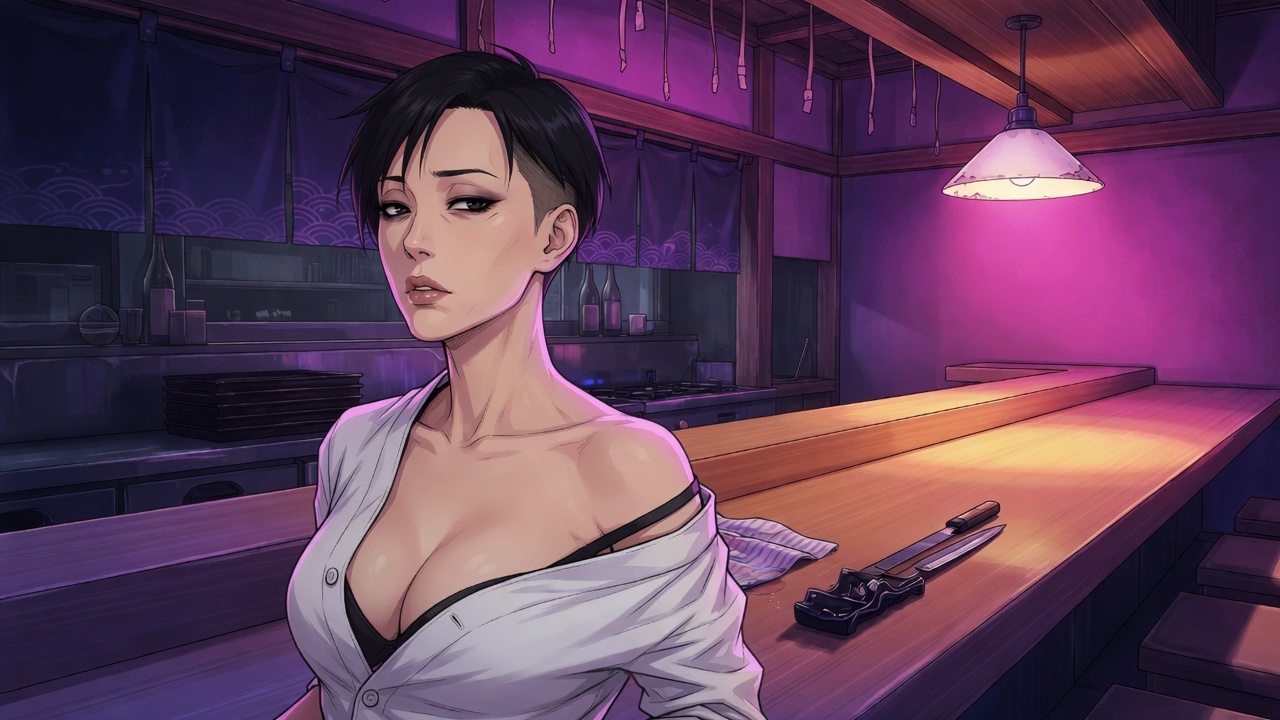
Last Course
After last order, an omakase sushi counter. Haneul will not put down the yanagiba. “This is the last piece.” Walk out through the noren here, and it is just breakdown.
Every story is completely free to read. No paywall, no account.