Short story 4 min read 19+
Last Course: After Last Order at the Counter
The noren is still swaying when the last guest’s footsteps fade from the alley. Wind followed him in; now the cloth settles, and the streetlamps down the alley go dark one by one, as if the street has decided to sleep without asking us.
Inside, one lamp is left burning.
You are the regular. Eight seats, one of them yours by habit if not by name. Omakase means I leave it to you — and for a year the leaving has gone both ways. Haneul composes the plates; you compose the silences between them. Wasabi still sits at the back of your throat, and the hinoki gives off its pale, sweet smell, mixed tonight with the damp of a wrung-out cloth.
You’ve watched those hands for a year. How the blade moves like it’s breathing. How she wakes the rice without waking anyone else. You’ve heard her laugh exactly once, at something you didn’t quite say. Regulars collect small things like that — it’s the only currency the counter accepts after dark.
You step out of your shoes and up. The wood is still warm, a whole day of standing and steel and steam soaked into the grain like a memory the floor hasn’t finished letting go of.
Eight Empty Seats
Last order ended half an hour ago. The overheads are down. Every seat is empty except yours, and even yours has been cleared — except for the deba she left out, resting on the counter like a sentence she hasn’t decided how to finish.
One strip of light lies across the hinoki. Only in that light is there still work.
When you put your hand down, the grain prints itself into your palm. You will feel it on the walk home. If there is a walk home.
Beyond the counter, steel touches stone. Once.
“This is the last piece.”
Haneul says it without looking up. Thirty-four, white jacket, short hair cut as clean as her knife work. Married — the ring stays on even when the gloves come off. The yanagiba in her hand is longer than your forearm, and she does not put it down.
The Arithmetic of One More
The night keeps offering you the same choice, in her voice and in everything she doesn’t say.
Walk out through the noren, and the evening ends as breakdown. Whose doesn’t matter. The fabric swings, the cold finds your face, and whatever this was stays a beautiful thing that almost happened. Across the city, her husband is the reason tonight’s course was already paid for. That fact sits at the end of the counter like a plate nobody has cleared.
Behind you, the noren waits, still moving a little, a door that hasn’t finished making up its mind. You watch her turn the little lock instead. The sound is very small. It travels much further than it should.
Continue this scene in Last Course →
What the Lamp Leaves Out
Last Course is built almost entirely out of restraint, which is exactly why it burns. Nothing here is coy — the pull between them is mutual, adult, and chosen twice: once across the counter, once in the click of that lock. But the game refuses to show more than hands, light and consequence. The camera keeps to where a seated regular would keep his eyes, and the tension lives inside that discipline.
What follows the choice is one long, quiet movement. The yanagiba finally set on its rest. The white jacket folded over a stool. The lamp turned until the shadows rearrange themselves, and hinoki and wet cloth closing over the room like water over a dropped stone. Even the husband is handled with a strange gentleness — a receipt, a name, an absence shaped exactly like a person. The game cuts away the way a good chef plates: at the exact moment before the piece is lifted, when wanting is still the whole flavor.
A Regular’s Notes
The first-person view is a scalpel. You see only what a guest at the counter could see, which turns every glance across the hinoki into contraband, and every sound — knife on stone, water wrung from cloth, the hum of the case — into a heartbeat that isn’t yours.
Haneul is written as a craftsperson before anything else. Her tension isn’t about being wanted. It’s about what her hands do in the moment they finally stop working.
And the affair is never scored as scandal. It’s scored as weather: pressure, release, then the strange calm after, with the city outside having already agreed to forget the alley exists. The late-night pacing does the rest — at this hour the whole city is a noren you could walk through, and the game knows you won’t.
Eight seats. One lamp. One piece left on the board, and she has already told you its name. The night asks only one question — whether you’ll still be sitting here, palm printed with the grain, when she finishes the cut.
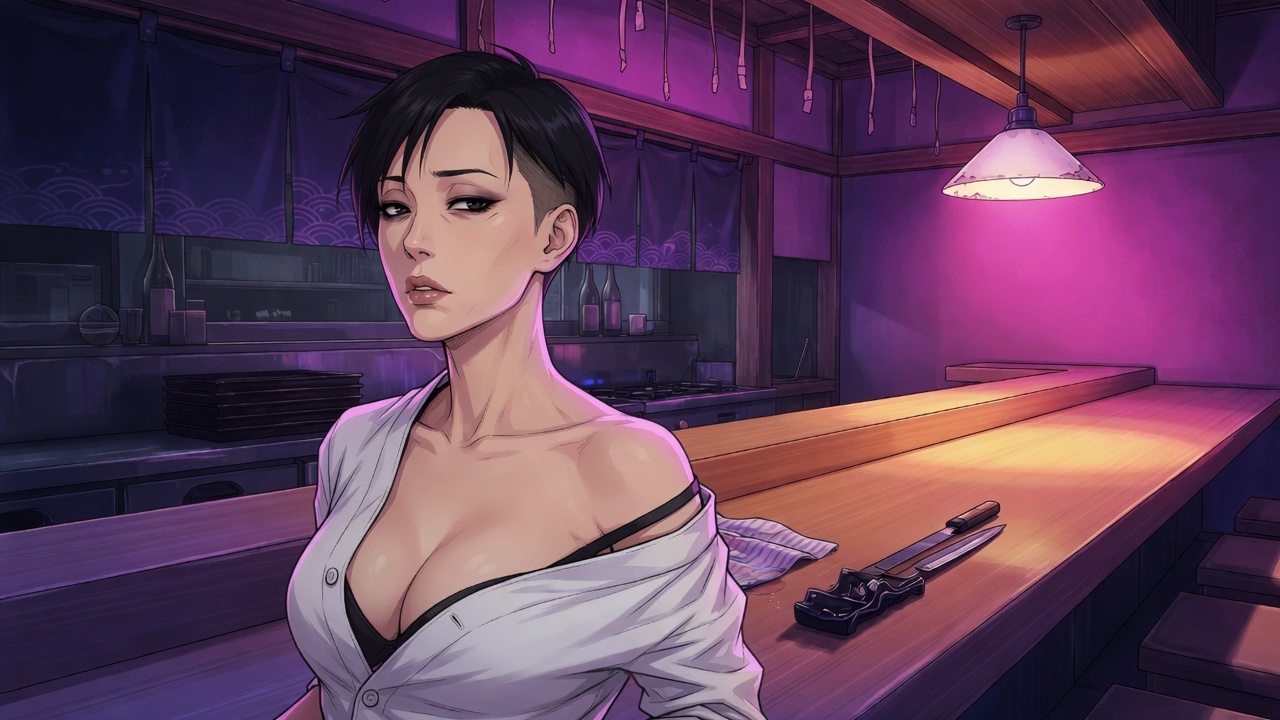
Last Course
After last order, an omakase sushi counter. Haneul will not put down the yanagiba. “This is the last piece.” Walk out through the noren here, and it is just breakdown.
Every story is completely free to read. No paywall, no account.