Short story 4 min read 19+
Tea Room: The Night Student and the Bowl She Won't Set Down
The last guest's footsteps thin out along the stone path, and the hanok exhales. That is what it feels like — the whole timber frame settling after holding its posture all evening. Outside the gate, the night still smells of steeped leaves, the way a concert hall smells after the music stops. Inside the walls, only the courtyard lanterns are still burning, and the charcoal smoke lies low along the eaves like a dog that has no intention of being called in.
I should have followed the others out. Instead I am standing in the tea room where I boiled water six times tonight, socks cold on old boards, holding a bowl I have just been told not to put down.
After the Last Guest
Night lessons at the tea room end the same way every week. The teacher thanks the students. The students thank the teacher. Somebody jokes about the water being too hot, and then everyone files out through the sliding door into the cold, and the evening becomes a receipt — one lesson, one pot, one line in the night log.
Wash-up is my job. The night student's last task. Three bowls sit on the tray, rims darkened where we drank from them, and I have carried that tray out to the basin a hundred times without a single thought crossing my mind.
Tonight the tray feels like a question with the grammar removed.
Why the Brazier Stays Red
The brazier is still red under its bed of white ash. Mirae explained it once, in her flat teaching voice: if the charcoal dies all at once, the cold shocks the ware, and tomorrow a bowl comes out of the cabinet carrying a hairline crack. So someone always stays behind and lets the fire down slowly, the way you talk someone off a ledge.
It has never been her. It has never been anyone but me.
That is my excuse, and I keep it polished: equipment, fire safety, a reason you could write in a ledger. The floor is cold through my socks, the grain of the boards pressing up in ridges I have never noticed, which is how I know how slowly I am walking. Beyond the paper door, the lantern light doubles itself on wet stone. Somewhere across the city, her husband is at his family's ancestral rite, bowing to a table of ceremonial fruit on a schedule — a man with an itinerary, a role, and a car that will bring him home late.
She is here. Jade jeogori the color of shallow water, hair pinned up in the same careful coil she wears to every lesson. And she has not told me to go home.
The Bowl She Won't Release
I kneel at the tray, because ritual is what I do instead of deciding things. I lift the first bowl to carry it out, and it is warm. It should not be warm — it has sat there through the whole closing sweep of the room. She has been keeping it against the heat the way you keep a hand against a fever.
I lower it toward the tray, and her fingers close over mine.
"Don't put the bowl down."
Four words, and the steam climbs up between our wrists. Her hand is warm from the ware. The paper door glows with lantern light, and beyond it the whole night is waiting to be rinse water.
Continue this scene in Tea Room →
There is a version of this night where I set the bowl down, and it is a perfectly decent version. I finish the wash-up. She signs the log with a small, level stroke. We bow to each other at the gate in the cold. Tomorrow every bowl is whole, the brazier is ash, and the lesson was only ever a lesson — and one of us, probably her, gets to keep her life in exactly the shape she built it.
The other version begins with a married woman's hand resting over a student's hand, and a bowl of cooling tea that neither of us is willing to let touch the tray first.
The Log Nobody Signs
The night log lives on a wooden stand by the door. Every week the teacher signs it, and I have watched Mirae do it a dozen times without even reading her own name, the way you sign anything you have done ten thousand times. Tonight the page is blank. She has looked at it twice since the guests left. Both times, her pen stayed capped.
She will not sign, she will not ask, and she will not put the bowl down. Mirae has arranged an entire life in which the decision is never hers — the ancestral rites belong to her husband, the ledger belongs to the school, even this stays a lesson, technically, until somebody makes it not one. Which means the student decides. That is the cruelty of it and the gift, handed to me in glaze and charcoal heat.
What the Sliding Door Weighs
The door is three steps away. Through it: cold air, wet stone, a bus timetable, a marriage, wash-up. It is astonishing how loud a door becomes when nobody is opening it.
That is what Tea Room understands about how these stories actually start. Not with a kiss — with a task someone refuses to finish. A bowl held too long. A ledger left blank. Two adults standing very still in a warm room, each waiting to see whether the other will be the responsible one, both knowing that if the bowl goes down, the night ends as dishes, and that if it doesn't, the tea room stops being a place where tea is taught.
The fire is low. The water is still faintly warm. Her hand has not moved.
Neither has mine.
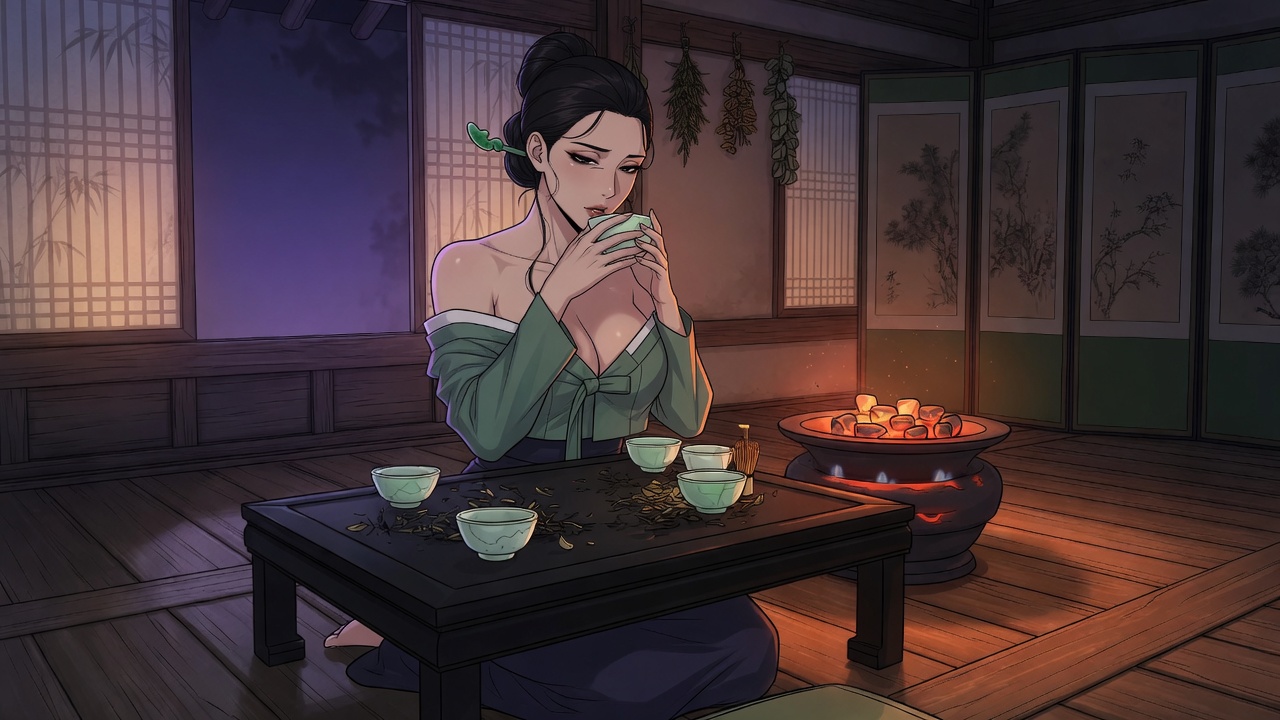
Tea Room
After a night tea gathering, a hanok tea room. Mirae will not put the tea bowl down. “Don't put the bowl down.” Slide the door and leave here, and it is just washing up.
Every story is completely free to read. No paywall, no account.