If you loved 3 min read 19+
7 Visual Novels Like Tea Room (Late-Night Hanok Affairs)
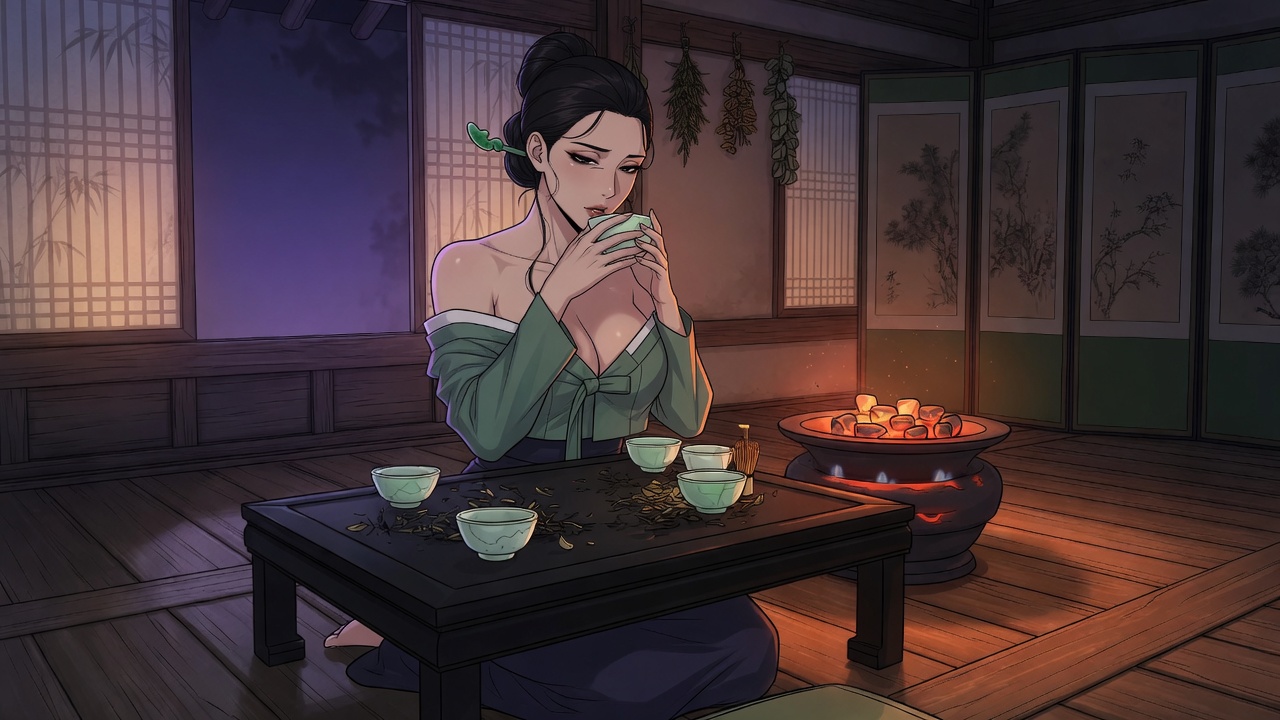
The last guest’s footsteps fade past the hanok gate, and the night exhales. Charcoal smoke lies flat under the eaves, and leaf-steam has gotten into the grain of every doorframe. You stayed behind because wash-up belongs to the night student — three bowls on a lacquer tray, the brazier kept red so tomorrow’s ware will not crack. That is the story you tell yourself. Then Tea Room closes its hand around the evening, because Mirae, your teacher for the night shift, has not set her bowl down, and she has told you — in a voice like water just off the boil — exactly why yours cannot touch the tray either.
Everything in this room is engineered restraint. Her hair stays pinned. The jade jeogori stays closed at the collar. Her husband is at his family’s ancestral rite, a fact the story hands you once and then lets hum beneath every silence that follows. The floorboards are cold enough that the wood grain comes up through your socks, and only the paper door still holds light. Slide it shut behind you and the night ends honestly — rinsed bowls, damped charcoal, nothing owed.
“Don’t put the bowl down.”
What follows is the rest of that hour, in other rooms and other hands — seven ways this site has found to make staying feel like a decision.
Last Track
Hours after the museum goes dark, a recording light still burns in the ADR booth, and a married voice actress keeps rolling a take nobody ordered. She will not let the exhibition tablet sleep — the gallery voice is all that remains of tonight — and the last Korean docent track keeps quietly growing. In Last Track, the storage door would turn all of it into closedown; the microphone would rather the take never ended.
Blue Chalk
A corner table on the second floor, one lane still lit, and Eunjae turning the blue chalk over like an answer she has not said aloud. “Just the chalk,” she offers, the smallest possible unit of staying. Blue Chalk keeps the stair light burning as the honest exit — leave now and it is last call, stay, and the felt holds you both a while longer.
Last Lane
Nothing is said here; the tell is a car. His is always in the lot on Tuesday ladies’ league night, and tonight her phone glows with overtime while the alley manager kills lanes around her one by one. One more game in rental shoes, pins falling on borrowed time — she does not call a taxi, and Last Lane understands the scoreboard was never the point.
Last Course
After last order, the counter belongs to two people and the noren are the only open door. Haneul keeps the yanagiba moving over a piece no customer asked for — “This is the last piece” — long after the rice barrel has been tipped and covered. Last Course makes breakdown sound like mercy and staying sound like the course the menu never printed.
Cover the Score
Curtain call is over, the house is empty, and the pit still hums with heat from the stage above. Nakyeong’s endpin stays planted on the concrete. “Cover the score,” she says — part instruction, part confession, part excuse, all four words. Climb Cover the Score’s pit ladder and it is instrument pickup in the cold; miss it, and the night plays on in a much smaller room.
Organ
The client signed off hours ago, the extraction hood hums, and Sia keeps pressing blotter strips like she is dealing cards to an empty table. One more accord, she murmurs — press another blotter — as if the base note she is chasing had a pulse. Walk out through the hood in Organ and it is only a formula saved; linger, and the formula follows you out.
Every night on this shelf runs on the same beautiful economy: nothing forbidden is taken, only kept a little past polite. Browse the rest of the affair collection, then let the tea-steam carry you to the corner-table glow of our Blue Chalk after-hours feature — same hour of the night, different felt.
Tea Room
After a night tea gathering, a hanok tea room. Mirae will not put the tea bowl down. “Don't put the bowl down.” Slide the door and leave here, and it is just washing up.
Every story is completely free to read. No paywall, no account.