Short story 5 min read 19+
Blue Chalk on Her Ring Finger: Last Call at the Corner Table
Last Lane
The stairwell light dies two steps from the top, and you take the rest from memory, one hand riding a rail somebody has dusted with talc until the wood feels like polished bone. Downstairs, the sign is already dark — the club's name gone out of the night, the front door locked an hour ago. Up here on the second floor, closing time is a rumor the last lane doesn't believe in.
The door stands half open. Wool felt and blue chalk breathe out of it, that dry mineral smell that gets into your cuffs and stays for days. You could still turn around. The stair light would carry you down, the night would end as nothing but last call — a receipt, a cold walk, a bed you sleep in alone — and tomorrow she'd be instructor Eunjae again, flipping badges, correcting strangers' elbows.
You go in.
Every table is covered, green vinyl sagging over the felt, but the corner table keeps its spotlight: one cone of white dropping through the slow drift of the AC. Cue dust hangs in it, silver, unhurried. Somewhere a radio gives out mid-song and doesn't try again, and the whole floor narrows to the small click of someone turning a cue.
Eunjae doesn't look up. Broad-shouldered shirt, short perm pushed back off her forehead, the cue rolling through her fingers like it grew there. Her instructor badge is flipped backward; you can see only the white back of it and the clip. Somehow that reads more honest than her name would.
"Not going down yet?"
She's chalking the tip in slow circles as she says it, eyes on the felt.
"I only leave this lane on."
You learned about blue chalk from her, months ago, some dead Saturday after the day members cleared out. Chalk hides everything, she said, holding up her left hand. The miscue. The miss. The pale band where a ring sat all afternoon and came off before a night shift. The blue is pressed thick into her ring finger tonight, fresh, deliberate, a smudge shaped exactly like something being covered.
You looked too long, that Saturday. Neither of you has mentioned it since.
You know the rest the way you know things you were never told: out of town until Friday, her phone face-down by the register, one he's away dropped to a table she was wiping though the table was already clean.
"You're late," she says, finally raising her head. "I kept the corner table warm. One game. Winner keeps the light on."
"And if I lose?"
"Then you take the stair light down," she says, "like everybody else."
Nine Ball
She breaks, nothing drops, and after that it stops being pool, or becomes a different kind of it. She talks instructor-talk — elbow in, stay down on the shot, eye level — but softer, pitched only for you, and every time she straightens out of a stance she's a little closer to the spot where you decided not to stand. The green wool runs short and quick under the light. The balls click. When she corrects your bridge, her fingers close over your knuckles and stay half a beat past teaching, callused where a cue builds calluses, and the blue dust comes off on your skin like something being handed over.
Your eyes keep going to her left hand.
"What about the ring," you start, and stop, because it isn't there and that's the entire story.
"What about it," she says, not looking up. She picks the chalk back up and turns it in her fingers, and you understand that she will not put it down — that it's the small blue permission she has granted herself. As long as she's holding it, nothing that happens here is happening yet.
The eight ball sits on the lip of the corner pocket. The lane light makes a little white stage of the table, the two of you, nothing else. Downstairs a car slows, and passes, and doesn't stop.
You reach for her hand. You get almost there.
"Just the chalk."
Continue this scene in Blue Chalk →
She says it quietly, the way she'd call a safety. Her fingers open anyway — around the cube, not around yours — and she presses the chalk into your palm like it weighs more than a gram and a half.
"Your call," she says. "The stair light still works. Nobody downstairs would ever know what this hour looked like."
The AC hums. The covered tables keep their silence. Her badge is still flipped, her ring still a smudge of blue, and her eyes hold yours in the cone of white with a steadiness that is visibly costing her something.
"Say it," she adds. "Whatever tonight is. Once, out loud — or chalk up and we play it safe."
You think about the stair light, the cold walk home, the bed you'd lie in reconstructing all of this. You think about her knuckles under your fingers, half a beat past teaching.
"I came for you," you say. "The tables were always the excuse."
She closes her eyes for the length of one slow breath, the way players do over a long rail shot. When they open, the decision has already been made and put away somewhere the downstairs sign can't see.
"He's away until Friday," she says, like she's reading a score off the wall. "The bed is made. The lights are off. You know how I feel about the dark lately."
You set the chalk on the rail. You do not go near the stairs.
"Winner keeps the light on."
She takes the eight without ceremony — a long, unhurried stroke, the click, the pocket swallowing it — and then the room is only ventilation and two kinds of breathing. She comes around the table, and her hand finds your collar, chalk-blue fingertips, close enough that you can smell the felt and the faint mineral dust of her.
"At home," she says, near your ear, "we only do it with the light off."
Her thumb crosses your jaw once, leaving blue where it passes.
"Don't kill this light."
You wouldn't dare. You cup her wrist and hold it there, and the chalk dust hangs silver around you, and the last lane light stays exactly where it is — white, patient, refusing the hour along with the two of you.
The blue doesn't brush off. Not tonight. Not from either of you.
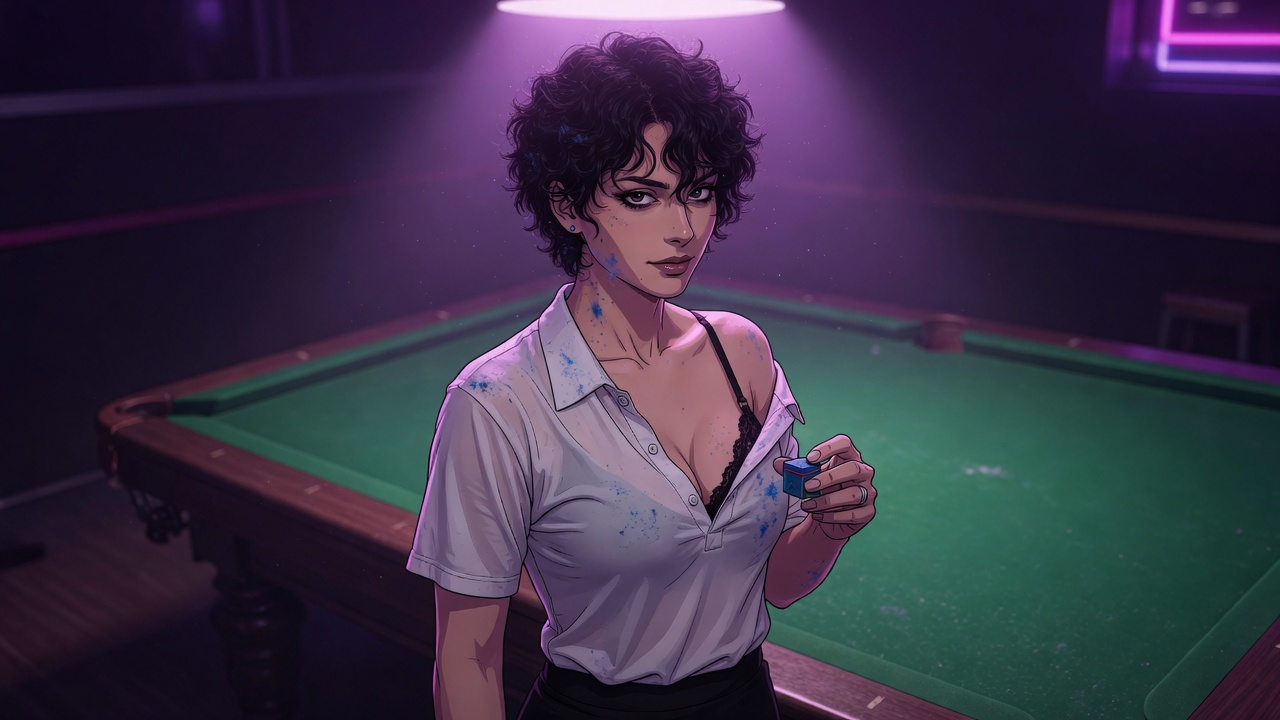
Blue Chalk
Last-lane lights. A corner table on the second floor of a billiard club. Eunjae will not put the blue chalk down. “Just the chalk.” Leave by the stair light here, and the night is only last call.
Every story is completely free to read. No paywall, no account.