Short story 5 min read 19+
Smoke — Twelve Hours of Hickory
The asphalt keeps the day's heat long after the day is gone. Eleven at night, halfway through a twelve-hour smoke, and the parking lot is still handing warmth back up through my boot soles like the ground refuses to admit the sun left. My job was simple at five o'clock and it's still simple on paper: the fire eats chips, I feed the fire, the briskets take what they take. Nobody warned me a night could get complicated around a sentence that small.
Across the dark the festival smears its light — fryer haze, string bulbs, music flattened into one long held note. Minseok's food truck is out there somewhere inside all of it, and I know the shape of that truck from her descriptions, which is a strange thing to carry. Out here only one thing is close, and it's the chimney: a pale column of hickory standing up in air with no wind to argue with.
The iron door stands open a hand's width, the way she leaves it when she doesn't want to knock the heat around. The inside air reaches me first. Hickory arrives, sweet and dark, and under it fat finding hot steel, turning into something closer to perfume than cooking. The smoke goes all the way to the throat. My throat keeps it.
Jiwon works the pit the way weather works a coastline. Thirty-four, bandana knotted low, neck stained amber at the edges where smoke gets into everything and stays. Her forearms carry burn scars instead of tattoos — a map she never picked out and never explains.
The fire asks
I count the pits, because counting keeps me honest. Two briskets, four racks of ribs, each sitting in its own private weather. The chips haven't been fed. The offset smoker burns deep orange, and right before the chips catch, the fire swells once — she taught me that the first week. The fire asks. Your job is to answer before the asking becomes shouting.
She doesn't look up when I come in. She has the hickory shovel and she will not put it down; it's become part of her arm, half tool and half an argument she's winning.
“Just feed the chips,” she says, to the fire, to me, to the twelve hours still ahead of us.
So I feed the chips, and the work does what work does when two people share one small hot room at midnight: it shrinks the room. She talks about smoke the way sailors talk about weather. She mentioned her husband exactly once, flat as coordinates. Minseok. His name is on a truck three hundred yards from here, and on the ring she wipes clean, touches with her thumb, and forgets.
Instead I watch her feed the fire. The shovel moves in a rhythm older than either of us, and the light from the firebox climbs her jaw and goes out, climbs and goes out, like the room breathes through her. When I reach past her for the chip bin, she doesn't step back. That's the whole sentence.
Her hand lands near mine on the lid. Near, not on — a question with fingers. The damper breathes once and the whole smokehouse inhales and holds it. “Festival runs till two,” she says to the firebox, quiet. “He won't miss me before close.” She reads it like a gauge, information offered to whoever happens to be in the room, and I hear it turn into an invitation between one syllable and the next.
“Say the word and I'll go count the ribs again,” I tell her, handing her the out she's owed. The shovel comes down against the pit's flank with a sound like a door. Her almost-laugh gets swallowed by the fire swelling, the bandana slipping a finger's width — and neither of us pretends, after that, that the room is about briskets. The iron door is still a hand's width open behind me. From the inside, this time, I pull it shut, soft as a damper, and the night outside turns back into weather. A temperature that will have to check itself.
Continue this scene in Smoke →
That's the hinge Smoke balances on, and it holds the story the way a damper holds a fire: barely, and completely. This is a late-night encounter visual novel told in tight first-person POV, and its true subject is restraint — how long two adults can share one small room being honest without anything explicit passing between them.
The night assistant's eyes turn out to be a great camera for it. You get the festival as a rumor of light, asphalt still warm underfoot, a chimney rising like a plumb line into the dark, and none of it is decorative. Every sensory detail doubles as pressure: the chill room's shelf of cold air, the greased ring, scars earned at this very pit. Even the sound design leans in — the damper's single breath, the firebox swelling right before the chips catch. The story builds want out of work, which is rarer than it should be and lands every time.
What raises it above its premise is fairness. Jiwon's marriage is never a prop; Minseok gets to be a whole person, tired and good at his own job, half a mile away in his own light. Her wanting is chosen, not stumbled into — you watch her decide in real time, and the POV is written so you decide with her, never for her. Her exit stays lit to the last second, too, because staying only means something if leaving stays possible.
The branching is built the same way, and the exit is a real door, not a decoy. One path walks out through the chill room — cold air like a slap of honesty — and logs the night as nothing more than a temperature check: thermometer, damper, log sheet, done. The other stays where the room stopped being about chips. Both routes are written with the same unhurried care, neither one judges him, and the fade-to-black is timed like a blade: the cut lands exactly where tension peaks, and the silence afterward says more than exposure ever could.
The briskets come off at dawn either way. But Smoke knows the difference between a fire you feed and a fire you tend — and by the time the chimney goes pale against morning, so will you.
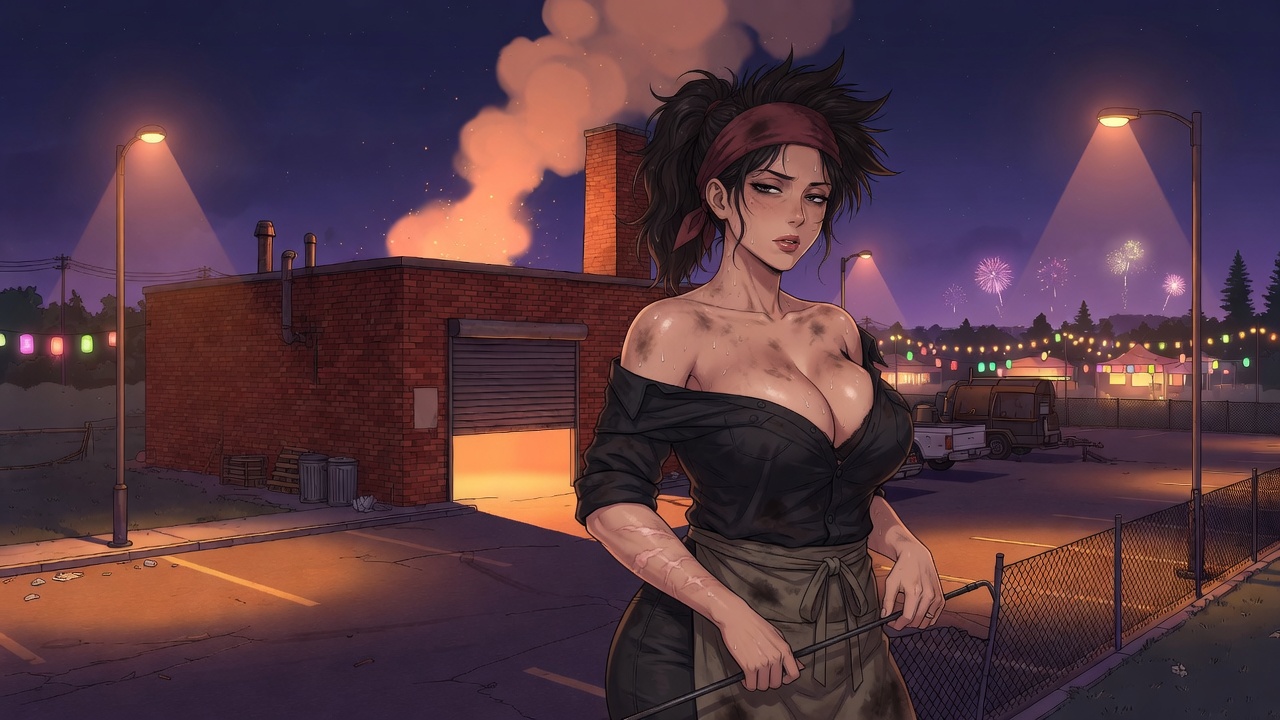
Smoke
Midway through a twelve-hour smoke. The smokehouse. Jiwon will not put down the hickory shovel. “Just feed the chips.” Walk out through the chill room and the night is only a temperature check.
Every story is completely free to read. No paywall, no account.