Short story 4 min read 19+
After Hours Tank
There is a sound an aquarium makes when it empties. Not silence — the pumps don't believe in silence — but a thinned-out hush, the human layer peeling away and leaving only the water's low machinery underneath. I heard it happen tonight, and I kept waiting for the gallery to feel bigger. It never did. It felt specific.
Coney Island had been loud all afternoon. School groups moving like weather fronts, a man explaining sharks with total confidence to nobody, a kid dragging his palm along the rail until a docent's look peeled him off. Then the last tour of the day drained toward the exit the way tours do: slowly, and then all at once.
The Last Tour
The ceiling lights went out bank by bank above the departing heads — that's the closing ritual here: exhibits first, people second, tanks last, because the tanks are the reason anyone pretends to leave. The PA chimed one more time, some final announcement losing its nerve halfway through, and died mid-syllable. After that, the gallery was empty the way a stage is empty.
I stayed. Volunteer lanyard, clipboard, tank check — one last round before the building belongs to the night crew. The rest of the staff had already gone down to the lobby, their voices climbing the stairwell and thinning to nothing. And the big ocean tank was still lit, blue as a held secret, and there was one other set of footsteps in front of the glass.
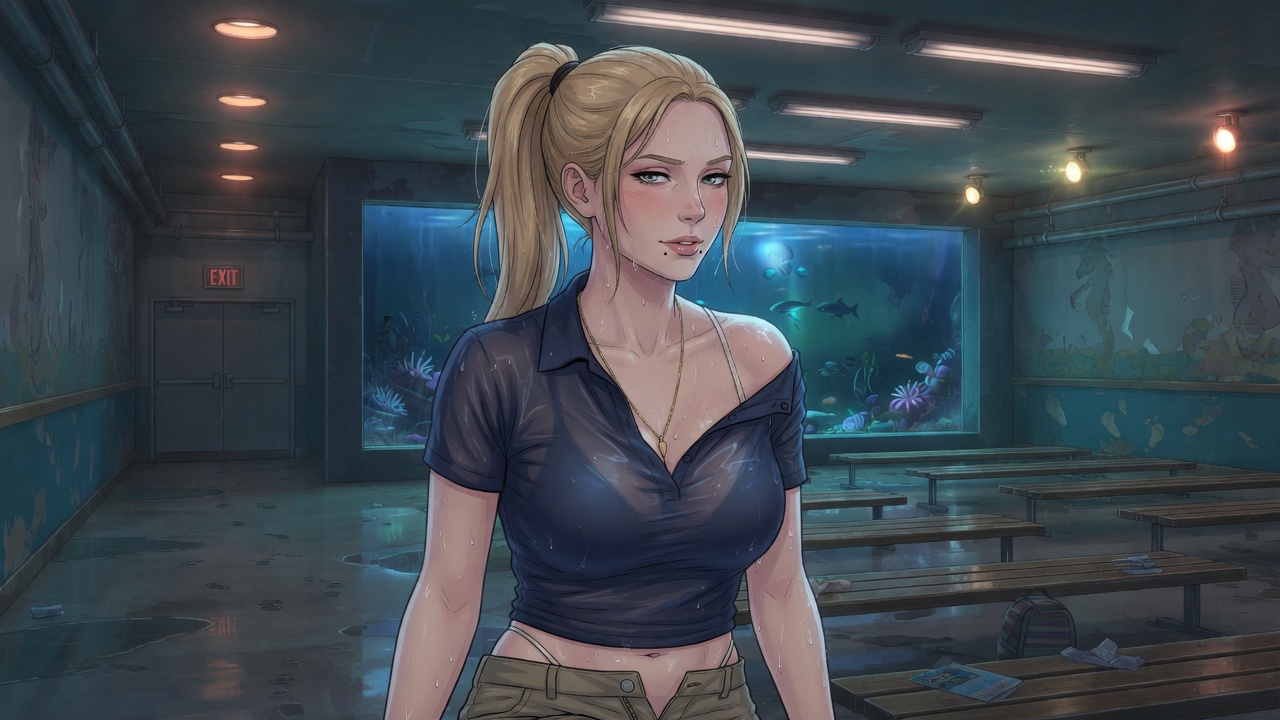
She was already there when I came around the rail. Navy polo, education staff — the one they put in front of forty eighth-graders because she can hold the room with a raised eyebrow. The polo was wet, feed prep or the touch tank getting ambitious, and it clung to her back in dark panels. Sandy blonde ponytail coming loose at the temple. One palm flat against the acrylic, like she was taking the tank's pulse.
The water light does something different after hours, when nothing competes with it. It painted. My face, the floor, the front of her shirt — the whole gallery rinsed in slow, patient blue.
Late twenties, easy. A mole by her mouth that I only noticed because she smiles sideways when she's about to say something true. A gold ring on her left hand, catching the tank glow and throwing it back small and bright.
Maren. I knew the name from the sign-in sheet, her handwriting rounded and certain in the row above mine. Education staff. Married. I knew about the ring the way you know about weather in a city you've never visited — factually, from a distance, without once imagining the sky over your own head.
Her husband works in this building too. Nights, security. Cole walks the rounds I never see and signs the logs nobody reads until something goes wrong. The place keeps the two of them in shifts, like tides. I've thought about that more than a volunteer should.
She said it to the tank, not to me, which was somehow worse. And the last bank of overheads — with the timing of something that had been eavesdropping — went out.
Exit sign, red, at the far end of the gallery. Tank light, blue, everywhere else. My clipboard. Her hand still on the glass. The hallway to the lobby is maybe thirty steps, and I counted every reason to take them and every reason I hadn't.
Continue this scene in After Hours Tank →
Blue Hour
Take the exit, and tonight stays what it was on paper: a late check, initialed, filed, forgotten by morning. Stay, and the gallery stops being public. That's the whole physics of After Hours Tank, an encounter visual novel about one square of parquet between an exit sign and an ocean, and about how long a person can stand on it pretending the choice hasn't already been made by the feet.
The blue keeps what the blue sees. Maren talks the way she talks to school groups — patient, dry, a step ahead — about how the tank changes after dark. The nocturnal stock comes out: the moray unspooling from its crevice, the octopus going liquid along the rockwork. Daylight aquariums are for children. The night version keeps adult hours, adult silences, appetites it doesn't announce on any placard. Her shoulder settles a hand-span from mine. In the glass, our reflections double — four people standing where there are two.
And underneath everything, the other sound the building makes: a radio somewhere below, a boot heel on a service stair, a door that closes with institutional politeness. Cole's rounds pass this gallery eventually. The story treats that not as a threat but as a clock. Every minute the blue holds is borrowed against a log that gets signed before dawn, in handwriting I'd now recognize anywhere.
Nothing in this story happens to anyone. Maren asks; you answer. You stay; she notices. The heat lives entirely in restraint — wet cotton, cold light, a wedding band warming against the glass — and when the moment finally turns, After Hours Tank looks away at exactly the second you'd beg it not to, leaving the tank's slow fish-light to finish the sentence in blue.
The tanks get checked either way. After Hours Tank decides who checks the dark.
After Hours Tank
Coney Island aquarium. After the last tour, a woman in a wet navy polo puts her hand on the big tank. “Once the lights go… it's just the glass.” Take the exit and the night is only volunteer duty.
Every story is completely free to read. No paywall, no account.