Short story 5 min read 19+
The Sommelier's Cellar Key — Last Call in the West Village
The Last Glass
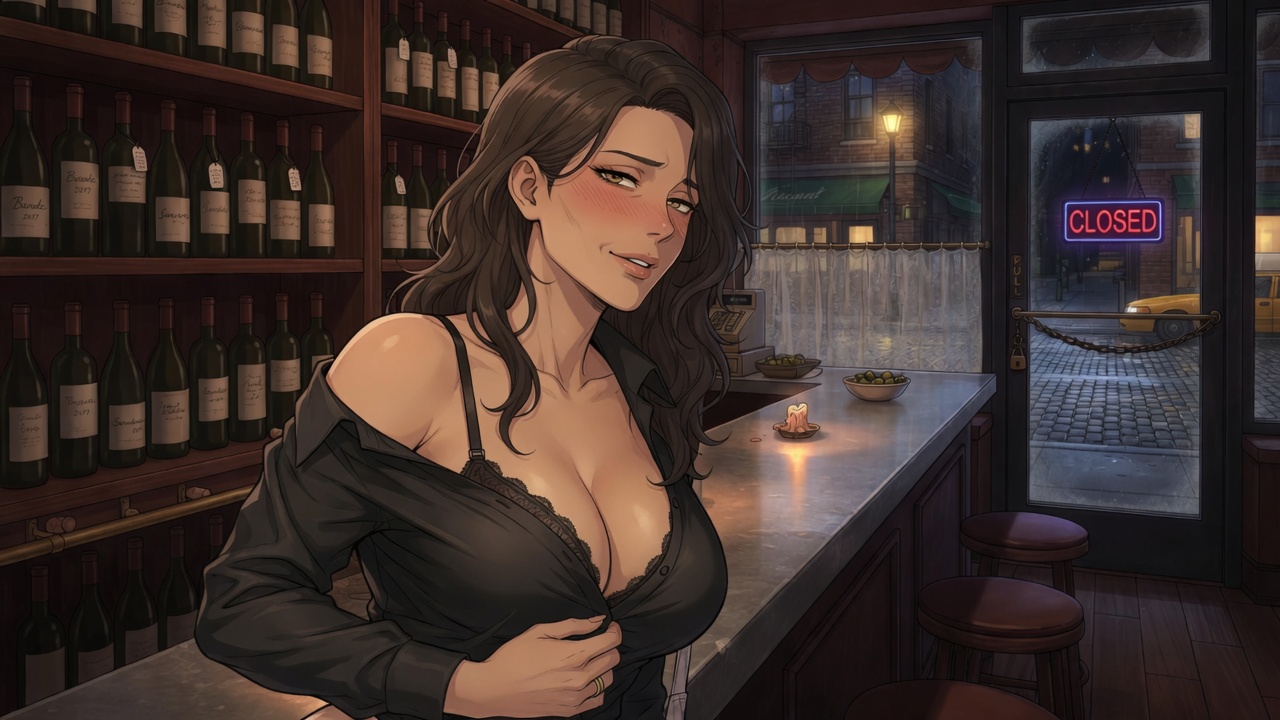
The candles have burned down to stubs, and their wax has set on the zinc in small white medallions. Last call was twenty minutes ago. Two glasses are left on the bar — yours, and the one the sommelier keeps topping up from a bottle that stopped being inventory an hour ago.
The window over the street is already dark. The sign is off. Outside, the West Village does what it does after midnight: it quiets down and minds its own business. You are still sitting. No one has asked you not to.
Isabelle has cleared every other table. You watched her do it — stacking, wiping, working the room back into itself — and she did not rush yours. Her apron string is already undone, hanging loose at her hip like a sentence she forgot to finish. From Lyon, she told the room hours ago, when the question was still safe. Here now. That was all. Here now.
The street door lock turns once from the outside, then once more from within. She does it without ceremony, the way a person shuts a book they have already finished. After that, the only way out is the alley elevator, and it hums behind its fire door — patient, indifferent, available to anyone who wants it.
She is not looking at the hook by the door, where your coat waits. She is very carefully not looking at it. Neither, you notice, are you.
She pours the last of the Barolo into your glass. The back of her hand is red in the candlelight. On her left ring finger a thin gold band cuts across the fall of the wine. She does not take the ring off — not to pour, not when she turns the glass a quarter turn so you can see its legs. When she sets the bottle down, gold clicks softly on the zinc. A small, bright punctuation.
Somewhere uptown, a husband. You don't ask. She doesn't explain. The ring stays exactly where it is — not hidden, not advertised. A fact, poured into the candlelight like everything else in this room.
The Barolo has spent an hour becoming something else: tar, dried roses, and underneath it all a cellar note — cool, mineral, kept — the taste of a thing stored below stairs that only gives itself up to whoever stays long enough.
"Isabelle," she says, as if the room were still full, as if you hadn't heard her give that name to three other tables. "From Lyon. Here now."
She turns her own glass by the stem, once, and the candle flame shivers in it.
"Your name… we don't have to ask tonight."
You almost offer it anyway. She stops you with two fingers on the rim of your glass, and the touch lasts a second longer than any bar requires.
A face that reads thirty. Hazel eyes gone wet with candlelight. A married sommelier who has locked a dark room with exactly one guest still in it — and poured you the last glass of the good bottle.
She straightens the undone apron string, thinks better of it, leaves it. Then she turns the cellar key over in her palm. You can hear it settle against her skin. The gold band presses it flat.
"Tasting is… in the cellar."
Behind the bar, the stair door stands open on limestone steps going down into warm dark. Two exits, then. The elevator for the check. The stairs for —
Continue this scene in Cellar Note →
Below the Bar
You leave the coat on the hook.
The stairs are limestone, worn soft in the middle by a hundred years of feet. She goes first with the candle stub, and you follow into air that smells of stone and old oak and her — smoke lifted off her wrist, green and warm. Racks run away into the dark on both sides, bottles lying down like a town asleep. Somewhere a compressor breathes in, and out.
She hangs the candle on a nail — of course there is a nail for it — and the light jumps. Her face is thirty exactly, or thirty is only what the flame insists. The apron goes over a peg, and without it the black silk blouse opens to the collarbone, and her scent arrives before her hand does. Closer than the wine. Closer than sense.
Deep on the lowest rack she finds a bottle with no label you can read, only her own handwriting in white chalk across the bin: do not open alone. She sees you reading it and does not take it down. Not tonight. The vintage is already poured.
"The elevator's still running," she says.
You don't move. She watches you not move, and something in her shoulders comes down an inch — a decision signed on both your behalves. Willingly. Twice.
"Tell me to stop," she says, near enough now that the words land on your skin, "and I'll write the check myself."
You don't tell her to stop.
Her mouth comes first. That is how you will keep it afterward — not her hands, not the dark, but her mouth arriving with Barolo still on her tongue: tar, roses, and that cool kept note underneath. Your back meets the racks and a hundred bottles hold their breath. The gold band scrapes slow across the back of your neck, and she does not take it off. Not for this. You feel her smile against your mouth, feel the question folded inside it.
Down here the candle is one inch tall and sinking. Somewhere above you, the wax on the zinc has long since set; the last glass stands full and abandoned; the elevator hums to no one. Her hand leaves your neck and drifts toward the nail, unhurried — a sommelier's hand, certain of the vintage, in no rush to bring back the light.
"Now," she murmurs, "we taste."
The flame goes out.
Cellar Note
West Village wine bar. A married sommelier holds the cellar key against her palm. “Tasting is… in the cellar.” Take the coat and the night is just the check.
Every story is completely free to read. No paywall, no account.