Review 4 min read 19+
Press Review: The Oak Press, the Yellow Bulb, and One Last Night
You will smell this game before you see it. Press opens on wet apple skins shining underfoot and a sweet, fermenting haze the writing treats like a third character, and that sensory confidence never wavers. It's the night after the harvest festival: lamps out, the orchard gate already cold, and one bulb still burning yellow in the cider press room. If "married woman" plus "orchard" in the same tag list makes you brace for cliché, I understand — and I'd still ask you to trust this one. It's the rare affair VN that remembers desire has a workday, and that the people we want are usually tired.
The hook
The setup is lean. You're the night helper, and you came through the orchard gate believing you were the last one on the grounds. The festival lamps are dead. Apple skins slick the stone floor, and the sweet smell catches your nose before anything else does. Inside, the fermentation barrels breathe low — yesterday's festival apples are still warm — and the oak press stands huge under the single yellow bulb, the first thing you see and, it turns out, the last thing anyone will leave alone.
Pressing is tomorrow. You know this because wooden crates are stacked by the door in patient rows, and because someone is already wiping the plate.
That someone is Sohee: orchard co-owner, thirty-six, an apron string and a short breath in the dark, and very much married. Her husband is away on a distribution trip, which the game tracks with almost bureaucratic precision — a route, a schedule, a return date. She looks up, hands you the line that will run through the whole night like a seam: "The pressing is tomorrow." It's an alibi. It's a schedule. Eventually, it's a countdown.
The characters in close-up
Sohee is the best-written woman I've met in this line in months, and the writing's secret is that it lets her be competent before it lets her be lonely. She wipes the press plate because tomorrow is her livelihood, not because a script needed her bent over something. Her marriage gets the same respect: no villain edit, no tragic-speech flashback. The husband is simply elsewhere, useful and absent — and somehow a truck full of fruit on a night highway is a more painful kind of rival than any scene of jealousy would be.
The narrator is sketched lightly, as POV leads in this format should be: hands, habits, a helper's instinct for reading what a room needs. Their rapport builds through chores — hauling crates, checking barrels, her correcting his grip on the wipe-down with a dry humor that never turns mean. And the game's key prop is the sliding door. Out the orchard gate, this night is a wash-down: hose water, sanitation, a shift that ends. Close that door, and the air inside stops being about any of it. You will feel the hinge move in your chest every time.
The tension engine
Everything here runs on deferral. "The pressing is tomorrow" lets every touch file itself as preparation — steadying an arm, sharing warmth by the barrels, a breath drawn short in a small room. The fruit does the quiet metaphorical labor: yesterday's apples still warm, barrels breathing, sweetness thickening toward fermentation. Nothing is ripe yet, and the game is superb on the difference between ripe and ready.
The pacing wobbles once. A mid-game loop of helper chores — stack, wipe, carry — runs two beats longer than it needs to, and I kept wishing for a single phone call from the road to sharpen the stakes. But the finale understands its own geometry. When the choice finally comes, the game doesn't stage it as dialogue; it stages it as a door. The fade lands with a gentleness that honors its own tag list — mutual, chosen, adult — without showing you a single thing it shouldn't.
Best enjoyed when
Play it on a cold night with rain against the window, ideally after a day that involved real manual labor or a farmers' market. It pairs beautifully with the last hour of an arcade's closing shift, another study in what people don't say while pretending to lock up. New to the format? This sits comfortably in the encounter tradition: one night, one room, one slowly collapsing excuse. Bring cider. You'll want something to hold during the long silences.
Final call
Press is a quiet triumph: a harvest-night affair story that treats labor, marriage, and want as three kinds of waiting. Sohee alone is worth the ticket — thirty-six, capable, funny, written like a person rather than a scenario — and the sliding door may be my favorite physical object in any VN this year. Points off for the repetitive chore loop and a husband who never quite gets a voice. Still, few games have made me feel a room's temperature this precisely. Step through the gate into Press yourself, or come around the other way and meet the woman wiping the press plate. Either way, the pressing can wait one more night. It was always going to.
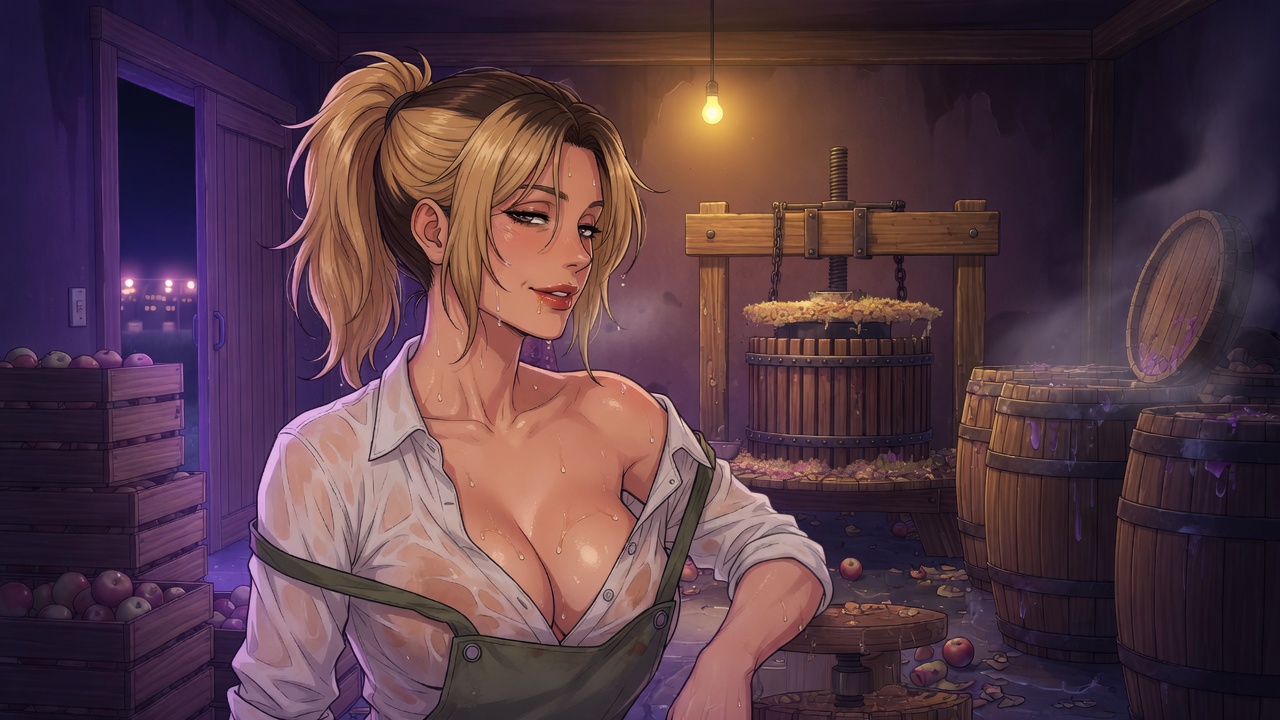
Press
Night after the harvest festival, in the cider press room. Sohee will not leave the oak press. “The pressing is tomorrow.” Walk out the orchard gate and it is only a wash-down.
Every story is completely free to read. No paywall, no account.