Short story 5 min read 19+
The Pressing Is Tomorrow: Her Night at the Cider Press
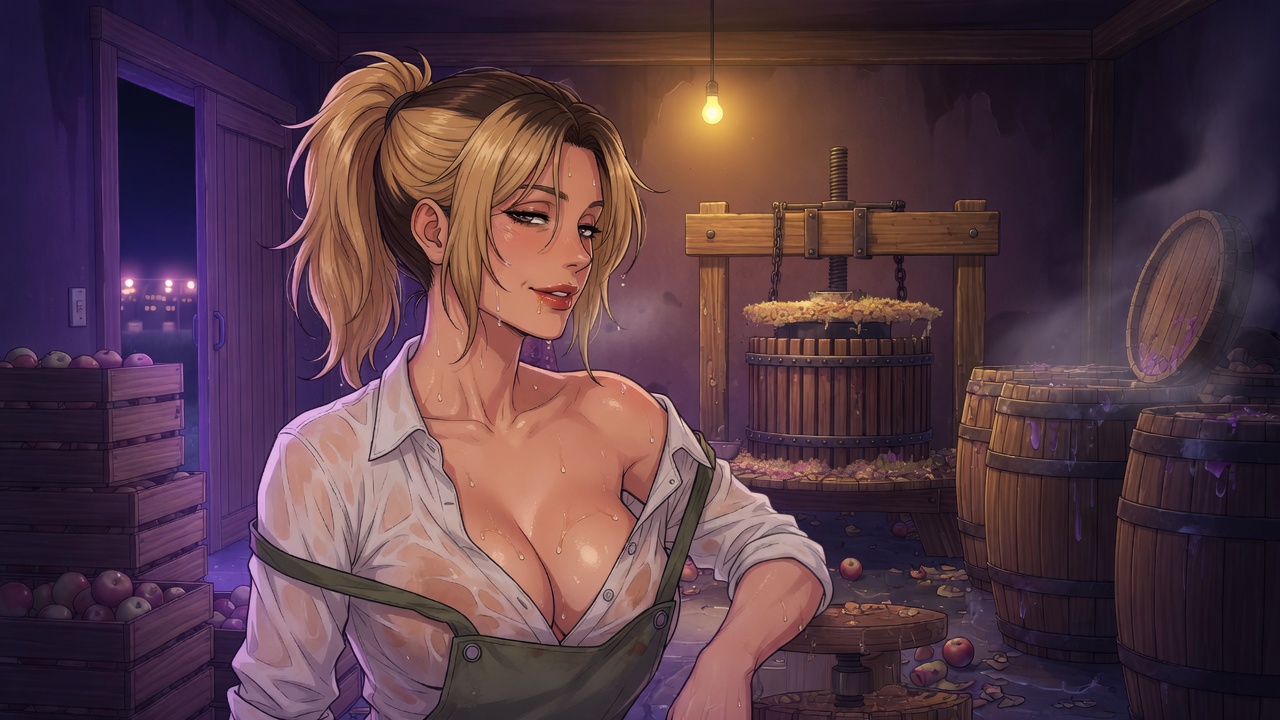
One Yellow Bulb
The last festival lamp along the orchard fence died while Sohee still had a rag in her hand, and she decided to take that as permission.
The pressing was tomorrow. That was the reason, the whole of the reason: the plates wanted wiping, the screw wanted checking, the trays wanted stacking, and somehow the someone for all that wanting had become her — thirty-six, co-owner on half the paperwork, standing in a cone of yellow bulb light telling a story to a press older than her marriage.
The oak press had been making cider since her grandmother's day, and it liked a hand on it the night before work. She was sure of that the way she was sure of very little else tonight.
She had come up through the orchard gate an hour ago, boots skating on skins the festival crowd had left shining on the stone like a spill of small red moons. The gate had gone cold under her palm. Down here the sweetness had found her before the light did — the fermentation barrels breathing low, yesterday's apples still warm inside them, still letting off the whole long day.
Cider had dried stiff on her apron somewhere around midnight. The strap had gone wet hours ago and never quite dried, a cool line across her chest that the bulb light had no business noticing. Her hair was pinned up off her neck, and under the blonde the roots had come in dark and thick — two days of festival without a hat, without a single thought, and now the dark showed in this light like a confession.
Her husband had been on the distribution run since Thursday. Roads are bad. Don't wait up. A text like a receipt. She hadn't waited up. She had driven back to the orchard instead and told the empty lot it was about the press.
The truth had a different shape. The truth was that Jun — the season's night helper, twenty-six, quiet, the kind of man who racked barrels like they were things that could be bruised — had left his wash-down hose coiled by the door, and a hose like that wanted retrieving, and retrieving meant boots on the stone path. She had been listening for boots for an hour and calling it attention to detail.
At the festival he had handed her a cloth before she asked for one. He had steadied a crate under her palm without touching her, which was somehow worse. All weekend everyone had looked at the blonde. Jun had looked at where the dark began. She had felt it the way you feel a thumb rest, briefly, on the back of your neck.
Then: boots.
"You're still here." He stood in the doorway with his collar up, breath short from the walk.
"The pressing is tomorrow," Sohee said — to the plate, to the screw, to her own hands.
"I only came for the hose." He didn't move toward it.
The bow of her apron string had come loose sometime during the festival. She knew it hung behind her now, an unfinished sentence at the small of her back. She knew he could see it. She did not tie it.
He came in as far as the crates. The door stood open behind him and the night leaned through, blue and cold, all the way to the edge of the yellow.
"Say the word," he said, "and I wash down and go home."
She turned the rag over in her hands. Under her other palm the oak was smooth where sixty years of harvest had rubbed it polite. Say the word. She was the co-owner here. Words were hers to say.
"The pressing is tomorrow," she said again, and this time it came out sounding like nothing to do with apples.
Behind him the sliding door began to roll — his hand on the frame, she realized, her heart a slow heavy knock, like a pipe in a wall — and the blue of the night narrowed to a bright line, and then the line was gone, and the room was only the bulb, and the barrels breathing, and the two of them, and the hose still cold on its coil.
Continue this scene in Press →
Wash-Down
For a moment nobody moved. The door had a sound it made when it shut properly, a soft wooden full stop, and after it Sohee could hear everything: the barrel-breath, the faint wire-hum of the bulb, Jun at the crates, breathing like a man standing at the edge of water in April.
"Sohee." First time he had ever said her name without ma'am attached. It landed somewhere the apron didn't cover.
She had a good marriage. She wanted that written down somewhere. Ten years, no cruelties, a shared calendar, a shared name, a husband who texted her about roads. And she wanted — with an appetite that embarrassed her — to be looked at where the dark came in, by someone who had looked all festival long and never once let his eyes travel further than she allowed. She allowed it now. That was the thing she couldn't take back, and wasn't trying to.
She laid the rag on the plate. She turned all the way around — apron string hanging, roots showing, thirty-six years of careful standing in the yellow — and reached past him for the hose.
It was colder than the gate had been. It lay in her hands like something asleep, and somewhere in the wall a pipe knocked once, the whole building clearing its throat. The tap was two steps away. She never reached it.
Jun crossed the small room the way you cross a stream, one decision at a time, and stopped with a hand's width of light between them — close enough that the festival was still on him, woodsmoke and apple and cold air. He looked, openly now, at where the dark began. Then up, to her eyes, asking without a single word of it.
"Tell me to turn on the water," he said.
She knew tomorrow already. Tomorrow she would say nothing; she knew the shape of that silence the way she knew the press — where her hands went, how hard, how long. But the night was not tomorrow. The night was one bulb and one shut door and a hose still cold in her hands, and Jun's question hanging between them like juice down the screw.
Sohee opened her mouth.
Press
Night after the harvest festival, in the cider press room. Sohee will not leave the oak press. “The pressing is tomorrow.” Walk out the orchard gate and it is only a wash-down.
Every story is completely free to read. No paywall, no account.