Short story 4 min read 19+
Incline: One Last Descent Before the Fog Closes In
They taped the last-run notice to the ticket window at dusk, and by eleven the tape has peeled at one corner, curling the way frost curls. FINAL DESCENT — 11:40 PM. Under it, the whole day's schedule is struck through with one long line, the way you'd cross out a name.
I'm the only passenger left on the upper platform. Everyone else went down hours ago — by car, by phone call, by the ordinary routes. The fog takes the ordinary routes personally. It comes up the mountainside in a slow tide and swallows the cable first; the wire simply stops existing a few meters out, though I can still hear it running through its sheaves somewhere inside all that grey.
Grease lifts off the wire. Mineral, almost warm, a wrong smell for a night this cold. My hands are bare and my knuckles ache. I should have brought gloves. Nobody warned me the mountain would take the temperature personally.
The last car of the night waits on the incline below the platform, and the platform ends like a cliff. Fog underfoot is thick enough that the stone simply quits; past the railing there is only white, falling away at an angle. One yellow car hangs in it, lit from inside, tilted to the grade. It looks patient. It has all night, because it does.
The Operator
She stands in the operator nook with the door propped open: thirty-one, short hair crushed under a cap, neck warmer up to the chin, gloves that have done real work. Hanbyeol — I learn that later, off a laminated name card, the way you learn most things about strangers too late to use them.
She's married. I know it the way you know the weather in a place you're only visiting: her husband is waiting at the downhill hotel for this very car. She tells me herself, lightly, mid-checklist. "He'll be in the bar. He always is, on my last runs."
Then why say it like that.
One Last Check
Her routine is a language, and I watch her speak it. Pressure gauge. Door lamp. A gloved hand resting on the brake lever — on the cover, not closing it. Apparently you leave one thing unfinished on a last run, so the mountain knows you're coming back. Inside the nook, the last-run log lies open beneath the frost-furred window, and its final line is blank: a whole descent waiting to be written down.
"Middle station's dark tonight," she says. "Nobody waiting at the platform. We could—"
She doesn't finish it. The fog finishes it for her, pressing white against the glass.
"Skip the middle station," I say.
She looks at me then. The look lasts exactly one breath too long — the kind you can't take back. Her hand stays on the open cover. The log stays blank. Overhead the cable gives its low hum, like something patient being asked to wait a little longer.
Continue this scene in Incline →
We take the grade. The wooden benches tilt us toward each other without meaning to — the mountain deciding these things for its passengers. Frost feathers the inside of the windows from the bottom up. Somewhere past the first curve the car stops feeling like a vehicle and starts feeling like a room that happens to be moving: one lamp, two people, and a dark so complete it counts as privacy.
She doesn't touch me. I don't touch her. The incline does enough. Every stretch of cable leans us a degree closer on the wood, and the brake-lever cover stays open the whole way down, like a sentence left deliberately unfinished.
Her reflection rides the frosted glass beside mine, doubled and softened, two exposures of the same thought. Once, when the car sways on a pylon, her shoulder settles against mine and stays — a weight of two seconds or a full minute, hard to say with any instrument I own. Neither of us makes it into an apology.
We pass the middle station without slowing. Dark platform, dead lamps, a place that officially doesn't exist tonight. Whatever the middle of this night might have been, we glide past it in four seconds of shadow — and the log at the bottom of the hill will keep none of it. Downhill, direct, one line. A terminus.
The downhill platform arrives out of the fog like a rumor confirmed. Beyond its lit windows, a hotel bar holds a husband who will never know the car skipped a station tonight. Hanbyeol signs the log with cold-stiff fingers while I stand in the doorway a beat too long.
"Watch the gap," she says, cap tipped down, and the car takes her back up into the white.
The night ends as a terminus. Some nights, that's the kindest thing a night can do: arrive somewhere final, leave the middle blank, and let the fog keep whatever it swallowed.
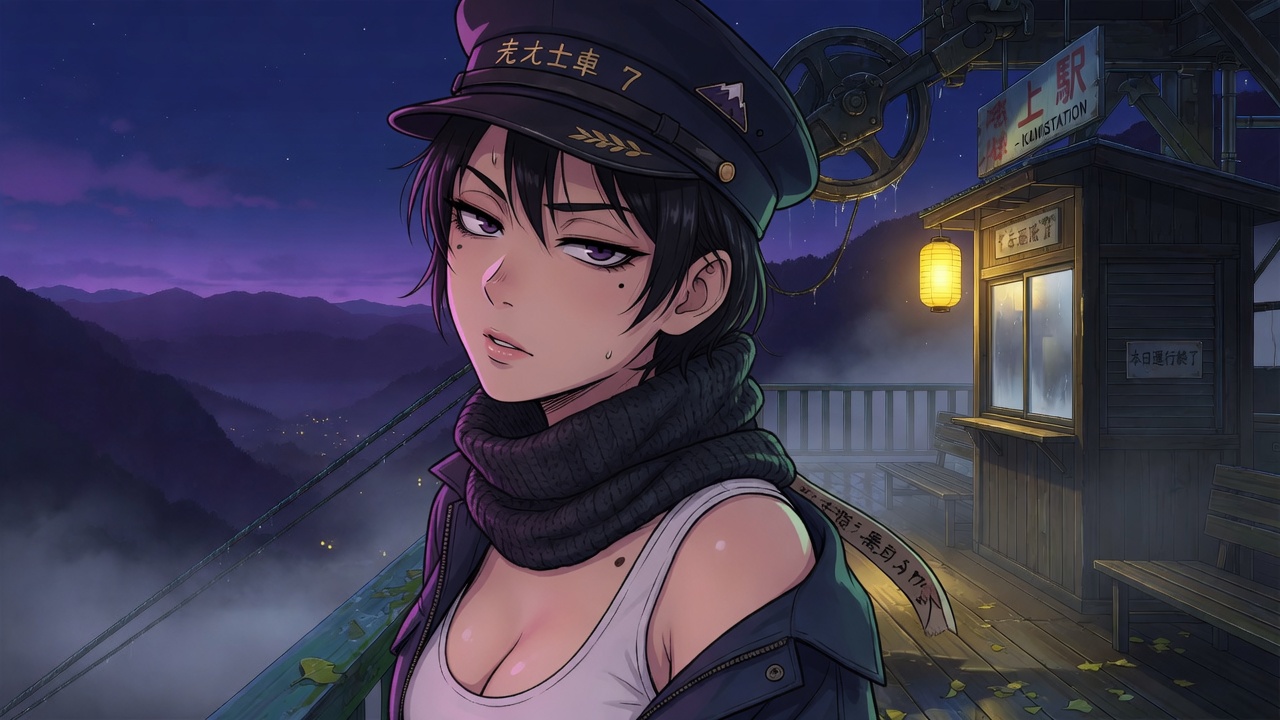
Incline
Last run of the mountain funicular. Hanbyeol keeps her hand on the brake-lever cover. “Skip the middle station.” Step off at the downhill platform and the night is just a terminus.
Every story is completely free to read. No paywall, no account.