Review 3 min read 19+
Hold Gate Review: Two Rooms, One Corridor, All Night
Some flights end at a gate. This one ends in a corridor, two key packets deep.
Hold Gate begins where travel stories usually cut to black — the rebooking, the shuttle, the hotel stitched to the terminal — and asks what you do with the hours the weather stole.
The hook
JFK, groundstopped. The transatlantic first-class cabin died in the weather, so there is no jet bridge — a bus instead, boarding passes only, funneled into the lobby of the Marriott fused to the terminal. Nobody checks passports twice; the night has already stopped being a flight and hasn't yet become anything else. Down the corridor's far window, rain slides over the tarmac lights, and the strangest detail lands first: the cabin air followed you here. Recycled, pressurized, seven hours old.
The airline issues two rooms. Two key packets. Same floor, neighbor numbers — hers 612, yours 614.
She was 2A. You were 2C. One aisle between you for seven hours — long enough to learn that she takes her coffee black and her turbulence without comment, that her humor arrives late and dry the way it does at the end of long flights, and that her name is Audrey.
The characters in close-up
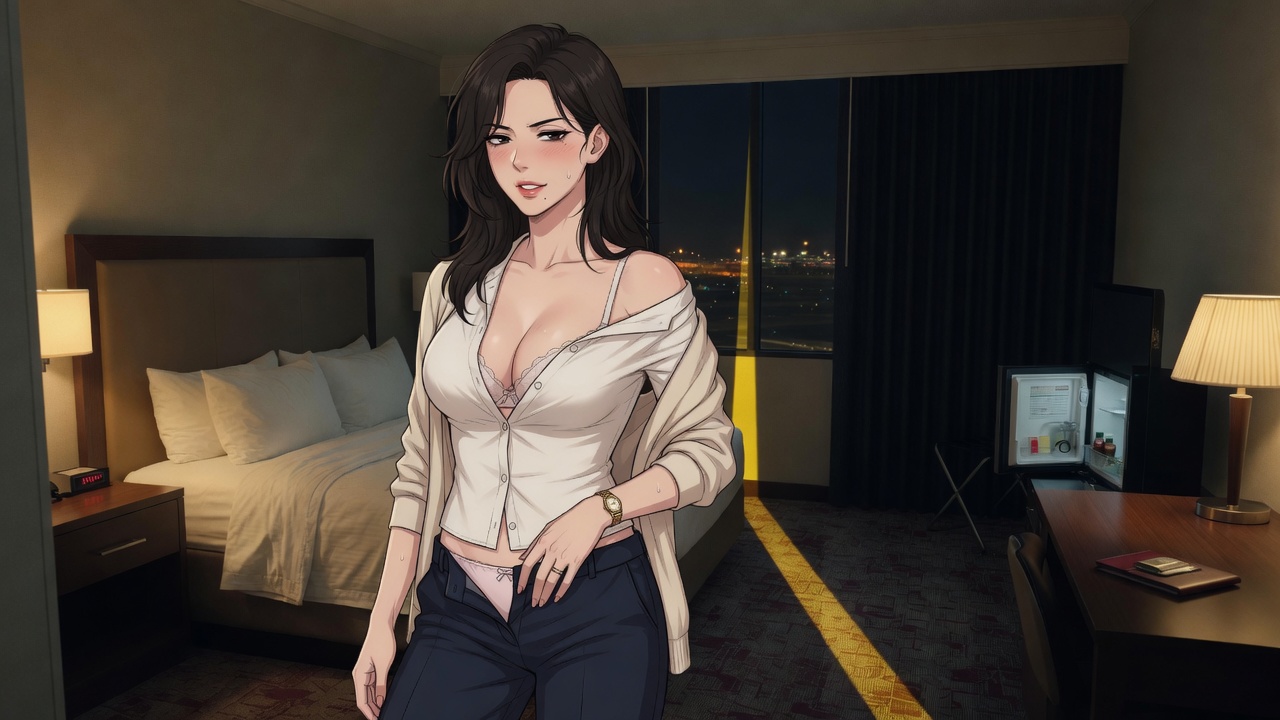
Audrey is thirty, and the game lets that read plainly — in her face, in the blowout flattened by cabin air, in the cream cashmere that slips off one shoulder while she pretends not to be exhausted. Married, headed home to London. Her husband is already there, and his text is two words long:
“Just sleep.”
What elevates her writing is the key packet. She folds it with her thumb. Opens it again. The gold watch knocks the plastic — a tiny metronome the game keeps returning to whenever the conversation runs out of safe things to say. You, in 2C, are given just enough self to be a choice rather than a camera: tired, courteous, and growing aware that courtesy and interest are beginning to look identical.
The tension engine
Neighbor numbers. That's the whole machine, and it's beautifully cruel. The corridor is fifteen steps long, the doors share a wall, and every interaction — the ice machine, the good-night, the too-long pause at the fork between 612 and 614 — is staged against the fact that this proximity was assigned by a rebooking algorithm. Even the sound design plays along: elevator chimes, ice dropping into a bucket, a door easing shut somewhere down the hall — the hotel's entire vocabulary of almosts.
The fork is a single motion. Walk into 614 and the night is exactly what it claims to be: a delay, room-service dinner, an early alarm. The writing never pushes. Audrey tests; you answer or you don't; every beat is mutual and chosen, which is exactly why the quiet ones land hardest.
Best enjoyed when
Stranded, honestly. This is the definitive delayed-travel piece — best at night, headphones on, weather audible somewhere behind the wall. It also suits anyone who likes tension built from logistics instead of leaps: boarding passes, floor numbers, a watch ticking against plastic. Chapters are cut like flight segments, each one ending on a small held breath, so it's easy to pick up and hard to put down. The run supports three passes comfortably — leave early, stay the night, and the third, where you watch her walk to 612 alone, which the game has the nerve to make feel like the saddest ending of the three.
Final call
Hold Gate is the strongest pure-tension piece I've played this year in the travel lane. Its romance never leaves the corridor, its heat never leaves the fade-to-black, and its best special effect is hallway carpet and two adjacent doors.
If it works on you, queue up next — a colder strain of stranded-together storytelling that pairs like a connection flight — then browse the rest of the shelf. And when you board the delayed red-eye yourself, remember the game's real question. It isn't whether you knock. It's whether, standing at 614, you can hear yourself not knocking — and know that the other ending isn't a lesser night. Sometimes a delay is just a delay. Sometimes it's the boarding call.
Hold Gate
JFK connected hotel. A married woman toys with the 612 key packet. “Tomorrow morning's the gate.” Walk into 614 and the night is just a delay.
Every story is completely free to read. No paywall, no account.