Short story 5 min read 19+
Honey
Honey
The smoker is the last thing I put down, and even then it won't quit. It ticks on the step, cooling, breathing its last of the dark. The smell of it climbed with me the whole way up — burlap and dried herb worked into my gloves, my sleeves, the back of my throat where clean night air should be.
I am seasonal help. I keep saying it like a rope I'm climbing. Seasonal help carries frames. Seasonal help filters what the day left behind and goes down the mountain before the valley coffee goes cold. Seasonal help does not notice whose windows are still lit.
But the windows are lit. Amber, both of them — the color of the honey itself, laid across the dark grass as if the house were keeping something warm on my behalf.
The hives stand in rows below the shed, pale boxes shouldered together. All day this shelf of mountain hums loud enough to hear from the valley road; visitors mistake it for machinery. Tonight, nothing. The bees are home. Whatever is still awake up here is awake because someone chose to be.
I lift the latch.
Beeswax and propolis hit first, the way they always do — resin and sweetness and something older, half church, half wound. Under it, the honey itself, warm from the room, from the long day, from her. The extractor stands in the lamplight, drum still turning, slowing, the last frames giving up the last of the comb. On the hook by the door, her veil hangs folded in on itself like something sleeping.
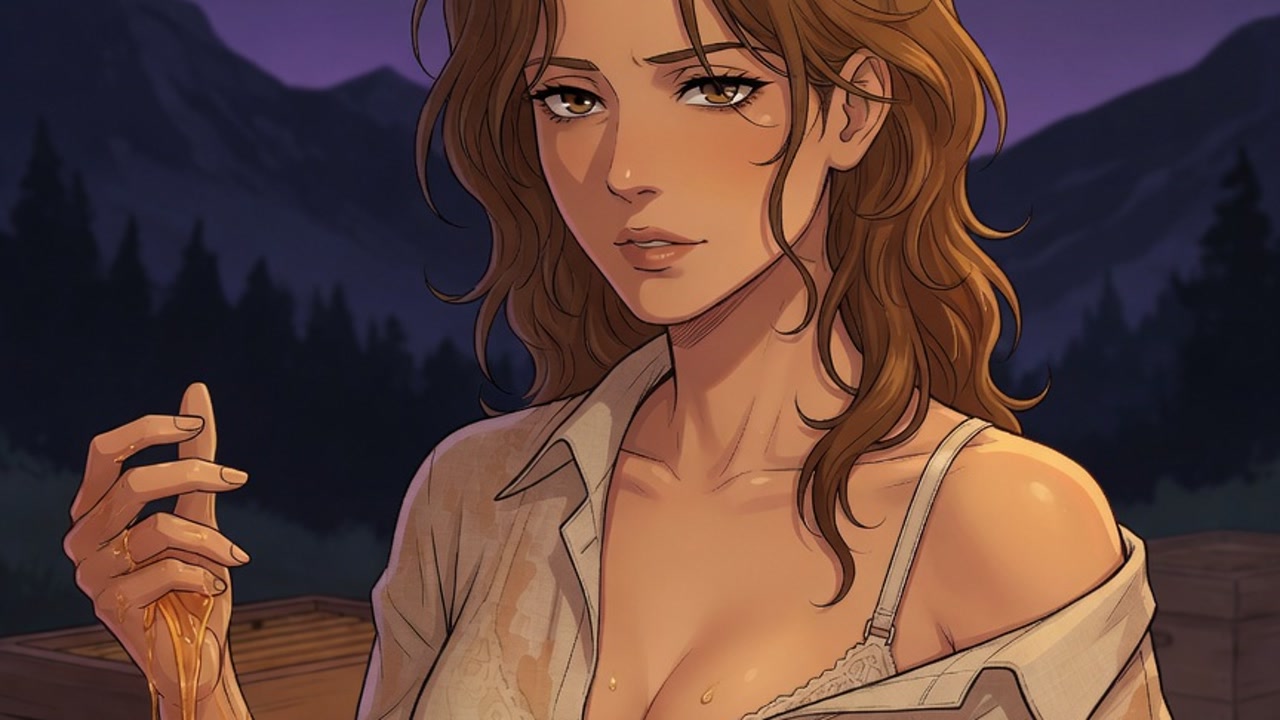
Dagyeong has her back to me. Linen shirt, sleeves past the elbows, wrists shining where the honey has found her the way it finds everyone eventually. She is the beekeeper of this mountain the way the mountain is the beekeeper of everything else — patiently, without asking. Her husband keeps his own apiary on the next mountain, a fact I know the way I know smoke: permanently, and against my will.
It sticks the way the honey sticks. I look at it longer than I should. Then I look at that, too, longer than I should.
“You're late,” she says, without turning.
“The frames still need filtering.”
“They'll wait.” She kills the extractor with a flat hand on the switch. The drum winds down, and the silence it leaves is enormous. Then she says the thing the whole night has been organizing itself around:
Put the smoker out.
“It's already out.”
“Put it out anyway.” Now she turns. Hair coming loose where the veil sat, a pale line of propolis across one knuckle like a second ring worn on the wrong hand. Her eyes do the arithmetic: me, the hour, the two doors this room owns. “Embers live longer than you think up here. They smolder all night and blame the wind.”
The filtering-room door is the one I came through. Behind it, the night is exactly what I was promised — straining cloth, cool buckets, leftover comb, the ordinary chores of an ordinary shift, ending the way shifts end. One door. One honest door.
The other door is the extract room.
I know what's in there because I helped carry it in: warm dark, the drum, a smell that gets into skin and stays for days no matter how you scrub. Stay in the extract room tonight and the shift stops being a shift — the mountain stops being hers and becomes ours for a few unlawful hours, and the thin gold band will stick to both of us the way everything here sticks. Sweetly. For keeps.
She holds my eyes and doesn't rescue me from the choice. That's the thing about Dagyeong: she will not put the extractor down, and she will not decide for me. She lets the quiet do what smoke does — settle everything, until the only thing left standing is what you want.
Her wrist is still shining. The drum has stopped. The honey in the comb is patient in a way neither of us is.
My hand still smells of burlap and sage. It has not moved toward either door.
Continue this scene in Honey →
Whatever happens through either door, the valley will hear nothing but the ordinary hum it always hears. That was the whole point of the smoker, and of the doors, and of the quiet.
Take the filtering room, and tonight resolves the way most nights honestly do: honey strained to clarity by morning, cold sweet tea on the step, a nod at the truck, a season that behaves itself. Some version of me would carry that door politely for the rest of his life, the way you carry a splinter you never got seen to.
Stay — and I stay — and nothing explicit needs saying in a room that already smells like this. I should go, one of us offers, and it isn't a sentence; it's a coin in the air. The wanting is mutual and chosen, spoken once at the threshold, plainly, the way adults do it, then answered with hands and with quiet. After that the dark handles the grammar. What reaches the page is texture — stickiness at the wrists, breath, the amber going to gold going to nothing. Fade to black; wake to honey on the doorknob.
This is Honey, an encounter story told first-person from inside my own better judgment's absence. It branches the way the room does — one door is work, one door is the affair — and it's honest enough to let the windows go dark at the right moment.
The branch that stays with me treats the affair as weather, not plot — something that arrives at the altitude it arrives at, changes the light, and passes through you changed. There's no villain in it. The husband on the next mountain is a decent man with his own smoker and his own amber windows, and the writing is adult enough to let that be the heaviest thing in the story rather than an excuse.
The night doesn't end; it only goes where good nights go. If you want to stand in it again — the warm drum, the amber windows of the honey house — it's all still up there on the mountain, keeping warm.
Honey
Night extraction, a honey house. Dagyeong will not put down the centrifugal extractor. “Put the smoker out.” Leave through the filtering-room door here, and you just strain honey.
Every story is completely free to read. No paywall, no account.