Short story 4 min read 19+
Level B2 — An Encounter Visual Novel
Garages are the honest parts of a building. Upstairs there are lobbies, team names, ways of being somebody. Down here the building shows you what it is: concrete pillars in ranks, bays wide and empty, fluorescent tubes that flicker like they can't decide. Level B2 smells of motor oil and, tonight, of the soju nobody managed to finish.
The company dinner broke up an hour ago. My floor scattered in every direction — taxis, the last train, one manager singing to the elevator buttons. My car sits in its bay behind a pillar where the light doesn't bother reaching, and my phone glows on the dash. Driver app. Request sent. The little circle blinks blue and finds nobody. At this hour, no substitute driver in the city wants my keys.
Her black sedan is still parked far off across the empty bays, holding the one steady light. Whatever brought her down here an hour after the toasts, it started with that small blue circle refusing everyone in the city, one driver at a time.
Then heels on concrete.
You hear that sound every day in this city — quick, bright, certain of the pavement. Not here. Not this far down, this late.
She comes around the pillar with her coat open, no hurry anywhere in her. Black dress from the dinner, the good kind of plain. Hair that fell in soft waves over dinner is pinned up now, like the evening got too warm and she handled it. Her phone lies flat on her palm, screen up. Same blue blink. Same nobody.
Another floor. That's all she is to me, and all I am to her. Eleven months in the same building, the same elevator at nine and six. A nod. “Going down?” Not a friend. Not a team. Not anything.
The closest we ever came was a rainstorm in March, when the elevator stuck between floors for four minutes and six of us watched the numbers and said nothing. She laughed once, at nothing, and I remember thinking the sound didn't match the office. That's the entire history between us: four minutes in a steel box, and one laugh I kept for no good reason.
Until tonight, when the garage is empty and she stops in front of me like a decision she finished making upstairs.
“I can't get a substitute driver… Haa, at this hour.”
The sigh does more work than the words. She glances back at her sedan, then at my car, then at me, weighing all three like arithmetic she doesn't enjoy.
“Just until the buzz fades,” she says — and rounds the hood to the passenger side before I've agreed to anything.
The door shuts with the softest sound in the world. Half a dinner's worth of soju comes with her, warm under the perfume, as she settles into the seat, folds one knee over the other, and studies the pillar ahead like it's a screen worth watching. The dome light clicks off. The car gets smaller.
Overhead a tube gives up, catches, gives up again. In the stuttering light her face is two different faces, and both of them are patient.
My hand is on the ignition. That's the whole situation. One turn of the wrist, one story or the other.
Continue this scene in Level B2 →
Ride, Or Room
Start the engine and the night stays an errand. A colleague from another floor, too deep into the company dinner, and me the sober one holding keys — take her around to her sedan, or all the way to an apartment door with its own lights on. Talk about the quarter, the weather, the broken coffee machine. Forty minutes and the story ends the way garages end: in gear, up the ramp, done. The decent version. Nobody writes songs about it.
Kill the ignition and the car stops being a car. The tubes flicker past the windshield. The handles sit quiet in their doors. An engine-off car is only a small dark room we're both already inside, with no meter running and nobody in the building who knows the address. The buzz will fade either way. The question the game won't ask out loud is what's left standing when it does.
What the Game Does With Silence
Level B2 is an encounter story assembled almost entirely from things that haven't happened yet. Two adults, each married to somebody who isn't in this garage, both sober enough to know that's exactly what they're choosing. Nothing here is an accident. She walked around the pillar on purpose, and every minute I stay in this seat is a minute she allows.
The restraint is the engine. A failing tube becomes a metronome. Her phone finally goes dark on her knee, done asking the city for help. Strangers' headlights sweep the ramp above and slide away. The whole scene runs on breath and small sounds — her coat settling, the clock in the dash, the pause between “at this hour” and whatever comes after it. The details are local and exact, the way a substitute-driver request dies at midnight, the way concrete holds the cold, so the silence never feels borrowed. When the story finally slips past the windshield, it happens between sentences: doors close, the frame goes quiet, and nothing you'd need to look away from is shown. Nothing is forgotten, either.
The key is cold in my hand. She watches the pillar and not me, which is its own way of watching.
The tubes flicker.
Turn it, or don't.
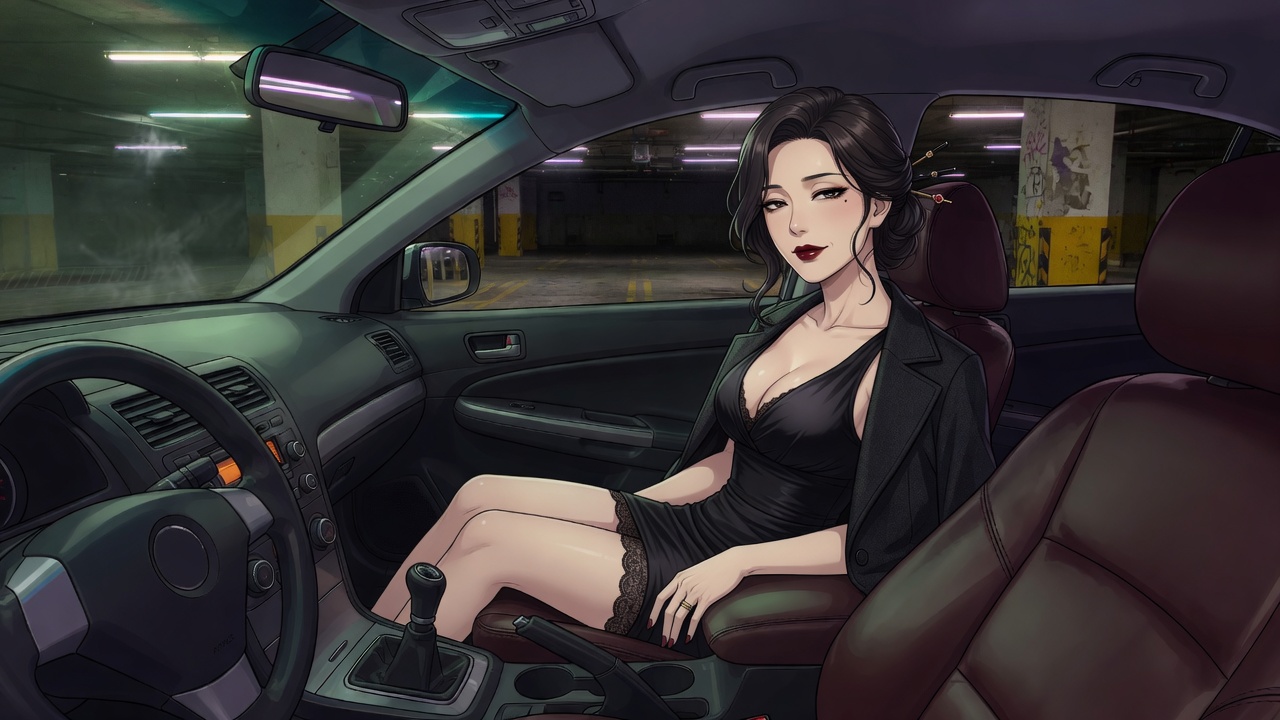
Level B2
After the company dinner, parking level B2. A married woman from another floor sits in the passenger seat. “I can’t get a substitute driver…” Start the engine here and it’s only a ride home.
Every story is completely free to read. No paywall, no account.