Review 4 min read 19+
Last Ink Review: A Consult That Outlasts the Neon
The OPEN sign is the last ambitious thing on the block. The rain quit an hour ago and the pavement is still telling on it, every storefront doubled and smeared in the wet. One floor of the walk-up holds its light like a held breath, and Last Ink keeps that breath for the length of a consult, a deadbolt, and one long look at a line.
The setup
It's Thursday in Brooklyn, and you are the name at the bottom of the day's list — the last walk-in, kept out of something like stubbornness. A text taped at the door warns that the booked stencil already went home on somebody's shoulder. The shop sits up three flights, and the stairwell announces it before the door does: green soap, stencil paper, the faint mineral ghost of ink. Only one floor is still lit.
Outside, the sign is black and gold, serious as a notarized promise. The OPEN neon buzzes on out of habit. Flash sheets shingle the glass — sailors, serpents, roses doing their best against a wet street. And through that glass: someone wiping down the red vinyl chair, platinum wolf cut bent to the work, ice-blue eyes catching the neon exactly once, like a struck match.
The bell over the door rings short. The hook by the register holds no hoodie. Maya, the apprentice, clocked out an hour ago. “Walk-in?” Flash is on the left wall. “Tonight it's only me.”
The cast and the chemistry
Luna is twenty-seven, unmarried, and owns every inch of that room the way only someone alone in their workspace can. You're the narrator — the walk-in, the civilian, the person who climbed the stairs on a damp Thursday because the night refused to end quietly. The script is generous with her; the POV is generous with you.
What makes the chemistry work is that it starts as something entirely legitimate: a consult. Her fingers on your forearm, testing the give of the skin. The phrase hold still, delivered without apology. A pen tracing a line that has nothing to do with the drawing. Professional touch is a loophole, and the game walks through it and quietly locks it behind itself.
Maya matters by being gone. The empty hook, the stool pushed in, the short ring of the bell — her absence converts a storefront into a sealed room, and the script knows exactly what it's done. Nothing has to be said twice.
That ellipsis does a career's worth of work. Leave it and everyone goes home respectable. Last Ink is built entirely around that hinge, and it makes you turn it yourself.
How hot does it get
Call it a slow smolder behind a glass wall. The stranger-in-a-public-place setup promises risk the script never cashes crudely: yes, there's a window, yes, there's a street, but the neon is dying and the block has already surrendered. The heat lives in props and proximity — the chair that still holds her shape, antiseptic turning intimate, a tattoo machine that sits silent all night like a dare nobody picks up.
For the ceiling check we owe you at VNights: nothing here is graphic. No anatomy as inventory, no acts as choreography. The camera cuts from the deadbolt to the light to the chair, and then to aftermath — air with a different weight in it, and neither of you apologizing. The fade is generous precisely because everything before it was specific. You don't miss what isn't shown; you're too busy remembering the snap of a glove.
Who it's for
This is a single-evening game about a single encounter, and it never pretends otherwise. If your shelf skews toward branching epics, the tight scope will read as a limit. If you like romance pressurized — strangers, late hours, one room, one decision — it will read as a promise kept.
POV players get the best of it. The second-person writing keeps your hands in frame, and the game trusts you to notice the neon dimming a shade, the street giving up its last taxi. Anyone who loved our piece on another closing-time story, a pool after hours will recognize the grammar — public space going private by degrees — and probably already has a coat on. For browsers of encounter VNs at large, this sits near the top of the late-night pile: atmosphere first, tension second, everything else a distant third.
The verdict
Last Ink earns its title twice — once for the shop, once for the mark the night leaves. It's short, controlled, and confidently suggestive, and this late-night tattoo parlor VN understands restraint as a form of escalation. Luna is a presence, not a prize. The walk-in is a participant, not a camera. The deadbolt scene is forty of the best seconds of quiet tension the genre has produced this year.
Quibbles are small. Maya deserved one scene, even a voicemail. The street outside is emptied a little too conveniently for the plot. Neither flaw touches the core experience.
Take the stairs. Order the consult. Let her study the line as long as she likes. Whether the deadbolt goes is between you, Luna, and the wet glass — but the game will absolutely hold the door while you decide.
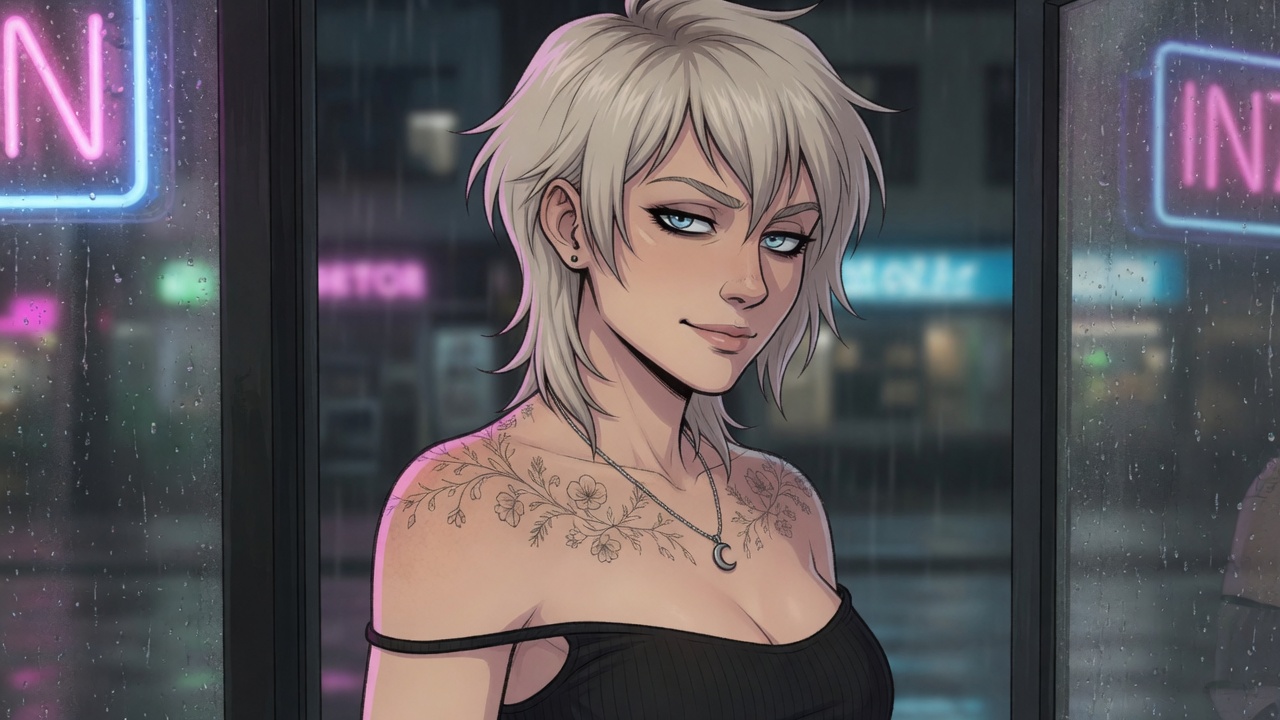
Last Ink
A Brooklyn tattoo shop. The neon is dying and the artist still won't leave the chair. “If I lock the door… I’ll just look at the line.” Take the stairs and tonight is only a consult.
Every story is completely free to read. No paywall, no account.