Short story 5 min read 19+
Last Ink
Last Ink
The text came in at 11:52, four minutes before I grew a spine:
stencil done. shop's open till midnight if you still want to look at flash. — L
I still wanted to look at flash. That was the story I was going with.
Thursday in Brooklyn, last walk-in of the night — my name in my own handwriting on the sheet by the register, which is how brave people do things. Rain earlier; the street was wet enough to double every sign on the block. The walk-up stairwell smelled like green soap and stencil paper the whole way up, the building exhaling the day's work through one narrow well.
Every floor was dark except hers.
Third landing. A black-and-gold sign, hand-lettered, sure of itself. Above it the OPEN neon still buzzing but dying — the O flickering like it was considering quitting, the rest of the word humming on out of loyalty. Flash sheets clung to the glass: swallows, moths, a fine-line snake, all of it lit from inside by a shop that should have been empty an hour ago.
Through the glass, someone was wiping down a red vinyl chair.
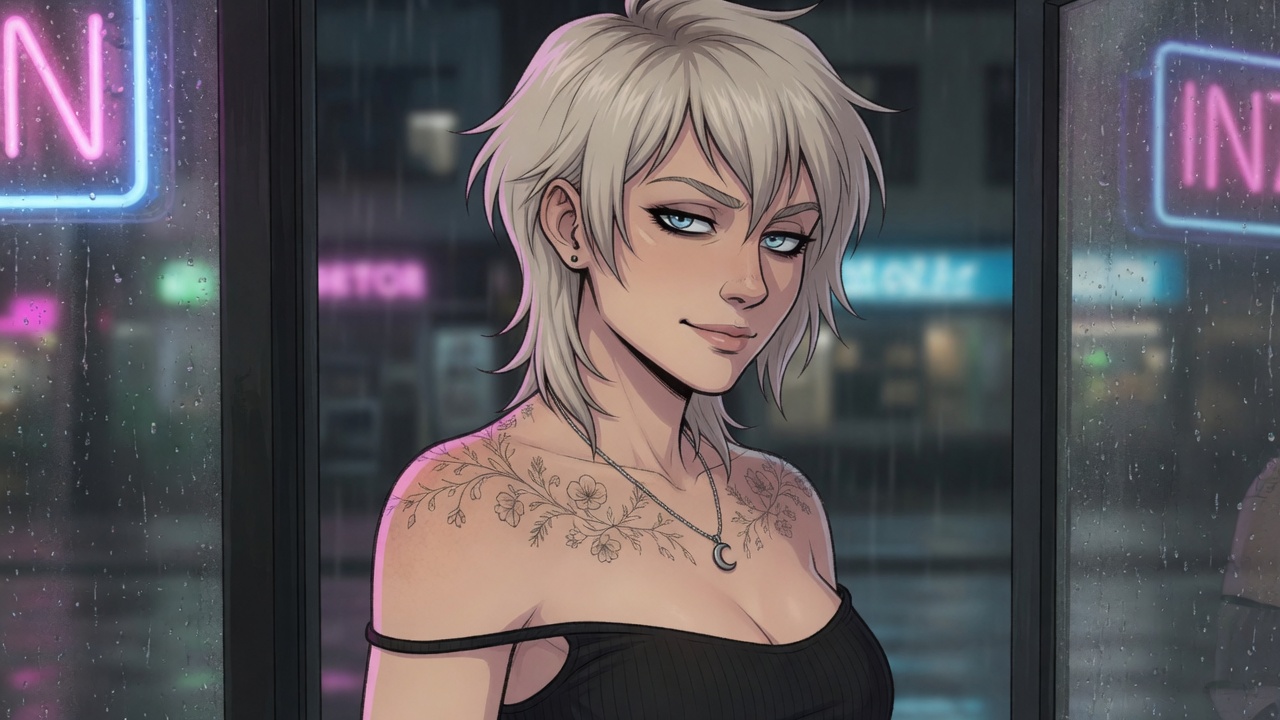
Platinum-blonde wolf cut, tucked behind one ear on the working side. Black nitrile gloves, cloth in hand, slow circles over the vinyl like it was the last thing in the world worth taking care of. The neon caught her eyes exactly once — ice blue, unimpressed, noticing me before I had decided to be noticed.
I went in. The bell over the door rang short, one flat note, like even it was tired.
No hoodie on the hook. No second cup going cold by the sink, none of the apprentice's clutter on the counter. Maya had clocked out and taken the ordinary version of this evening with her.
“Walk-in,” Luna said. Not a question. She tipped her chin at the left wall. “Flash is all walk-ins. Custom, Maya can book you Thursday—”
“Maya left.”
“Yeah.” A beat. She peeled one glove off with her teeth, and I want it on record that I survived that with dignity. “So tonight it's only me.”
Her name was on the license taped to the register and nowhere else. I knew the rest from the internet, which I'd checked on the stairs like a coward with a plan: twenty-seven, this shop, that waitlist. Unmarried, said the bare finger holding the cloth. The room smelled of green soap and ink and a ghost of citrus, and under all of it, warm skin — the day had been long, and the walls keep everything.
She settled into the red chair the way other people settle into thrones, one arm over the back, and studied my forearm where the moth was supposed to go. Two fingers closed around my wrist and turned it toward the light. Professional. Clinical. The drag of her thumb across the inside of my wrist was neither.
“Here?” she said.
“That's the idea.”
“Mm.” She let go and reached for the stencil, and I learned how fast a person can miss being held by the wrist. “If I do it tonight, it's after hours. Off the books. Maya keeps the books.”
“It's not midnight yet.”
“Almost.” She came back and held the stencil above my arm without touching it — a paper ghost a centimeter off the skin, reading the line against the tendon, the curve, the way a line wants to live on a body. Close enough to feel the warmth coming off her hands and not the hands themselves. The neon buzzed. The O finally gave up. Somewhere below, a car hissed through the wet street, going home.
Then she said it, mildly, like a warning label, like a menu item, like anything but what it was:
There is a version of tonight where I said another time, took the stairs two at a time, and went home with a consult, a card, and a very respectable evening. That version of me was already on the landing, coat half on, being so reasonable about it.
The deadbolt was within reach of her hand. She didn't look at it. She looked at me and waited, patient as a needle, and let the choice sit between us like fresh ink — nothing to do but decide whether it goes in.
Continue this scene in Last Ink →
I won't narrate the bolt going home. I'll say the shop stopped being a storefront somewhere between the second deadbolt and the first time she laughed at something I said — a low, surprised sound, a machine she didn't know she had — and that after that, the night went where good nights go: into the dark, at the speed of trust.
Here's the honest version of what the game gives you. Take the stairs, and tonight stays a consult: the moth remains a paper ghost, Maya books you for Thursday, and you ride home reconstructing the weight of two fingers on your wrist like a man reading tea leaves. Throw the deadbolt, and the scene keeps every degree of heat and discloses none of the anatomy — fade to black with the neon finally dark, and the next thing on the page is her voice in the back room asking whether the line healed the way you wanted.
Luna is written as a grown woman who knows exactly what she's offering and never once begs you to take it. That's the whole engine of Last Ink: mutual want, stated in ledger-flat sentences, with a locked door for a signature. Nothing is taken in that shop that isn't given first.
What sticks with me, weeks on, is the pacing. The game spends its first half on nothing — a chair being wiped, one dying letter of neon, a text message — and earns everything afterward from that stillness. When the door finally locks, it reads as a sentence completed rather than a switch flipped, which is rarer than it should be, in games or in Brooklyn.
The sound does half the seduction, too: the bell, the buzz, the wet street, vinyl complaining under a hand. It's a shop at midnight, rendered well enough that you can smell the green soap from the title screen.
I left with the moth, done after hours, off the books — a fine-line thing on the inside of my forearm that I now check in mirrors like a man checking a pulse. The rain had stopped. The street doubled every sign on the block, and mine was the only one still lit from inside, going out behind me.
If you want to know precisely how a consult stops being a consult — how a shop with a dying OPEN sign stops being open and starts being somewhere else entirely — the whole night is one flight up, still buzzing.
Last Ink
A Brooklyn tattoo shop. The neon is dying and the artist still won't leave the chair. “If I lock the door… I’ll just look at the line.” Take the stairs and tonight is only a consult.
Every story is completely free to read. No paywall, no account.