If you loved 3 min read 19+
7 Visual Novels Like The Booth: Office Affair & After-Hours VNs
Every teardown sounds the same from the back wall: floor mics dying one by one, house lights dropping a stop like a room exhaling, somebody coiling cable in the dark. What a teardown never sounds like is lit. Tonight three interpreter booths run along the conference hall's back wall, two of them already black glass, and only booth A is still white — which is where The Booth keeps its light on. Inside: Seorin, twenty-nine, a married simultaneous interpreter, underlining a note on a pad while her badge swings loose against her chest. The headphone cushions still look warm. I know this because I keep looking at them instead of the XLRs on the floor, which are mine, which are my job.
The checklist is short and I've done it a hundred times: pack the consoles, coil what's mine, kill the last feed, go home. Her husband is at a client dinner — that detail arrived hours ago the way small facts do, folded into small talk between sessions, and it has been sitting in my head ever since like an unmuted channel. Through the glass she notes that the corridor lights are out, flat, like a weather report. There are two readings of that sentence. Latch the booth from the inside, though, and the soundproofing grows one layer thicker. I'm a technician; I know exactly how many decibels one more layer buys, and I know some signals are sent hoping for gain.
“After Hours” — the button at knee height
Friday, ten at night, an elevator bank that should be empty and isn't quite. In After Hours, a married team lead catches the closing doors with one hand and remarks, lightly, that nobody's home at her place tonight either. Press 1 and you're both just tired, both just overtime, both just colleagues with a shared calendar. The button sits at knee height. Neither of you reaches.
“Deal Close” — a key as punctuation
A Midtown penthouse, a deal signed hours ago, a kitchen island with a house key set down on it like a period. In Deal Close, a married VP narrates her husband's morning absence to nobody in particular, and the elevator waits, punctual as a court order. Leave and the night is paperwork — filed, stamped, archived. Nobody drafts the alternative out loud. Nobody has to.
“Radar” — frequency change
After the last departure, a small-airport tower cab goes quiet enough to hear yourself decide things. In Radar, Yunseul will not put the strip bay down and informs the empty room that she has changed frequency — to whom, on which band, is the entire question. The spiral stairs down are official tower closedown. Up here, static has never once meant empty.
“Last Track” — booth discipline
Booths, apparently, are my genre. In Last Track, after a museum empties, a married voice actress records the final Korean docent narration with the exhibition tablet glowing in her hand, refusing to mark the session complete — one more plaque, one more pass, only the gallery voice is left. The storage door opens onto a loading dock and an ordinary closedown. Voice professionals have the strictest booth discipline of anyone. This story exists to test that sentence.
“Watch the Drop” — the fall is the trick
A late-night private rental turns an aerial studio into a theater with an audience of one. In Watch the Drop, Hyewon stays knotted into the silk above the mats and asks whether you're watching, because the drop, she explains, is the entire trick — the fall is the part you rehearse for. The door code works from both sides. The rigging always holds. That has never once been the scary part.
“One More Play” — the manager's exception
Basements keep the best hours, and crane machines keep the best secrets. After the weekday closing announcement, the crane corner in One More Play is still lit, and manager Gaeun — author of the closing announcement — decides the night gets one more play, joystick still in her fist, claw swaying over a prize neither of you can name. Slip out past the coin changer and it's just closed. She counts the coins every night. Tonight she isn't counting.
All of the above, booth included, belongs to the office romance visual novel wing of the catalog — the after-desk shelf, where buildings empty and plots arrive. For the cleanest of them, read our Deal Close feature, and take the elevator down at your own speed.
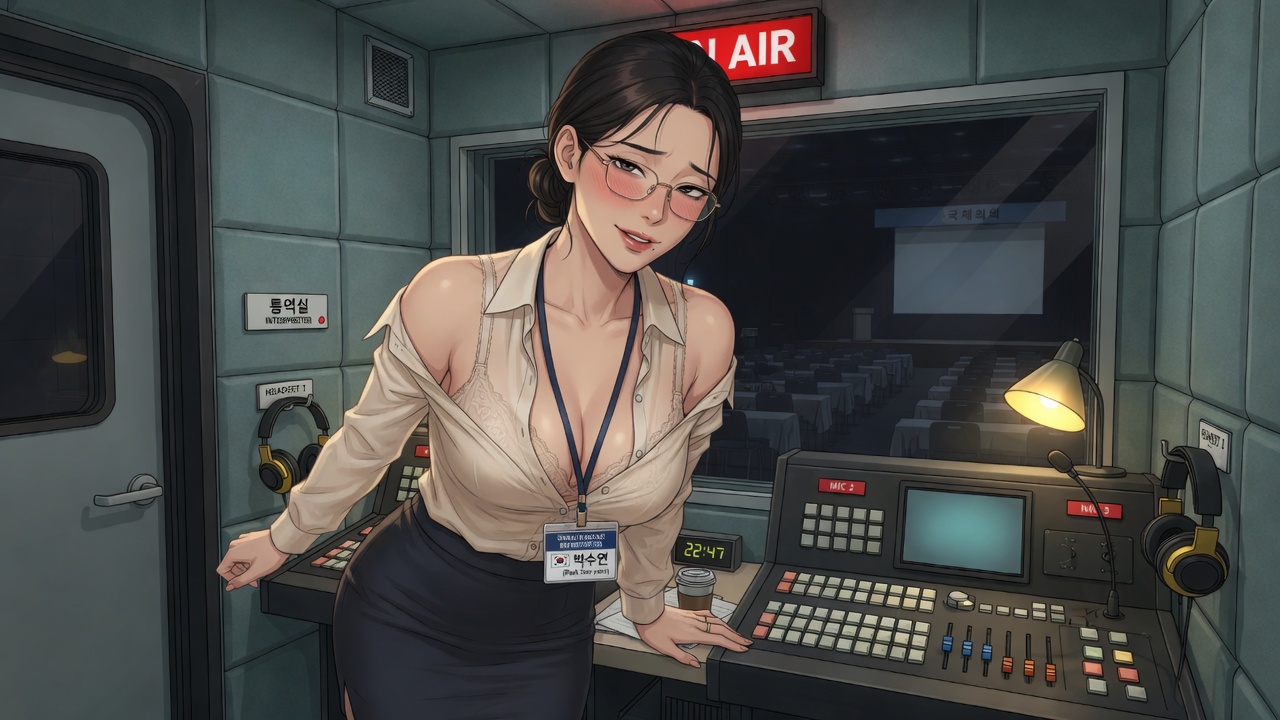
The Booth
International conference. The last session is over. The booth A interpreter will not take off her headphones. “The corridor lights are out.” Pack only the consoles and the night is just teardown.
Every story is completely free to read. No paywall, no account.