Short story 4 min read 19+
Radar — after the last departure
The last departure clears the frequency at 23:47, and the airport begins switching itself off. Runway edge lights go down in sections, a slow tide of white pulling back across the field until the only thing burning for kilometers is the tower.
I should sign the close-out, kill the cab, and take the spiral stairs down. That is the job. The entire job.
Instead, I am watching Yunseul not put the strip bay down.
What the scope shows at midnight
From the ground floor it looked like any other close. Steel door, the night-shift logbook still open on the counter, spiral stairs waiting for a palm. The rail is cold even in July, and from the top of the tight curl of them, cooling-fan noise leaks down along with the smell of coffee that gave up an hour ago. You climb into it: fan-hum that never stops, and above, strip-bay lights blinking at a field they have stopped serving.
The apron is empty now except for the ghost of the last feeder's exhaust, hanging over the asphalt and thinning by the minute. One car left in the lot under the tower. Hers.
Inside the cab, Yunseul stands half-turned from the scope, headset on, re-sorting a strip bay full of strips for flights that no longer exist. Thirty-two, night assistant, a neat bob that has stopped pretending it is early. The headset has pressed a red line across her temple, and her navy shirt is open one button past regulation — the small mutiny of hour eleven. Her husband flies the same kind of feeder out of a bigger field two hundred kilometers east. She mentions him the way you mention weather on another continent. Accurate. Far away. Nothing to be done.
“Close-out's signed,” I say. “Bay's next. Then home.”
She slides one last strip into its slot. Square. Precise.
“I changed frequency.”
In this room that sentence comes with a procedure. A handoff. Change frequency, good day. An aircraft leaves your airspace and becomes someone else's sound. Except she is not handing off an aircraft. She is telling me which frequency she has been tuned to tonight, at 23:52, in a cab above a dying field — and who is receiving.
The spiral, and what waits at the bottom
The stairs are still open. That is the entire problem with the stairs.
Take them now — palm to the cold rail, burnt coffee thinning behind me — and the night stays what it is supposed to be. Logbook closed. Tower closed. One car pulling out of an empty lot with nothing to wipe off the glass.
She takes the headset off and sets it on the strip bay, careful as an instrument. Nothing else about her is careful. There is a mark on her cheek where the earcup sat for nine hours; she does not know it is there, and telling her would mean getting close, and we both understand I am not planning to say anything.
The scope draws its circle over a field with no one left to watch. The fans hum on. Below us the runway finishes going out, section by section, until the brightest thing for kilometers is this room at the top of the dark.
She looks at me across the bay — strips for dead flights stacked between us — and her voice drops to the register she would use for a plane in trouble.
“Read it back to me,” she says.
Continue this scene in Radar →
After the sweep
What I read back is not the close-out.
Her hand finds mine on the edge of the strip bay and closes over it, warm from the headset, steady the way her voice is on a bad-weather approach. The bay rolls shut on a shift with nothing left to land. The scope keeps drawing its patient circle, and the cab narrows to fan-hum and static and the red line the headset left on her cheek — which I finally get close enough to examine properly, and then closer, and then the log stops meaning anything at all.
Much later, the coffee burner clicks itself off, having outlasted both of us. Gray light comes up along the runway thresholds. The first feeder of the day checks in on frequency, crisp and professional, and it is not her husband's voice, and neither of us says a word about how obvious the relief is.
Two signatures go into the night log, neat and boring. Between those lines there is nothing written, and nothing that needs to be. In the lot there is only her car and the shape the night has left on both of us; she drives, and I watch the tower shrink in the mirror until it is just another light going out — the last one, on purpose this time.
Some nights you cannot hand off. You keep them low on the frequency, under the static — and years later, a headset mark on a stranger in a crowd can still turn your whole evening into a tower cab.
If yours have ever ended one runway light at a time, step up into the cab and hear how quietly this one went out.
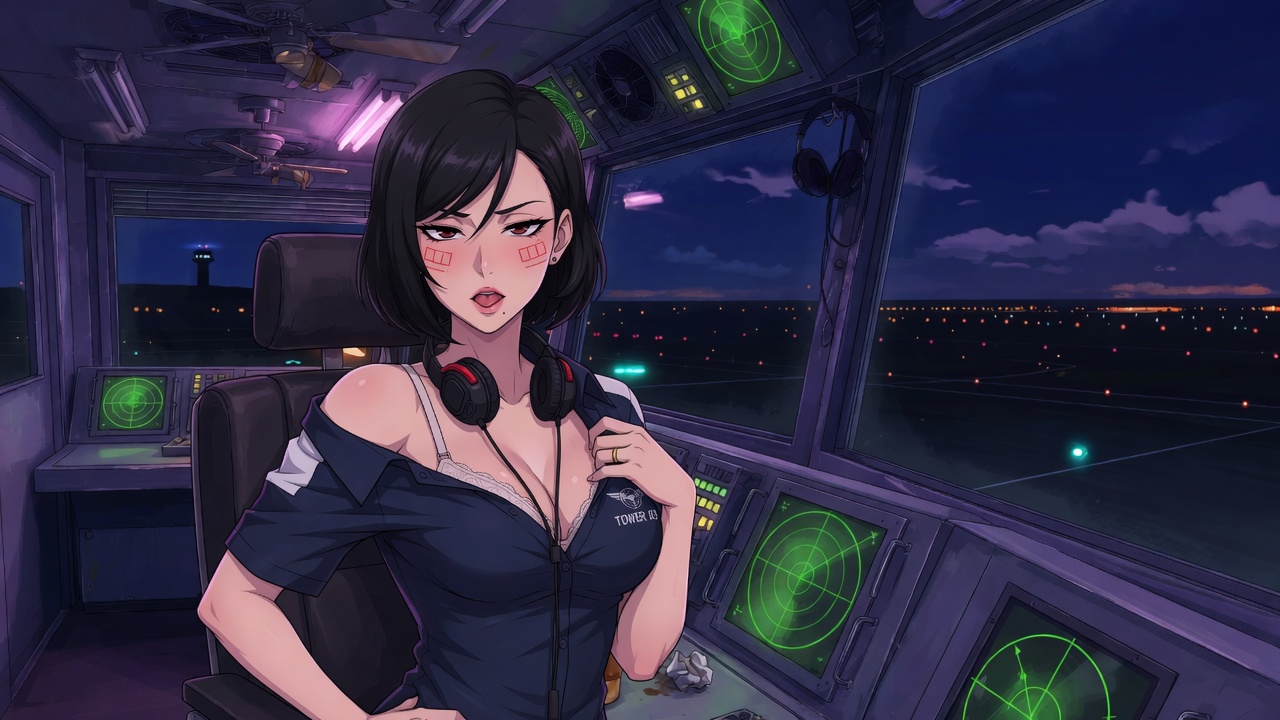
Radar
After the last departure. A small-airport tower cab. Yunseul will not put the strip bay down. “I changed frequency.” Take the spiral stairs here and it is just tower closed.
Every story is completely free to read. No paywall, no account.