Review 3 min read 19+
Radar Review: A Tower Cab After the Last Departure
"I changed frequency." Three words, said without looking up from the strip bay, and the night stops being a shift and becomes a channel — open, live, both ends listening.
First impressions
The last departure is over before Radar lets you settle. You watch the runway lights at the small airport go out one by one, like a city being folded shut for the season. One car remains in the lot under the tower — Yunseul's. The apron is empty except for the last feeder's exhaust, lingering on the asphalt like something the night forgot to claim, and at the top of the structure the strip-bay lights blink on, patient as a pulse. The opening minutes of Radar are all subtraction: aircraft gone, staff gone, daylight gone. What remains is the tower, still bright, and you, still climbing.
The climb matters. The steel door on the first floor opens onto a night-shift logbook nobody closed, and above it the spiral stairs wait for a palm. The rail is cold; the turns are tight. Cooling-fan noise leaks down the stairwell tangled with burnt coffee, and by the time you reach the cab you already understand the game's sensory argument. This is a room built to keep two things awake — the airport's machinery, and whoever is inside it.
What makes it work
Yunseul, thirty-two, is the tower: a neat bob with headset marks pressed into it like the day's signature, navy shirt buttons done up with a precision the night has started, very slowly, to test. She is a tower controller, the night assistant, and she will not put the strip bay down. That object — a bay of the shift's paperwork, technically finished — is the best prop in the script. Holding onto it is her way of saying the shift is not the only thing still open tonight.
Her line — "I changed frequency" — is the best sentence in the game precisely because it is a true radio phrase before it is anything else. Controllers hand off traffic; people hand off themselves. The writing never winks. It simply lets the vocabulary of the job carry a second meaning that nobody in the room is disciplined enough to say out loud, and both of them know it.
Her husband is a feeder pilot on another frequency, present the way radio presence is: structured, audible, unfleshed. He is never a villain, which keeps the tension honest. What remains is a choice framed with real care. Take the spiral stairs now and the work is done, the logbook closes clean, the night is just tower closed. The scope draws its circle, the fans never stop, and the game lets the room's rhythm do the seducing.
Where it bites
The bite is patience. Radar is slow on purpose, and its slow passages are procedural — strip bays, handoffs, the whole ceremony of closing a tower for the night. If you need plot velocity, the middle hour will test you. The other bite is the staircase. The game never lets you forget the way down is right there, that leaving is one palm on one rail away, and it makes you feel every step you do not take. That is where the tension actually lives: not in what happens, but in how long nothing is allowed to.
Heat level
High voltage, low explicitness — and deliberately so. Nothing here turns graphic; the game works entirely in suggestion, glances, and the grammar of closed doors, then fades to black exactly where it should. The heat is thermal instead: burnt coffee, warm fans, the hush of a cab sealed against the dark. When the moment finally lands, it is quieter than the cooling fans and heavier than the scope's slow, full circle.
Should you play it
If late nights are your genre, yes — no holding pattern required. Radar is one of the sharpest office-set vignettes on the site this year: small, controlled, confident enough to let a strip bay carry the subtext. Walk up and take the tower cab after last departure yourself, and see how long you last before you stop calling it overtime. And if the after-hours mood still has you when the scope goes dark, step into our after-midnight arcade story — same hour of the night, different machines — or browse further down the office shelf until morning.
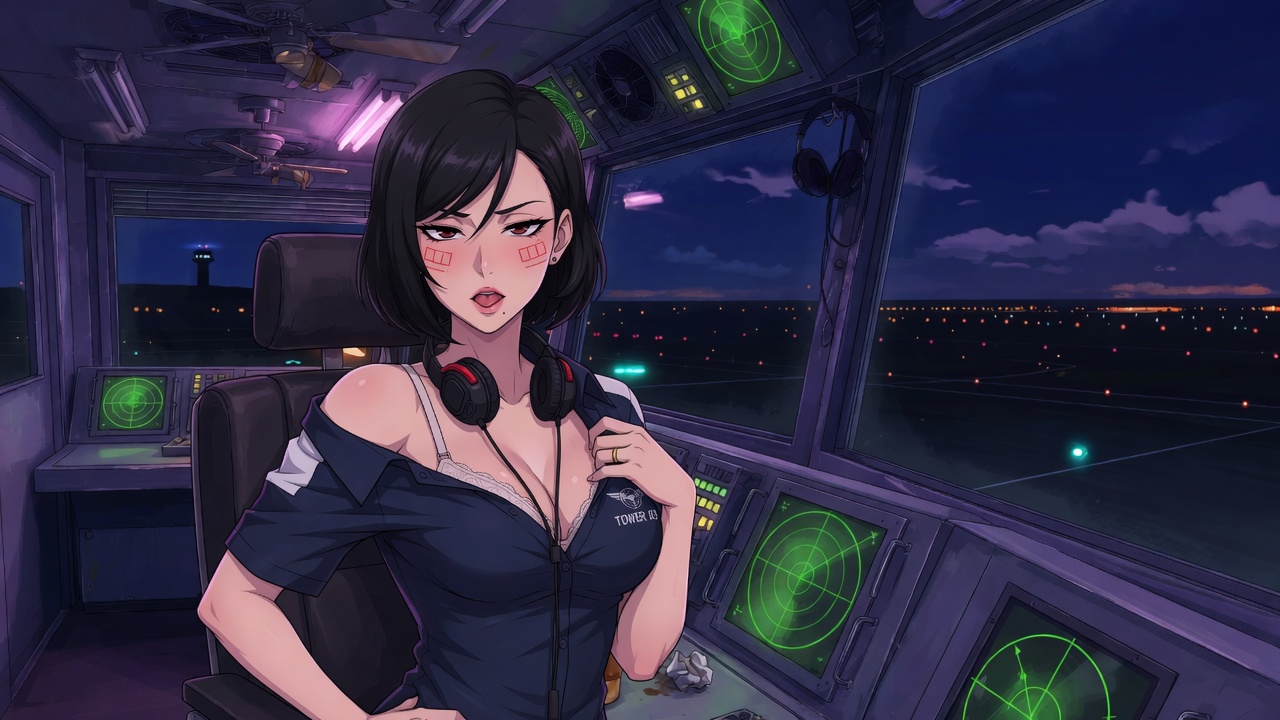
Radar
After the last departure. A small-airport tower cab. Yunseul will not put the strip bay down. “I changed frequency.” Take the spiral stairs here and it is just tower closed.
Every story is completely free to read. No paywall, no account.