Short story 5 min read 19+
The Light in Booth A: Late Night with a Married Interpreter
The Last White Light
The last session ended the way they all end: one floor mic at a time. The chairman's went first, then the delegations, a polite row of little red lights dying left to right like a parade being told to keep it down. House lights dropped a stop. The whole hall exhaled into that blue-gray half-dark buildings do when they think nobody's watching.
Three interpreter booths sat along the back wall. B had gone dark at nine. C went at ten, its occupant leaving the way interpreters leave — silently, and slightly faster than is polite. That left booth A still burning white, bright as a refrigerator left open in an empty kitchen.
My job was simple: pack the consoles, rack the cases, don't break anything with a serial number. The XLRs could lie on the floor a while yet. That part was mine, and I was in no hurry to claim it.
I'd like to tell you I didn't notice her. I'm going to be honest instead, because nobody audits a tech's conscience at midnight, and because you'd see through it anyway.
Through the glass she underlined something in her notes, and the motion set her badge swinging on its lanyard, a small white pendulum. INTERPRETER. BOOTH A. The photo looked ten years younger than the face above it, and the face looked twenty-nine — the age where a face starts telling you what it will look like forever, and I wanted the long forecast. A thin gold band sat on her ring finger. I clocked it the way you clock a fire exit: immediately, and with a shameful little flare of relief that I had noticed at all.
The headphone cushions on her console still looked warm. You can tell. Fresh foam has a matte innocence. Cushions worn for eight hours have a give to them, a lived-in softness. It's my job to know things like that. It is not my job to know about hers.
I knew the sound of a booth door latched from the inside better than my own front door — the flat click of done, of everyone gone home. Nobody latches a booth for teardown. So I only knocked, or performed a knock; soundproofing that thick takes your knuckles' whole story and keeps it. The sound stayed in my palm like a coin.
She slid the glass panel aside a hand's width.
“Oh — teardown? Channel A. I only left the monitor on.”
Her voice was the voice of a woman caught keeping a secret that turned out, on inspection, to be a lamp. I said something technical. She nodded as if it were interesting. I gathered headset cable and pretended my hands hadn't rehearsed.
When I reached for the cable at her elbow she slid her water bottle toward me instead, a small deliberate gesture, like a bartender cutting someone off. There was conference ink on her thumbnail, the smudge that comes off delegate badges and never quite comes off skin.
“The last session ran long,” she said, after a sip. “My mouth is dry.”
“The corridor lights are out,” I offered, by way of explaining the dark. Or excusing it.
“I know. That's why I could still think in here.”
I had thrown that breaker myself at eleven and thought nothing of it. Now it felt like an accomplice.
Her phone buzzed once against the console, face-down. She didn't turn it over.
“Client dinner,” she said, watching my face while she said it — which I noticed, because I was noticing everything, which is the problem with me. “They toast a lot. It runs long.”
Somewhere across the city a man was raising a glass to partnership. I'm not proud of how little that slowed me down. Her monitor threw its white light up between us. On her notes the underlines had underlines, and below the last one, in handwriting that had lost its diplomatic posture, sat one word in her own language.
I reached past her to unclip the headset cable and made the mistake of not rushing it. She didn't move away. The badge had gone still.
“Latch the door,” she said, quietly, like a note passed in class. “From the inside. Then the silence gets one wall thicker. I like it thick.”
Continue this scene in The Booth →
One Layer Thicker
The bolt went home with the sound of a decision. The hall noise didn't drop so much as vanish mid-syllable, like tape cut with scissors. What was left was the monitor's hum, the ventilation, and two people breathing at slightly different speeds, each pretending to be the calm one. Somewhere far below, a floor buffer started and stopped, gagged.
She took the headphones off herself and set them on her notes, cup-down, the way you silence a thing. Without the monitor light her face was all shadow and outline. In the dark she looked like a different tense of the same woman — future, maybe.
“You kept looking at the cushions,” she said.
“I look at everything. Occupational hazard.”
“Mm,” she said. “Me too.”
She kissed me first, which I will be grateful for on my deathbed, because it meant I never had to decide to be that kind of man. She just decided I already was. Her hand found my collar; the ink on her thumb smudged off onto my jaw, and I thought, absurdly, that I'd wear it out of the building on purpose.
I am a careful man with equipment. I took my time anyway. Thin straps, a small caught breath, the give of warm fabric, and then the weight and heat of her filling my hands like something I'd been carrying all night without knowing it. She stopped breathing. Then she let it out against my neck, slow, the way you lower something heavy down a stairwell without a sound.
“The light,” she said, against my ear.
She reached past my shoulder, and booth A went dark for the first time all night.
In the black: her laugh, one note, quickly dealt with. Her hand finding mine and moving it where she wanted it — which was answer enough to every question I'd been afraid to ask, and a few I hadn't thought of yet.
“Leave the XLRs,” she whispered. “They'll keep till morning.”
For the first time in nine years, I left cable on the floor.
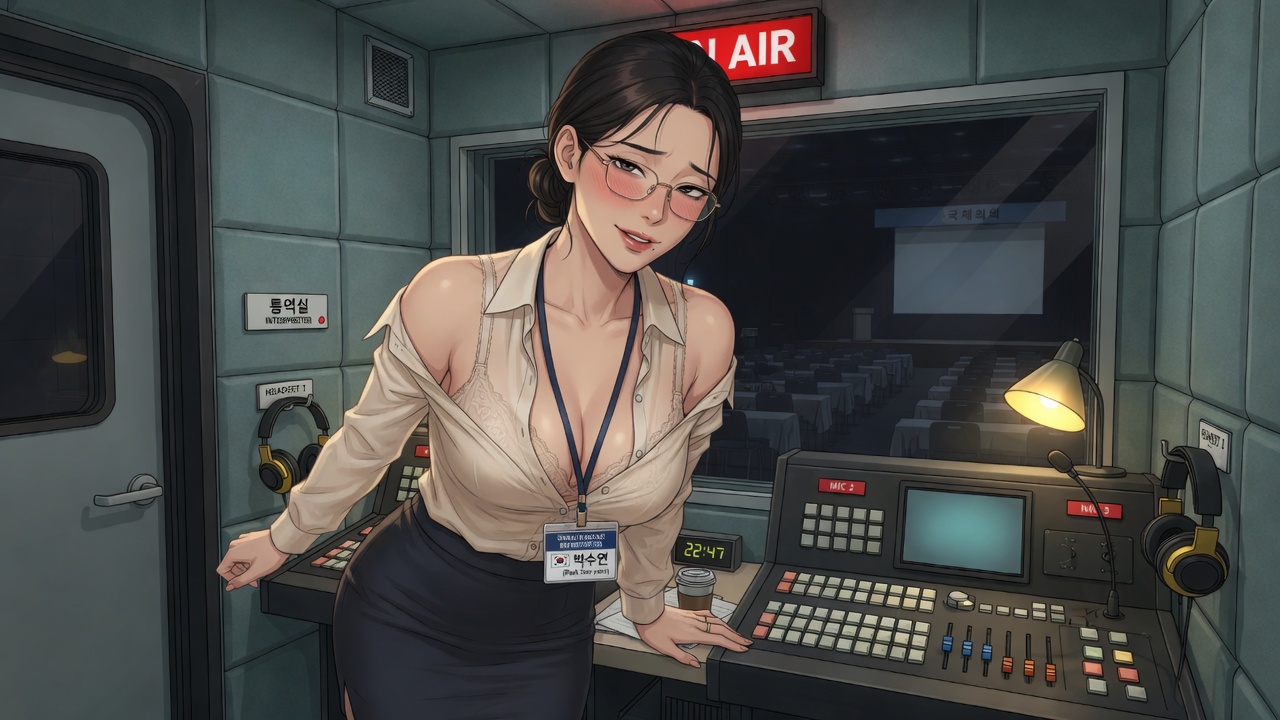
The Booth
International conference. The last session is over. The booth A interpreter will not take off her headphones. “The corridor lights are out.” Pack only the consoles and the night is just teardown.
Every story is completely free to read. No paywall, no account.