Short story 4 min read 19+
Last Toast — An Affair Visual Novel
The Chair Nobody Saves
The speeches end the way good ones do — a laugh held a beat too long, a raised glass, applause that loosens something in the room. Inside the reception tent the string lights sway on their wire like a slow tide, and the band slides out of the toast into something with more hip in it, an invitation dressed up as a song.
You're a groomsman. Your champagne has gone flat in your hand. At the head table the groom is filming the bouquet — the actual bouquet, lilies and eucalyptus propped against a wine barrel — and half the tent has its phones up, archiving a Saturday in Sonoma that nobody will ever rewatch.
Not just-left empty, either. The sage silk that was draped over its back an hour ago is gone. Her place card leans against a dessert nobody's touching, while the whole room celebrates flowers.
You notice. That's your first decision of the night, whether you meant it or not.
Sage Silk, Cold Shoulders
Bridget stands just past the tent's edge, where the floodlights quit and the vineyard begins.
Twenty-seven, and nothing about her face lets you forget it — a grown woman's face, clear-eyed and amused at the corners. Strawberry-blonde waves pinned half-up, the rest loose enough to argue with the wind. Hazel eyes that have spent six hours on the clock: toasts, smiles, the choreography of her best friend's happiest day. The shift is over. What's left underneath is quieter, and more awake.
Her nude heels hang from one hand; she's barefoot on wet grass she never planned to touch. The other hand is closed around something small enough to hide. When the night breeze comes off the vines, the slit of her dress opens along her thigh, and the freckles across her bare shoulders stand out, cold-pinned. She doesn't flinch.
Inside, the music jumps a level. Somebody whoops. The tent glows at her back like a lantern you could still walk into.
You cross the damp grass toward her. Every step is a decision you keep remaking.
“The Extra Champagne”
“You're the only one in there not filming anything,” she says.
Her voice still has Boston in it, softened by wine and a very long day. She turns her closed hand over and opens it: a small brass key on a white ribbon.
“Barn's got a loft,” she says. “The extra champagne got stashed up there. Somebody with sense hid it from the dancing.”
“Somebody,” you say, “with a key.”
The look she gives you is the first honest thing all day — one eyebrow, half a smile, hazel eyes finally doing their actual work.
“Ask me nothing,” she says. “My husband still thinks the bouquet is the most interesting thing at this wedding. Gotta hand it to him — for a few more minutes, maybe it is.”
She nods past the tents, to where the barn sits black against the hills, one loft window holding a weak gold light. “Stairs are in the back. You'll hear the party the whole way up.”
Continue this scene in Last Toast →
Two Ways the Song Ends
The tent offers you a version of tonight with no risk in it. Stay for the next song, then the one after. Lift whatever glass finds you. When the band quits, you'll have attended a beautiful wedding, the maid of honor will be a woman you spoke to once by the tent pole, and a toast will be the last thing anyone proposes. The night stays a toast. That's a fine ending. Endings mostly are.
The key offers the other version. Old stairs at the back of the barn, boards under her bare feet and your dress shoes. Cold bottles, warm dark, a view where the vineyard lights stay below you — rows folding into hills, the party reduced to a small lit room among all that black.
The game doesn't push. That's what's good about it. It hands you the wind, the ribbon, the band muffling through canvas, and lets you stand there being the one who chooses. Bridget chose before she ever showed you the brass — you can tell by how still she's holding, by the way she watches you do the math instead of doing it for you. Mutual, adult, wide awake. Whatever happens next is something two people walk into on purpose.
And if you climb — the heels go down by the stairs like a period at the end of the reception, and the rest belongs to the game. Some doors you write around, not through. What the scene gives you instead is texture: the bow of the ribbon when she tied it, a laugh she puts a hand over, the particular quiet of two people agreeing without a word.
Why It Sticks
Last Toast understands something about affair stories most don't bother to learn: the transgression is the smallest part. The tension lives in the almost — a key in a closed hand, a husband's camera lens glinting across the tent, a woman cold enough to shiver who won't, the narrow gap between a toast and a confession.
The prose keeps its hands where the scene keeps its lights: suggestive, low, more taut than bare. When the story finally slips past the frame, it happens the way nights actually do — between one line and the next — and leaves you holding the ending you picked.
The toast, or the stairs. Flat champagne in a glowing tent, or the extra bottle nobody was supposed to find, poured in the dark above the vines.
She's waiting on the grass with her shoes off.
The wind is moving the lights.
Go be the one who decides.
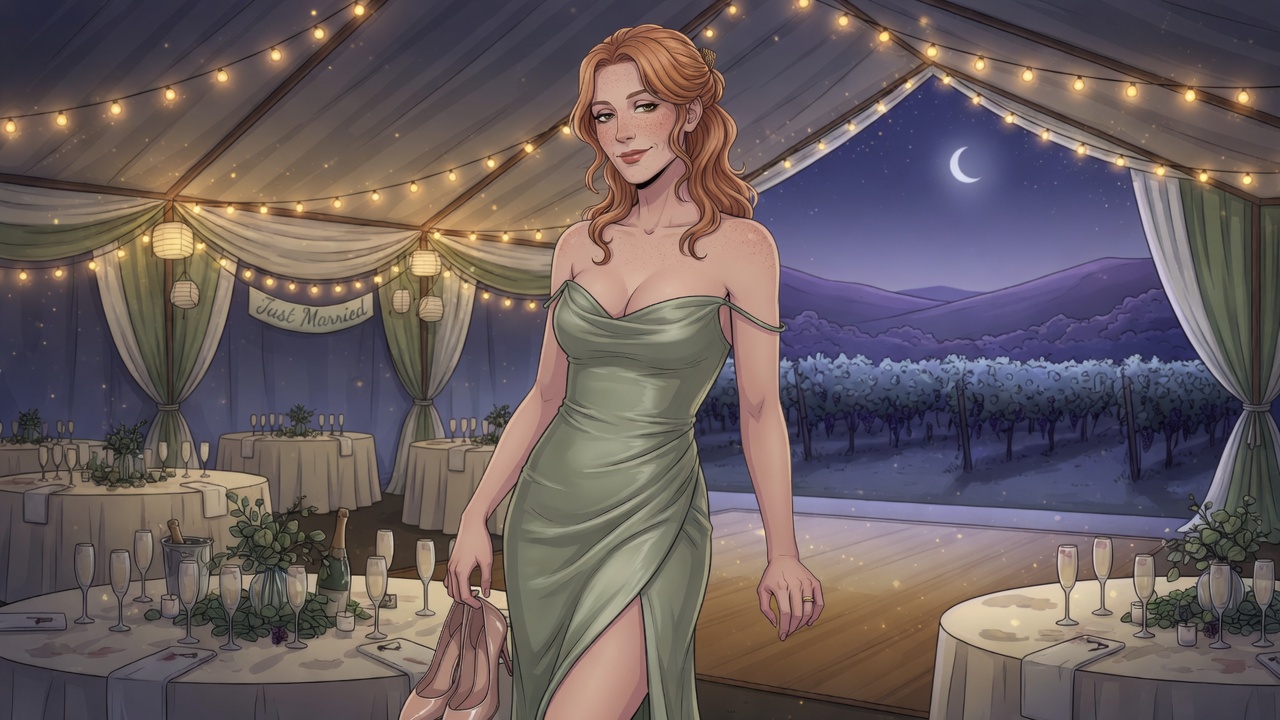
Last Toast
A Sonoma vineyard wedding. The married maid of honor shows you a barn key. “The extra champagne.” Stay in the tent and the night is only a toast.
Every story is completely free to read. No paywall, no account.