Short story 4 min read 19+
One Pair: The Listening Booth Stays Amber Past Closing
The needle is riding the inner groove when the song starts telling the truth. That dry whisper at the end of a side, where the music has run out and only dust keeps talking. One strip of fluorescent still burns above the listening booths. Every other light in the shop is already off, and the crates have gone the color of closed things. I am the last customer. I have been the last customer for an hour, and the record is about to make it official.
Side A: The Last Customer
I know this shop the way you know a jacket — where the jazz leans, which crate hides the mispriced pressings, where the floor announces you in front of the soul section. Regular enough that Somin stopped saying we close at nine weeks ago. Tonight she hasn't said anything at all, and the silence has a texture.
Between the crates, my fingertips come up gray with vinyl dust and static that snaps faintly against the dividers. My jacket sleeve still carries this morning's coffee grounds; I grind by hand, and the mess follows me. The shop smells the same way. Her drip went cold beside the counter sometime in the afternoon, wet grounds sitting bitter in the filter, and closing time in here has smelled like that ever since — burnt, honest, faintly sad. I have loved that smell for years. Tonight I can hardly stand near it.
By the door, the shutter switch hangs on its bracket, patient as a period at the end of a sentence.
Side B: One Pair
Because she is still in the booth.
The glass is fogged at mouth height. Inside, the little amber lamp is on — the only yellow left in the building — and the open-reel headphones sit over her ears, the cord sliding off her knee and trailing to the floor in a loose loop. The turntable under the glass is still turning. Neither of us has reached for the tonearm. When the song ends, one of us will have to.
She sees me through the fog. She doesn't wave. She slides the door open a hand's width, and the warmth from inside touches my face like something with intent.
"One pair," she says, tilting the headband like it's arithmetic. "There's only one pair."
Not an offer, exactly. A fact about scarcity. If I want to hear how the side ends, I come inside and lean close enough that the cord pulls taut between us — or I go home with the song unfinished, which after tonight will feel like a different kind of unfinished.
The finger curled over the headband is the one with the ring on it. Her husband left on a trip Tuesday; she mentioned it this afternoon, offhand, the way you mention weather, and I have spent four hours aggressively not thinking about that, the way a man keeps not thinking about a thing until it is the only thing left in the shop.
She moves her shoulder. Not aside. Just enough.
The switch waits by the door. The booth waits behind me. The needle is somewhere in the last thirty seconds, static counting down in a language I don't speak but understand completely. Hit the switch, and this night files itself away as closing — lights, lock, a regular who bought nothing.
Continue this scene in One Pair →
Run-Out Groove
Everything in this story happens in the space between two objects: the switch by the door and the silence in the groove. The writing keeps its hands where the shop keeps its lights — low. The ring stays on her finger. The husband stays on his trip, a shape at the edge of the frame, and the story never pretends that's nothing. What it does instead is make the wanting mutual and the choosing visible. She kept the headphones on. She opened the door a hand's width. She moved her shoulder. The narrator is the one holding an entire night between a switch and a doorframe, and the scene is honest about which of those is harder to reach for.
Somin is the closer — precise, unhurried, a woman who knows exactly how long a record can stretch past its last note. The narrator is a digger who thought he had memorized every crate in the store and finds, at closing, the one section he has never browsed. The husband exists only as a trip, a mention, a weather report, and the story treats that absence the way the shop treats its dark corners: present, unlit, not excused.
There's a smaller pleasure underneath the tension, too. The record-shop detail is real — inner grooves, fogged booth glass, static that bites your fingers between crates, coffee grounds that outlive the morning — and the scene trusts its objects. The objects earn the mood.
Tagged for recording, late night, POV, a married woman, an affair, and tagged accurately. Nothing here is explicit; the heat comes from a fogged pane, a trailing cord, a cold cup of drip, and the arithmetic of one pair between two people. If your taste runs to tension you can hear — the hiss at the end of a side, a zipper you never hear at all — the booth is still amber.
The song ends. The arm lifts, or it doesn't. Somebody's hand moves, or stays exactly where it is, and the night takes its title from whichever it is.
That night is shelved under One Pair.
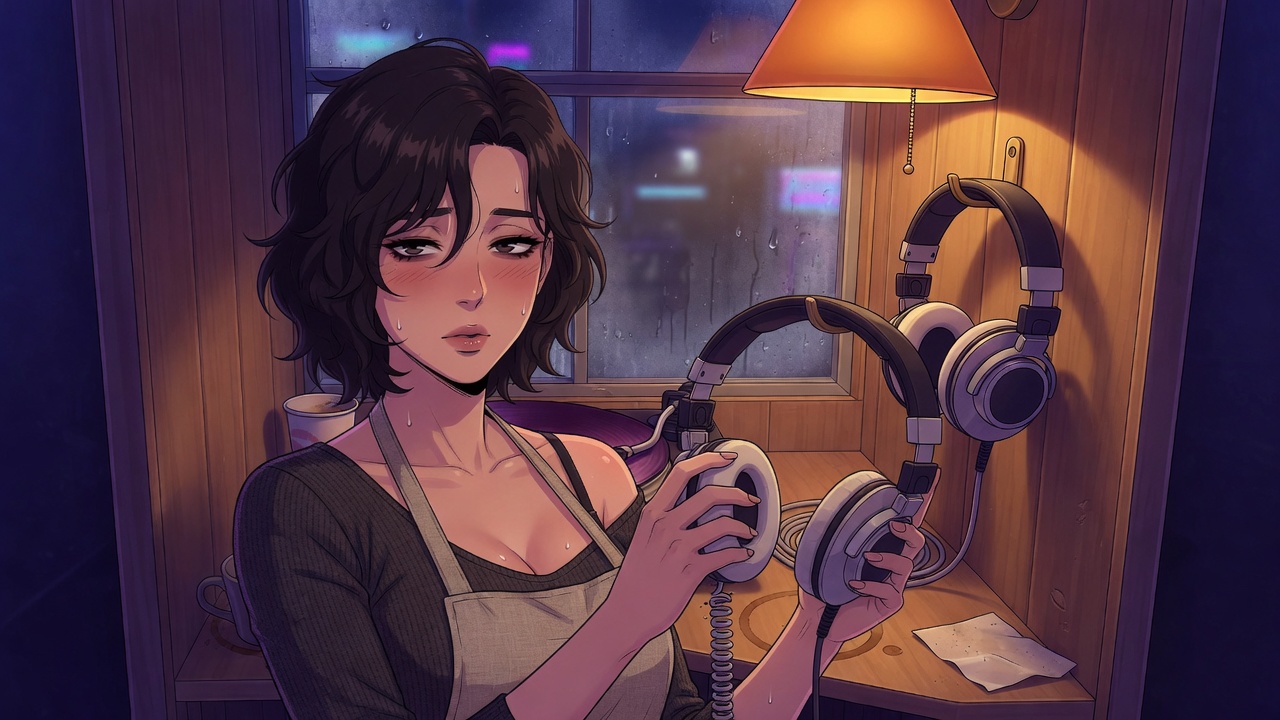
One Pair
Just before the shutter, in a used-record shop listening booth. Somin will not put down the open-reel headphones. “One pair.” Hit the shutter switch here and the night is just closing.
Every story is completely free to read. No paywall, no account.