Short story 5 min read 19+
Last Reel — After the Credits, the Booth Stays Hot
The house lights should have come up two minutes ago. They don't. On screen, the end credits keep climbing — grip, gaffer, the caterers — and tonight they climb for an audience of one, in the last single-screen house in the district still threading 35mm on weeknights.
The final staff name takes its sweet time, and I know why before I look up: the booth window sits high on the back wall, a small yellow rectangle burning into the auditorium ceiling, and a shadow crosses it. Somebody is still up there. Somebody is still working.
The polite thing — the thing a paying customer does when the film ends — is to file out through the audience exit and let closing be the theater's own business. I get as far as the lobby.
But the metal stairs to the booth run up the back of the building like a spine, and they're warm underfoot. The lamp above is still lit; I can feel it through the floor, a low animal heat rising through my soles. The door I assumed would be locked stands open the width of a hand.
Celluloid finds me before anyone does. That smell — vinegar-sweet, dust and chemistry, every old summer at once — leaks through the gap like the booth is breathing out.
Inside, a 35mm reel turns slow and steady on the spindle, the whole story flowing backward through the gate, rewound by hand when the motor could do it alone. The lamp throws heat like a small stubborn sun. Hot glass, hot film, hot air.
And on the bench beside the projector sits the projectionist.
Yerin, twenty-eight, in an oversized shirt that slipped off one shoulder sometime in the past hour — whether she noticed, or minded, is unclear. Her glasses have left faint marks at her temples where they were pushed up into her hair; ink stains her fingers, the marker she uses to label reels, a habit the multiplexes laughed out of her and this house never did. She holds a flange in both hands and does not set it down when I come in. She holds it the way you hold something when putting it down would mean deciding.
“We're closed,” she says, not looking at me, in the voice of a woman who has never once meant it.
The Flange
I know things about her the way a regular knows things: coffee at the second-feature mark, a muttered apology to the projector whenever a print jumps, and a wedding ring that stays home on nights her husband's own program runs at the other house across town — two projectionists under one roof, she told me once, laughing, would only ever fight about leader. That other house went dark an hour ago. I've spent all week pretending that detail doesn't matter.
“Credits were good,” I say, which may be the stupidest sentence ever spoken in a projection booth.
She finally looks at me. The lamp paints one side of her face the yellow of the window upstairs, that late color that makes any cinema feel like a secret. “My husband's screening ended ages ago,” she says. “He'll be home by now.” A pause wide enough to thread film through. “I won't be.”
The reel keeps turning, patient as a metronome. Rewinding is busywork and we both know it — the print could be boxed in five minutes. Her hand stays on the flange anyway, keeping the night on the spindle.
There are two ways out of this room. Down the metal stairs, through the audience exit, into an ordinary street where tonight closes itself neatly, a ledger balanced: film seen, house empty, nothing happened. Or there's staying. There's reaching past her to slow the reel — my hand over hers on the metal — her breath changing — every consequence after that arriving at once.
She tips the flange toward me — an offer, a surrender, a dare, all three.
“Just rewind. Stay and rewind it with me. Or go. But decide while it's still turning.”
Continue this scene in Last Reel →
Rewind
I stay. Of course I stay. Anyone reading this far already knew how the review ends.
What follows is conducted at the tempo of film — slower than digital, deliberate, every frame held a beat longer than it needs. She shows me how to mind the flange and uses the lesson to stand closer than instruction requires. Her shoulder settles against mine in the lamp-heat. The oversized shirt slides a little further, and this time she notices, and smiles, and lets it. Ink-stained fingers lace through mine on the rewind handle, both of us pretending the machine needs two people, both of us knowing better. The lamp keeps its small sun burning. Neither of us is in any hurry to box the print.
When the last of the reel is safely wound, she kills the lamp. The booth drops to one amber work-light and the sound of the projector spinning down, a held breath finally let out. Whatever the night becomes after that happens in the dark, off-screen, above an empty house — where it belongs. Some scenes are only ever shown behind the booth window.
Up here the rules are hers: light levels, handling times, how slowly a thing gets rewound. She walks me through every one of them, and after a while none of them is about film.
Much later: the alley door, air like cold water. She locks the booth behind us — that one, she actually locks — and the yellow window goes out over the empty seats. “Thursday's print is a mess,” she says, mouth close to my ear beneath the flickering marquee. “It'll need a long rewind.”
I tell her I know my way up those stairs now. She says that's what worries her. She's smiling when she says it.
We leave by separate doors. That was the arrangement, and for once tonight, we keep it. Behind us, the marquee bulbs hold their little fire all the way down the street — the only witnesses left, and they've seen everything already.
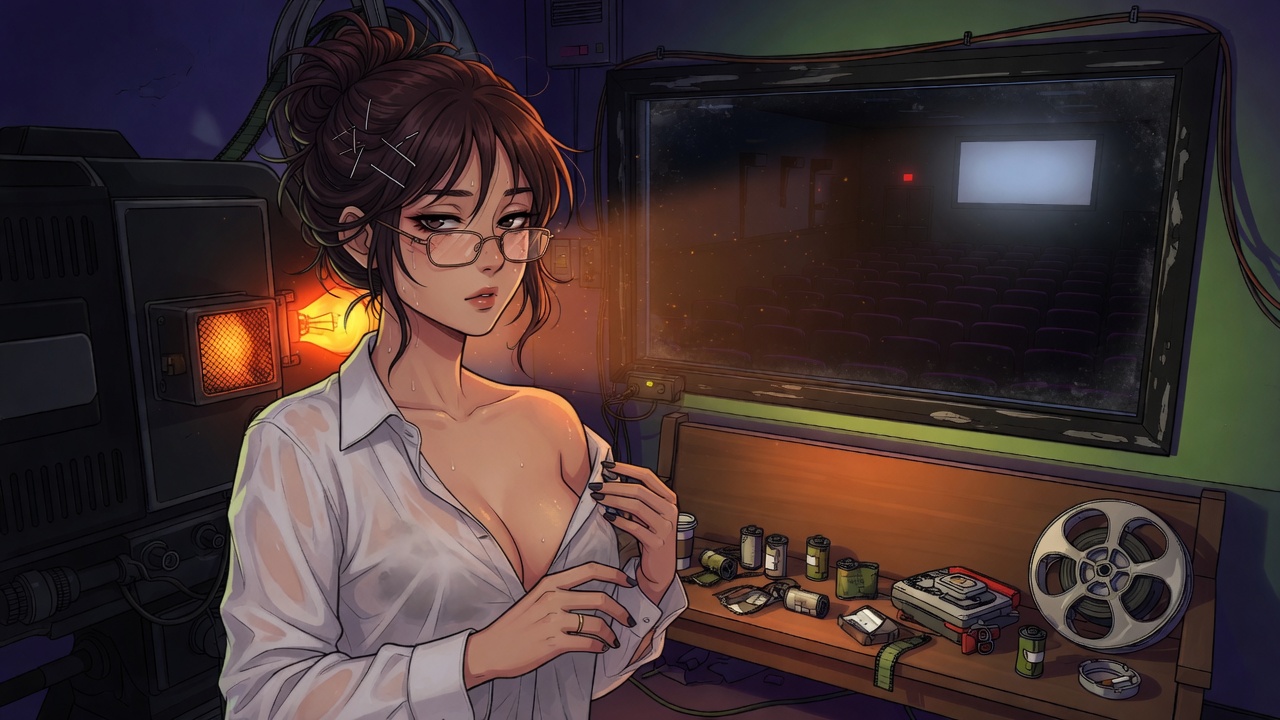
Last Reel
After the end credits, the projection booth of a single-screen indie cinema. Yerin will not put down the 35mm reel flange. “Just rewind.” Leave by the audience exit here, and it is only closedown.
Every story is completely free to read. No paywall, no account.