Review 3 min read 19+
Salt Review: Full Moon on the Flat, Long Exposure Nights
Full moon turns the salt flat into a second sky. That's the first thing Salt gets right: it hands you a landscape so bright and so empty that any two people standing on it look like the last two people anywhere. The genre rarely uses distance this well. This game makes distance the villain, the matchmaker, and the scenery all at once.
The hook
The jeep slips once on the crust — a small, physical lie your body believes immediately, and proof the developers have stood on salt at night. Brine hits the nose first. Night wind pins your shirt flat. The radio died once already. And ahead, where tire tracks are breaking the salt crystals, the camp deck floats with one lantern still on.
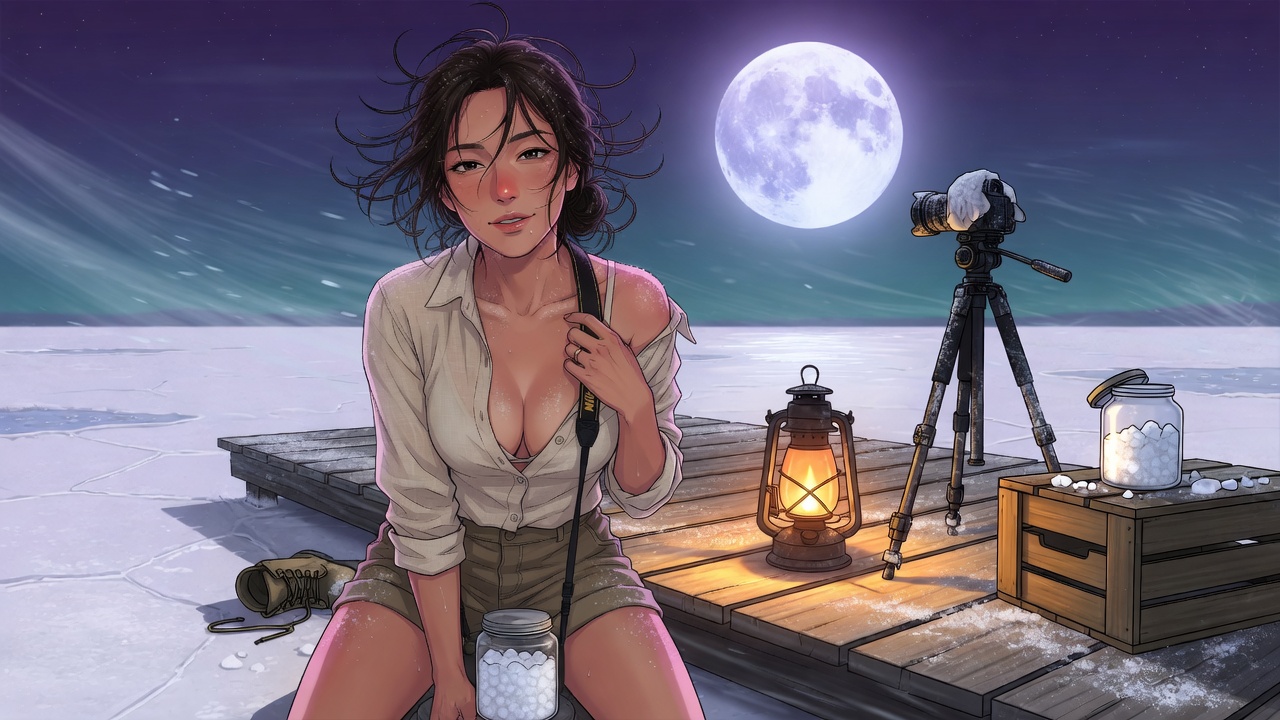
After the camera team pulled out, one long exposure is left: salt crystals in moonlight, a tripod dusted white, a crystal jar sitting beside it. And something is moving on the deck. That movement is the entire game, and Salt is disarmingly honest about it. Salt is a travel VN built on distance — and then it spends ninety careful minutes erasing it.
The characters in close-up
They are kilometers apart, and it matters that the distance is real — measured, neither denied nor dramatized.
She says: take your shoes off. On a deck above a salt flat, that's photography etiquette and invitation in the same breath, and the script lets it be both without winking. The narrator is a travel photographer — a peer, not an apprentice — which changes the chemistry entirely. This is a conversation between equals with tripods, and the mutual want is built like a focus pull: slow, deliberate, both parties adjusting.
The tension engine
The radio. Specifically this: it crackles again — another point, her husband's camera-team call sign — and then it cuts. That crackle is Salt's masterstroke. Every time it sounds, the flat becomes finite again: two lit points on a white sheet, spouses a jeep-ride apart. Every time it cuts, the deck contracts back to two people and one lantern, and the silence does the rest.
The central image is the long exposure: a photograph that exists only because nobody moved for a long time. Desire is framed the same way. Stay on the deck and it becomes something else. The fade to black arrives like a shutter closing; you never see the picture develop, and that restraint is the entire argument. Readers of our after-hours series should pair it with the funicular car story — a night ride worth boarding: two machines that only run after dark, two rooms suspended over emptiness.
Best enjoyed when
It's raining where you are. Genuinely — this is a game about dry white vastness, and the contrast does half the emotional work. One sitting, dark room, ambient track untouched. The opening drive asks fifteen minutes of patience; the deck under the full moon pays all of it back with interest. If your collection leans toward travel VNs where weather is a supporting character, this belongs on the top shelf.
Final call
Salt is the quietest of the late-night married-heroine stories I've reviewed here, and possibly the most affecting. Its flaws are pacing scars: the middle hour circles the same three props — jar, tripod, radio — and players hunting for twists will find only wind. But the writing respects everyone in it. The husband is a call sign, never an obstacle course; Dasom is a woman choosing her exposure time, never a temptation with a name.
Verdict: four and a half slow, moonlit stars. Take your shoes off. You'll see why.
Salt
Full moon, a salt-flat camp deck. Dasom will not set the crystal jar down. “Take your shoes off.” Leave in the jeep here and the night is only a pull-out.
Every story is completely free to read. No paywall, no account.