Short story 4 min read 19+
Salt — A Travel Visual Novel
"Shoes off," she said — the first whole sentence either of us had managed in an hour.
To account for that hour, you have to go back to where the headlights quit on the road and started trusting the flat.
Full moon over a salt flat is not darkness. It's a single held note of white that plays on the inside of your eyes long after you blink. The jeep slid once on the crust — a slow, weightless drift, tires finding a seam the crystals had kept to themselves for a season — caught, and kept crawling toward the only lit thing in forty kilometers of moonlight: a wooden camp deck with one lantern still burning.
Brine reached me before the moon did, salt and mineral riding the night wind, and the wind pinned my shirt flat to my back like a hand that had been waiting all evening for the chance. The radio had died once already — a burst of static, then that particular silence machines make when they stop pretending. I drove with the windows down anyway. Some places you want to hear.
Behind us, our tire tracks went on scoring the white, cracking crystal after crystal, the first sentences anyone had written on it all night. Ahead, the deck floated like something built by people who knew the flat would carry it.
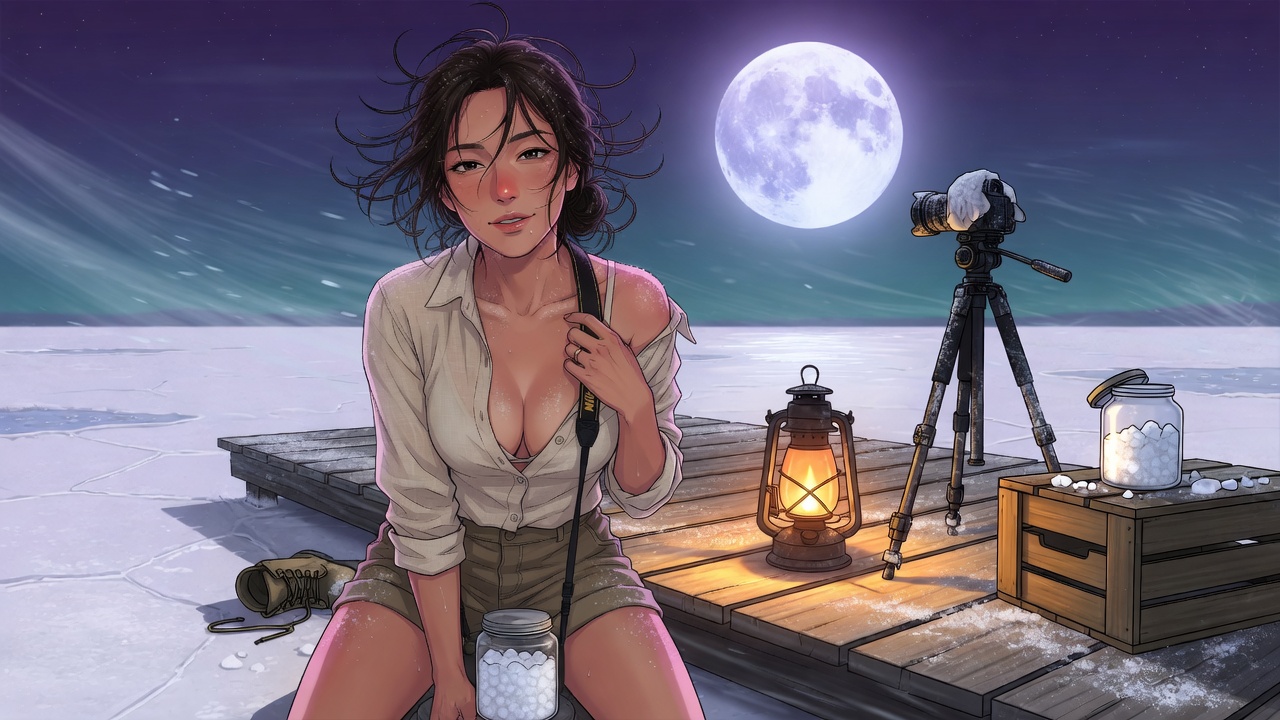
On the deck, the tripod wore a fine dusting of salt, and beside it sat a crystal jar — actual crystals, moon-bright in the lantern light, the kind of still life a photographer sets up once and waits a year to shoot.
The team had pulled out at dusk, scattered to points south with their own tripods and their own silences. One long exposure was left running here: salt crystals under moonlight, shutter open, minutes pooling into the sensor the way brine pools into the low places. And something was moving on the deck. It took me a moment to understand that the something was a person crouched at the tripod's shoulder, and another moment to accept that the person was Dasom.
Thirty-one. Salt-flat guide, night photographer, the reason every camera team that works this flat works it in one piece. Married — her husband was running a crew at another point tonight, a fact the flat reminded me of before she did. She had the crystal jar in both hands and was not setting it down. It had become, I realized, subject and alibi at once: the thing she was guarding, and the reason her hands were full.
The deck radio crackled once — a call sign from another point, her husband's team checking the chain — and cut. Static, then nothing. The flat took the sound back the way it takes everything, without argument.
Dasom didn't look at the radio. She looked at me, then down at my boots on her clean boards.
"Shoes," she said, as if one word could carry it. Then, softer, the way you confirm an exposure setting: "Off."
There is a version of this night where I get back in the jeep. In that version I keep my boots on, make a joke about brine and shift schedules, and drive our tracks back the way we came. The long exposure would finish without us. The lantern would burn until it decided not to. By morning her husband's crew would roll in, and the whole night would compress into a pull-out — the photographic kind, the frame you lift yourself out of before it can commit, cropped tight, nothing left in it that might develop into trouble. Four tires and a horizon, cleanly severed.
I gave that version about as much thought as a shutter needs to blink.
In the other version, I sat on the deck rail and worked my boots off, and the night stopped being a pull-out the moment my bare feet found wood the lantern had been warming all evening. Dasom finally set the jar down — beside the tripod, precise as punctuation — and the two of us finished the exposure together inside a silence the flat approved of. Whatever passed between a guide and a guest on a moonlit deck, with a call sign still hanging somewhere over the crust, belonged to the moon, and the moon doesn't testify. The wind told no one. The shutter kept its one long eye open and let the minutes run.
What the Frame Keeps
Weeks later, the photograph comes back from the flat: white on white, salt crystals sharp as a held breath, and at the edge of the lantern's reach two soft blurs where stillness used to be. She could crop us out — she's the photographer, and cropping is her native language. She hasn't. The file sits in her drive under a name only she knows, the way the flat keeps every track until the next wind rules otherwise. Some frames you lift out of early. Some you let run long, and long is the whole point.
If the moon is full where you are tonight and you find one lantern burning over all that white, Salt knows the way across the crust.
Salt
Full moon, a salt-flat camp deck. Dasom will not set the crystal jar down. “Take your shoes off.” Leave in the jeep here and the night is only a pull-out.
Every story is completely free to read. No paywall, no account.