Review 4 min read 19+
Sign Off Review: The Affair That Starts When ON AIR Dies
There's a moment in every broadcast night when the show stops being a show. The last track fades, the red lamp cools, and the mixer rolls over to an ad loop nobody is awake to hear. Sign Off builds its entire affair inside that gap — the minutes after the audience leaves and before either of you finds the nerve to. It's a short game about a long pause, and it's one of the smartest, quietest things on VNights right now.
The hook
Friday, nearly two in the morning, Brooklyn. Only the first floor of the college radio building is still lit, and you have been the last guest slot for an hour — the kind of overstay that stops being an accident somewhere around midnight. Last semester's posters still line the hall, promising Brooke Lang and her late-night program. The campus gossip comes free with the posters: married DJ; husband drives a taxi through these same hours; two schedules that never once touch.
Through the soundproof glass, Brooke has her hands on the mixer, the red ON AIR lamp still burning above her. A wine-red bob caught in her headphones. A black tank slipping at the chest. Then the lamp dies, and she waves you in: last guest, you still here? Just sign-off left. Come in.
The booth door is thick. When it shuts, the hallway ceases to exist. There is only your breath on the guest mic and her voice low in your cans: don't take the headphones off yet. When ON AIR dies, only ads go out. I'll tell you then.
The characters in close-up
Brooke is twenty-eight and rendered in small, precise details: the gold band on her left ring finger that the camera keeps in frame exactly long enough to hurt; the tank strap she notices and doesn't fix; the way she talks to the empty city like it's a single person who never writes back. She's warm the way late-night voices are warm — practiced, a little worn, more honest at two in the morning than the daylight version of anyone.
You are the last guest, a body the show booked and forgot to send home. The husband exists mostly as headlights somewhere over the bridge, and the game is careful with him: not a villain, not a fool, just a shift. That restraint is what makes the wanting legible as a choice instead of a score. Two adults, one booth, and a marriage neither of them mentions out loud.
The tension engine
Nothing in this booth hides. The soundproof glass looks straight out at an empty hall; the ad loop ticks along like a kitchen timer. What the insulation actually protects isn't sound — it's the work. As long as the ads roll, the night is still technically a shift, and two adults can stand close to a shared microphone and call it broadcasting.
"I'll just leave the ads running."
That one line is the whole engine. Take the headphones off, take the stairs, and the night ends as a good show you once sat in on — a nice memory with a commute attached. Stay, and the soundproofing starts working in reverse: the room shrinks to glass, breath, and the space between two chairs while Brooklyn sleeps off its Friday. Every choice the game offers is tiny — a fader, a chair, a sentence finished or not. That's why they land so hard. And when the fade to black comes, it reads less like a censor's hand than like the studio lights going out one last time on purpose.
Best enjoyed when
Headphones on, lights low, actual night outside your own window. This title lives or dies on its sound design — the clunk of that heavy door, the hiss between ads, a fader pulled down for good — and it dies nowhere. If that texture is your thing, our piece on how staged sound sells an entire scene makes a natural companion; Sign Off clearly studied the same school of quiet. It's also among the most restrained entries on the encounter shelf: nothing explicit, everything charged, and the silence between ads doing more damage than any monologue could.
Final call
An affair story doesn't need much plot. It needs a room, a clock, and a reason nobody leaves — and Sign Off has all three, plus the best use of a commercial break this medium has produced. Ninety minutes, maybe less, and it puts you back on the stairs feeling like you personally decided something.
Sign Off is an easy recommendation. Play it once to leave at the right time, headphones off, stairs taken, night safely over. Then play it again to stay past sign-off and learn what the ads sound like when nobody's watching the booth. That second run — wine-red bob, gold band, glass that keeps the work from seeing — is the one that stays with you.
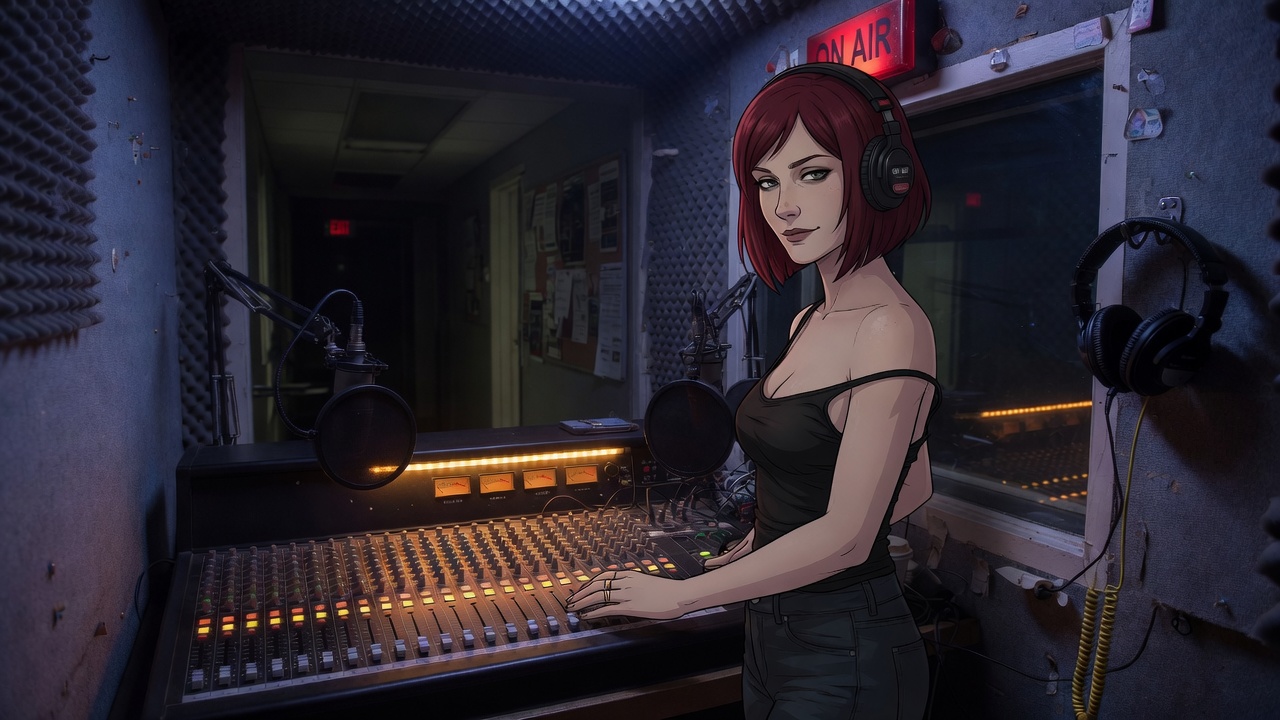
Sign Off
A Brooklyn college radio booth. After late-night sign-off, a married DJ doesn't take her headphones off. “I'll just leave the ads running.” Take the stairs and the night is just a last-guest slot.
Every story is completely free to read. No paywall, no account.