Short story 4 min read 19+
Sign Off — Two A.M. in the Booth with Brooke Lang
Brooklyn. Friday, almost two in the morning. The college radio building keeps one lit window in its whole dark face, and it's on the first floor, and I've been on the wrong side of it for an hour.
I'm the last guest. That's official — the rundown had me slotted at one, four segments, out by a quarter past. But Brooke Lang stretches a late-night hour the way taffy stretches, and every time I stood to go, she cued a song instead of a goodbye. Now the rundown is finished, and I'm standing in a hallway that smells like burnt coffee and nineties carpet.
This is where Sign Off plants you: the wrong side of the glass, holding a choice the story refuses to make for you.
1:54 A.M. — The Hall
Last semester's posters line the corridor, corners curling: The Overnight Frequency, with Brooke Lang. Her name in a font that promises more than the college ever delivered. The legend that comes attached: married. Twenty-eight and married, and the campus version of the story always adds the detail that matters at this hour — her husband drives a taxi nights. Somewhere out in the dark, a meter is running on this evening whether anyone knows it or not.
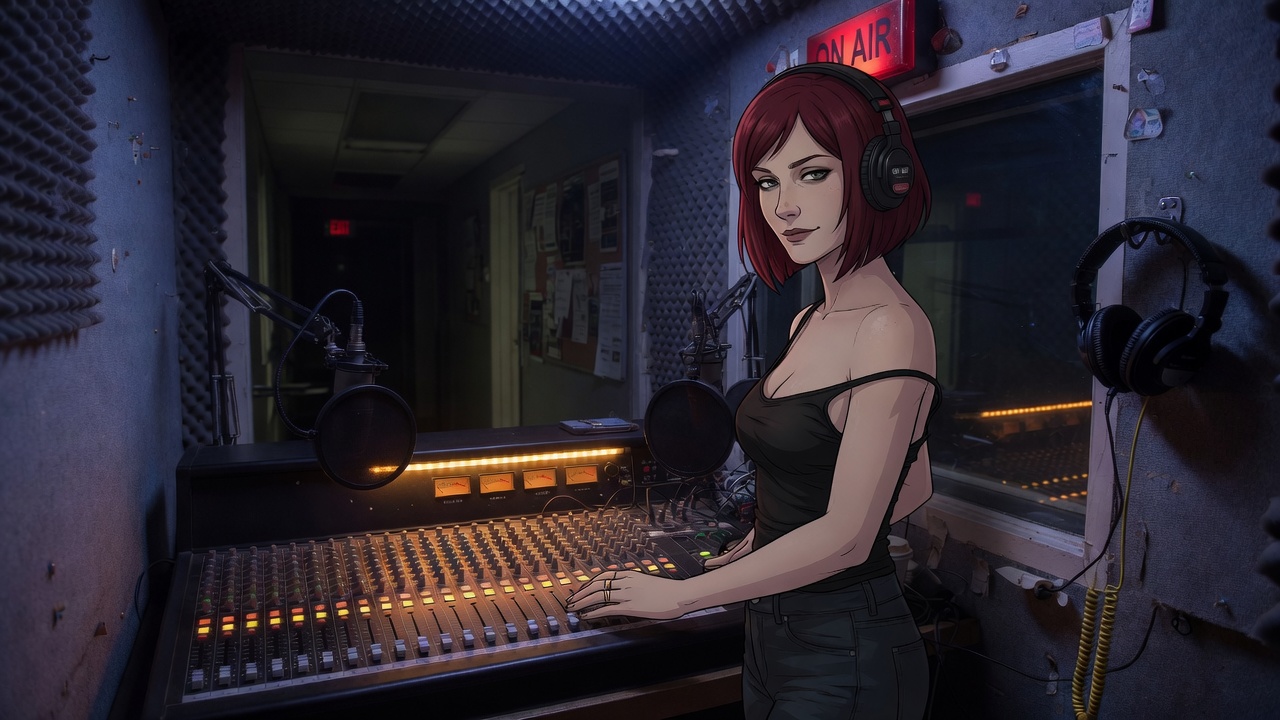
Through the booth's soundproof glass, Brooke has both hands on the mixer like it's an animal that needs calming. The wine-red bob snags on her headphones each time she dips to read the board. Black tank, slipping at the chest, infinitely patient about it. And above the door, the red lamp: ON AIR, still alive, still lying to the night about how this is going.
She sees me before I decide to knock. One finger leaves the fader and beckons, and the intercom crackles with her voice — the on-air voice, honey over gravel:
"Last guest, you still here? Just sign-off left. Come in."
1:58 A.M. — The Booth
The door is thicker than most walls I've lived behind. When it swings shut, the hallway dies mid-thought — no hum, no hiss, no city. The booth becomes a small country with a population of two, and my chair sits close enough to the guest mic that my breathing registers on the meters like weather.
Brooke slides a spare set of headphones across the board, then leans back and studies me over the rim of the desk, the gold band on her left hand catching the red of the lamp. Two minutes to the top of the hour. Somewhere in the building, a clock insists on itself.
"Don't take the headphones off yet," she says. "When ON AIR dies, only ads go out. I'll tell you then."
Continue this scene in Sign Off →
2:00 A.M. — Sign Off
She does the sign-off in eleven seconds flat — station ID, her thanks with my name in it, tomorrow's weather delivered like a rumor she refuses to confirm. Then her finger touches the fader, the red lamp dies, and the mixer rolls on into the ad loop without her: a mattress warehouse, a bodega, a study-abroad program. The city selling sleep to nobody, right on schedule.
Brooke doesn't take her headphones off.
She takes her time instead — unwinds the cable, sets one earpiece against her jaw like she's listening to a frequency the board can't reach. The tank has lost its argument with gravity; she has noticed, and she lets the noticing sit there between us, unedited, off the record. The gold band gets one slow turn of her thumb, like a dial finding a station.
"I'll just leave the ads running," she says. "They don't need me. For the next little while, nobody is on air."
The exit is right there. Stairs, hallway, night air — a last-guest slot neatly signed and filed, Friday kept professional, and Monday turned into a story I tell nobody, fondly, to myself.
She waits the way she runs a board: no dead air, no rush.
What happens between two people behind soundproof glass stays there. The city gets the ad loop. The tape — and Brooke records everything; she told me that her first night, laughing — the tape keeps the rest, and the tape is hers.
3:12 A.M. — The Stairs
The building lets me out into a Brooklyn that has stopped pretending. First birdsong. A delivery truck idling at the corner, roof light on, driver's arm out the window. I don't look any longer than anyone would.
Some stories are about what people say. Sign Off is about what the equipment hears while they don't: the hum of a board with no hand on it, an ad loop filling a room nobody's in, a guest mic that only ever recorded breathing. The tags — radio, recording, late night, married woman — undersell it. The best thing this story does is make silence sound like a decision.
Her show runs Fridays. The sign-off is always the same eleven seconds. I know because I've started listening from home — and because the last thing she says, every week, right before the ads roll in, is a sentence with two meanings and one listener.
Sign Off
A Brooklyn college radio booth. After late-night sign-off, a married DJ doesn't take her headphones off. “I'll just leave the ads running.” Take the stairs and the night is just a last-guest slot.
Every story is completely free to read. No paywall, no account.