Short story 4 min read 19+
Upper Berth
The tunnel takes the radio first.
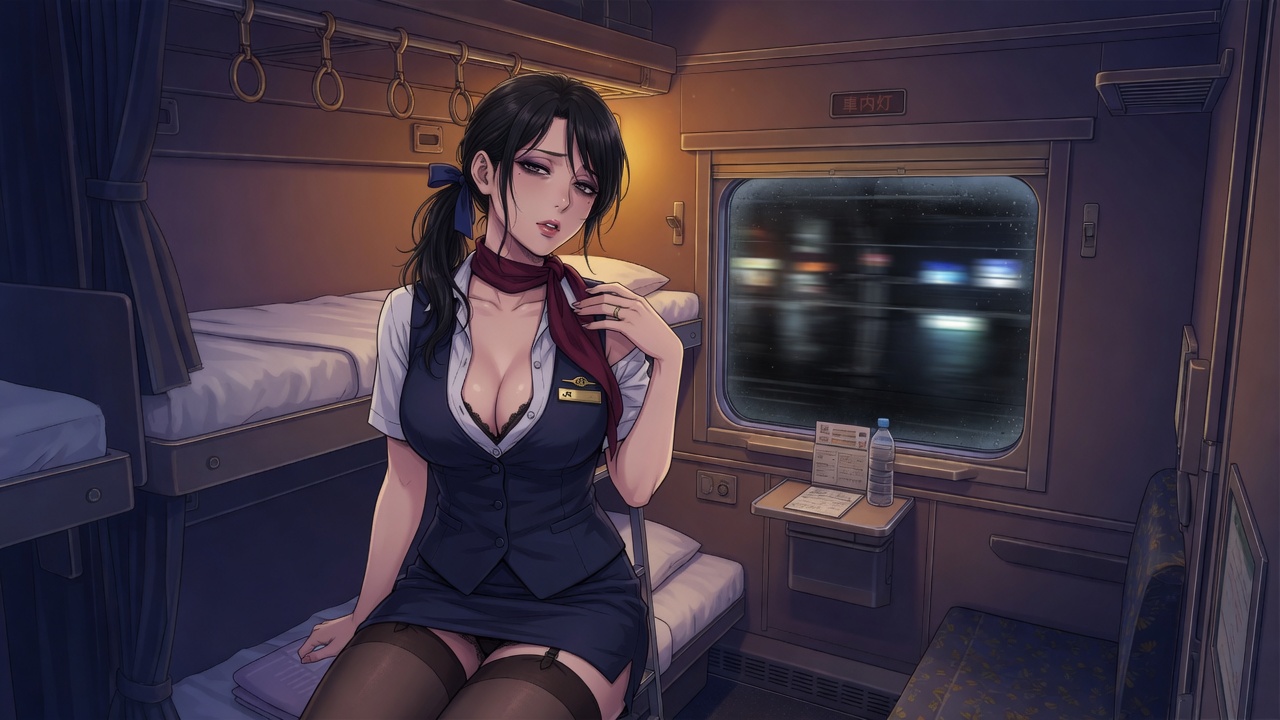
One moment the speaker above the corridor door is murmuring about rain somewhere far from here. The next it is a hairline of static, then nothing, and there is only what the rails say under us — two long notes, a seam, two long notes again. Past midnight. The overnight train threads into rock, and the whole world narrows to steel, black glass, and one yellow reading lamp in a two-berth cabin.
Cabin 7, my ticket says. Upper berth. My knee learns this before I do; the ladder is steeper than the diagram promised and jabs the same spot twice, like the car clearing its throat. The lower berth is made up and empty, linen folded back with hospital corners, still holding the cold of the storage locker. No one has slept in it tonight. No one is coming to.
The curtain will not hold still. Its ring taps the window frame in the curve of the track — a small brass heartbeat, knock, knock — out of rhythm with the rails. I lie there listening the way you listen to a drip you keep meaning to fix.
Leftover Night-Shift Work
There is a checklist wedged in the door clip. An attendant's clipboard, filled to the second-to-last line: water, heater, beds. The line for this cabin's linen is blank. So is the last line of the passenger list.
Leftover night-shift work, I think, the way you think anything at that hour. Somebody will come by.
Somebody comes by.
A knock, soft. The corridor keycard chirps once against the lock — a sound like a coin dropped in a cup — and the door slides open on a woman who is apologizing before she is fully through it.
She is twenty-eight, maybe, hair tied back in a way that admits her shift started long ago, a neck scarf knotted at the throat, a stocking seam drawn straight as a rail line down the back of her leg. She turns her badge toward me out of pure habit — Daon, a number, the little railway crest — as if I weren't the only witness, lying in the berth she is apologizing for.
“I'm sorry. The night list wasn't finished. Your linen — let me.”
She works fast. Fresh pillowcase, blanket shaken once and squared away. She makes up the lower berth, though I tell her twice I'm booked on top. “You checked in late,” she says. “On paper, the lower was yours until it wasn't.” She smooths a wrinkle with the flat of her hand, and the lamp makes a small ceremony out of it.
Small talk at that hour is weather and timetables, and she gives me the timetable: her husband is working tonight too, on the train that passes this one going the other way. “Somewhere back there, we crossed,” she says. “Two lights in the dark, moving fast.” She says it the way you'd mention a neighbor's fence. The scarf sits loose at her throat. She doesn't tighten it.
She should leave. All the checklist needed was a signature. Instead she stands a moment by the window while the tunnel lets go of us and the speaker overhead starts murmuring again — still rain, still somewhere far from here. The curtain ring knocks its brass knock. Her hand comes up to still it and doesn't quite let go.
The lamp is on my side of the cabin. The curtain, when she draws it halfway across, is on hers.
“Just lower the curtain.”
Continue this scene in Upper Berth →
Here is the night as a timetable. The corridor is eleven steps, end to end. The keycard chirps for me as easily as it chirped for her. I walk out; the curtain falls on an empty cabin; at some small station the night ends as sleep. The upper berth goes back to being a berth. The lower stays made up for a passenger who never boards.
Here is the night as the lamp sees it.
Both of us are awake. Both of us are staying. That much is as plain as a printed schedule, because she drew the curtain from her side, and I leave it down from mine. Her scarf comes loose on its own knot. The stocking seam goes crooked against cold linen neither of us checked. The badge ends up face-down on the fold-out table like a coaster nobody uses, and the curtain ring has finally stopped knocking. The train takes a long curve; the lamp swings its small gold light across the ceiling, along her shoulder; and I stop keeping track of which of us is leaning.
After that, memory works like a tunnel — light at both ends, dark between. At some point the lamp clicks off. At some point the untouched lower berth stops mattering to either of us.
Morning comes up over grey farmland, businesslike. The cabin smells of coffee from the dining car and nothing else worth naming. Daon stands by the door, badge turned right way round, scarf re-knotted at the throat, tugging the curtain open a hand's width. All business again, as if the night had signed for itself.
“Arrival in forty minutes. Sign the list before the inspector comes.”
The last line of the passenger list is still blank. She watches me while I decide what to write.
Some nights the train is only a train. And some nights, the upper berth is not a job.
Upper Berth
Past midnight in a tunnel. A two-berth overnight sleeper. Daon will not let go of the curtain ring. “Just lower the curtain.” Walk out with the corridor keycard here, and the night is only sleep.
Every story is completely free to read. No paywall, no account.