Review 4 min read 19+
Shared Berth Review: A Cabin Sold Twice Under Fog
The fog reached the Wando pier before the ferry reached open water. By the time the engines had settled into their slow pulse somewhere under the hull, the last two-berth cabin on the overnight run to Jeju had been sold twice — once to a woman whose husband missed the boarding gate, and once, on paper, to a stranger. Shared Berth builds its entire evening out of that clerical accident, and it never once raises its voice about it.
The hook
It starts at the gate, which is a brave place to start. A married woman stands alone with a phone at her ear, turning the ring on her left hand like a worry bead. The call ends. She keeps staring at the screen as though she could reload a man back through it. Then the ticket office calls my name, and the arrangement is stated with brutal bureaucratic calm: the last two-berth has been sold as shared. The upper bunk is mine.
Shared Berth refuses to dramatize any of this. She takes the ticket. Nobody apologizes. The finger under the ring has gone white, and that white knuckle is the loudest image in the first act — a whole marriage compressed into one joint of one hand.
“I'm Hayun. He… missed the gate. I was already on board.”
The line lands mid-scene, without music under it, and it works precisely because the scene never asks it to.
The characters in close-up
Hayun is twenty-nine and written in small strokes: a travel knit under her coat, a voice pitched to carry only as far as a cabin wall, and an early, prim announcement — she'll sleep in her clothes — that the story keeps circling like a tongue returning to a sore tooth. The husband is a beautiful absence: a missed gate, a delayed connection, a phone that lights and lights. The narrator is a stranger with an upper bunk, no agenda the text will confirm, and no argument to make.
What impresses me most is the restraint. Nobody here is predatory, and nobody is pushed. Hayun gets the quiet arithmetic of a woman recomputing her own life mid-crossing, and the game simply lets you watch the numbers change. Her desire, when it surfaces, is hers. That authorial patience is what makes the night feel adult instead of merely rated for it.
The tension engine
The cabin is small enough to be a held breath: upper bunk, lower bunk, a round porthole, and a door that only locks from inside. That last detail is the entire machine. Privacy aboard this ferry is a courtesy rather than a rule, and both characters — and the player — know it.
Between engine beats, the lower berth moves. A foot slips off the mattress edge. A coat is folded, or not folded. The POV framing hands every small motion to you for interpretation, and the script declines to confirm a thing until you've already leaned in. The dawn announcement gives the night a shape: hours of fog, hours of almost, and a horizon waiting to make everything ordinary again.
The oldest rule of slow-burn romance applies — nothing happens, repeatedly, until everything does. And when everything does, the game keeps its promise: a fade, an engine note, a coin of lamplight in the porthole glass. Whatever passes between the upper bunk and the lower one stays between them, which is exactly why it stays with you.
Best enjoyed when
Late, obviously. This is a lights-off, headphones-on VN, best played with rain against your own window to double the fog. The pacing is engine-thrum patient, so bring the version of yourself that never skips text. If you like journeys where the vehicle does half the seducing, the funicular-car story is its natural companion — another night ride, another cabin barely bigger than the tension inside it — and the wider travel shelf has more where both came from.
It rewards a second run, too. Once you know where the night goes, every polite sentence on the deck sounds different. The fog scenes stop being weather and start being cover. That is craft.
Final call
Verdict: a small, sure-handed piece of adult tension that earns its fade honestly. Hayun's choice stays hers, the stranger's restraint stays real, and the fog stays on the outside of the glass where it belongs. Nine crossings out of ten, I'd call the ferry the second-most interesting thing aboard. On the tenth — the night the last two-berth sells twice — the boat is just the vehicle and the cabin is the destination. Book the upper bunk and find out what the lower one sounds like between engine beats: this overnight crossing is the kind of quiet that keeps you awake on purpose, and I mean that as the highest praise a night ferry can carry.
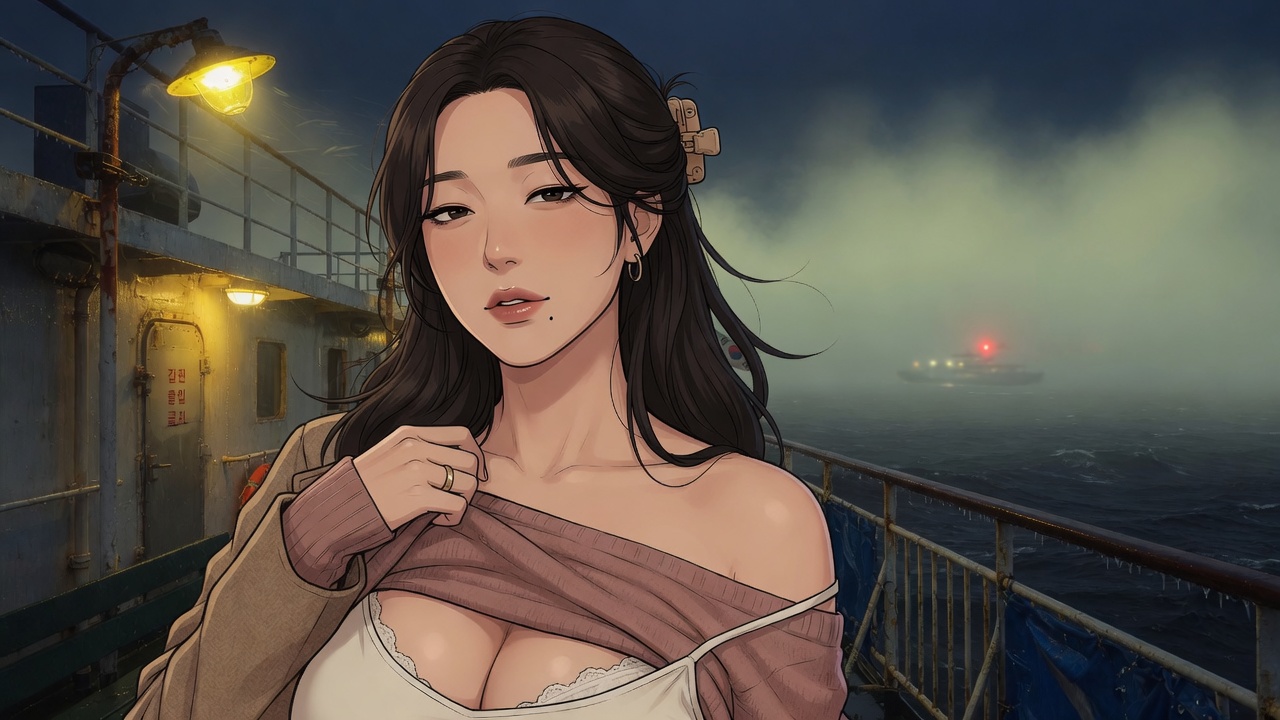
Shared Berth
Overnight ferry toward Jeju. Her husband missed the gate, and the ticket office sold the last two-berth cabin as shared. The upper bunk is mine. “I'll sleep in my clothes.” The door only locks from inside.
Every story is completely free to read. No paywall, no account.