Short story 4 min read 19+
Tide Key: A Montauk Night That Turns on One Brass Key
Low tide doesn't look like absence. It looks like inventory — every rock, rope and rusted mooring ring laid out in the open where the water used to be.
I walk the last board back to the shack with the leash wound around my fist, and Montauk after dark is quiet enough to hear the sand move under my heels. The tide has pulled out a quarter mile. The beach is twice its daytime width, flat and shining, holding the last of the sky like a tray.
Parking-lot sand works into my shoes on the dune path and grinds with every step. One light is still on up there: the rental shack, a yellow square in a wall of dark dune grass. The day-trippers cleared out at noon, and the lot behind the dunes is down to three cars. One of them is mine.
The rack outside holds six boards. Five are still wet with salt. The empty slot is mine.
There is sand stuck to the deck in little dried continents, and one line of bare footprints leading around the side of the shack toward the outdoor shower. Small prints. Recently made. They stop at the shower and do not come back.
On the wall by the steps hangs a steel lockbox for the room key. The latch is open. A gold band sits on the ledge beside it, catching the porch light — not set down so much as surrendered, the way things sit when a hand has just left them. I clock it the way you clock weather. Quickly, and with a decision following right behind.
Salt and Brass
She comes around the corner pulling a wet cover-up over a swimsuit — twenty-nine or thereabouts, sandy hair stiff with salt, bikini straps showing at the collar like rigging. Sienna Cole. I emailed this woman twice about check-in times, and she signed both replies with a smiley face, and I thought about that smiley face for roughly six hours of a nine-hour drive.
She takes the board out of my hands before I can offer it, stands it in the empty slot, cinches the strap. Then she nods at the lockbox like it's part of the conversation.
"My husband runs the dawn boat," she says. "On the water at four. Home by ten. Asleep by nine." She reads it out the way you'd read a tide chart — facts, numbers, no complaint anywhere in it. "Nights out here are very long."
I don't ask what she does with them. She isn't offering me an excuse. She is reading me a timetable so there can be no confusion later about when she is alone.
"The guest shower closes at ten," she says. "This isn't that key."
It sits flat on her open palm. Brass tag, worn smooth — the outdoor shower, behind the shack, on the private side of the dune line. Steam is already ghosting off the pipes. She ran it for herself and never turned it off.
A step behind her, the lockbox hangs open. A room key dropped in, a lid clicked shut, and the paperwork is finished. No guest. No checkout time. No receipt for what the shack is after that.
The ocean breathes somewhere past the dark. The ring glitters on its ledge. Her hand is absolutely steady.
Continue this scene in Tide Key →
Refuse the key, and this stays what it says on the receipt: one night, one shack, checkout at eleven. In the morning she is the owner again — friendly, brisk, untouchable behind a counter — and I am a guest with sand in his shoes and a long drive east. There is nothing wrong with that night. Most people would have it. The Atlantic will never mention it to anyone.
But she isn't asking to be rescued, and that is what I keep noticing while the steam drifts between us. The ring came off before I ever walked up this dune. Whatever this is, she decided it in her own order and on her own time: band first, offer second, lockbox last. Her voice doesn't soften and her hand doesn't waver. Nothing here is a trap; a trap has a hidden mechanism, and every mechanism on this dune is in plain sight. Two adults, one exact moment, and a door that locks from the inside.
The Geometry of One Night
Everything Tide Key hangs from that open latch — whether the shack stays a rental or becomes a room, whether the night keeps its receipt or tears it up. It is a very small brass decision, and the whole story turns on whose hand closes it.
The shower hisses softly against the wood. Her cover-up is still damp; the tide is still out; the sand is still impossibly wide. Somewhere past the dark, a charter boat is waiting for first light, and its captain is warm and asleep in a house on the harbor road, and none of that is mine to think about yet.
The key is warm from her palm. The lid of the lockbox is still up. Nine hours of highway, one low tide, one worn brass tag — some choices you drive all day toward, and this story only wants you to have to stand here first, salt-stung and barefoot, before you make it.
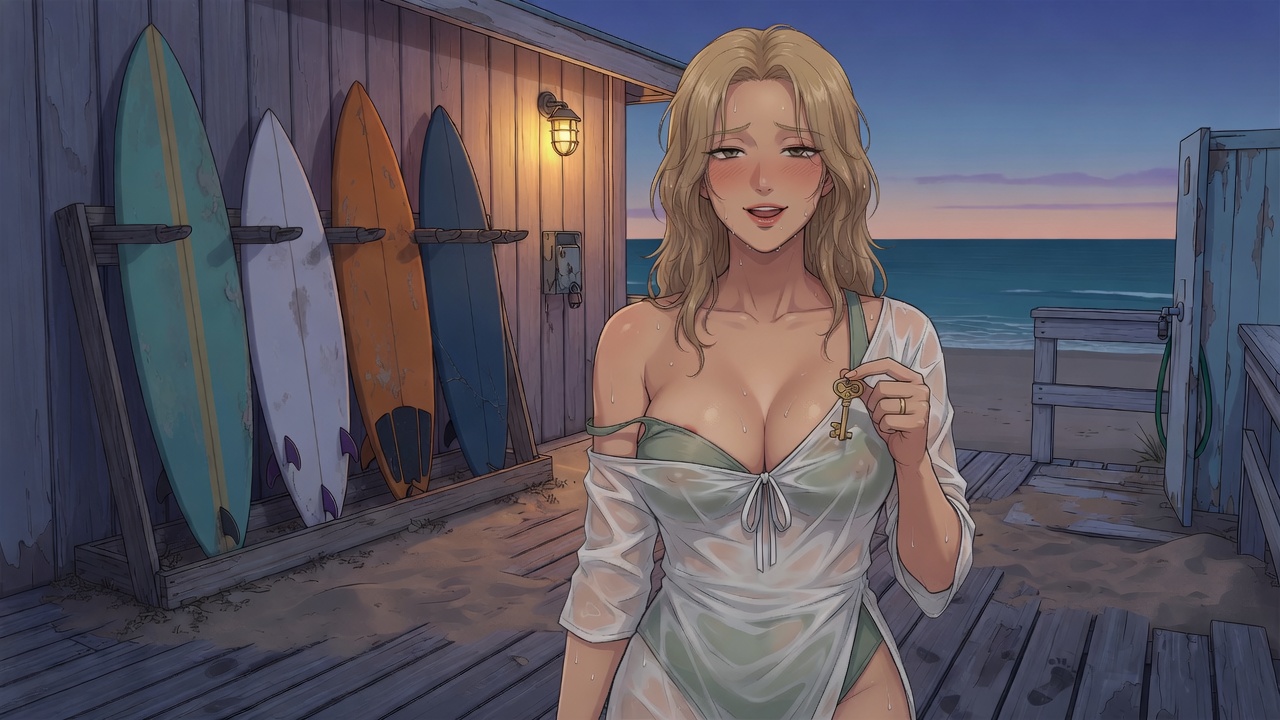
Tide Key
A Montauk beach rental shack. After low tide, the married owner takes the last board and holds out the shower key. Close the lockbox and the shack becomes a room.
Every story is completely free to read. No paywall, no account.