Short story 4 min read 19+
Stall
The market lets go of its noise before it lets go of its light. Speakers die first, then the fryers, then the last voices, until the whole street sounds like water finding a drain. I walk as far as the alley and stop.
Pack-out. Every vendor here knows the choreography by heart — trays stacked, cash box under an arm, tent poles clacking into their bags. Behind the stall truck the air still smells warm, grease and coal holding the day's heat long after the customers have gone. Only the folding tables are left, folded and leaned against the wall like they're embarrassed to still be awake.
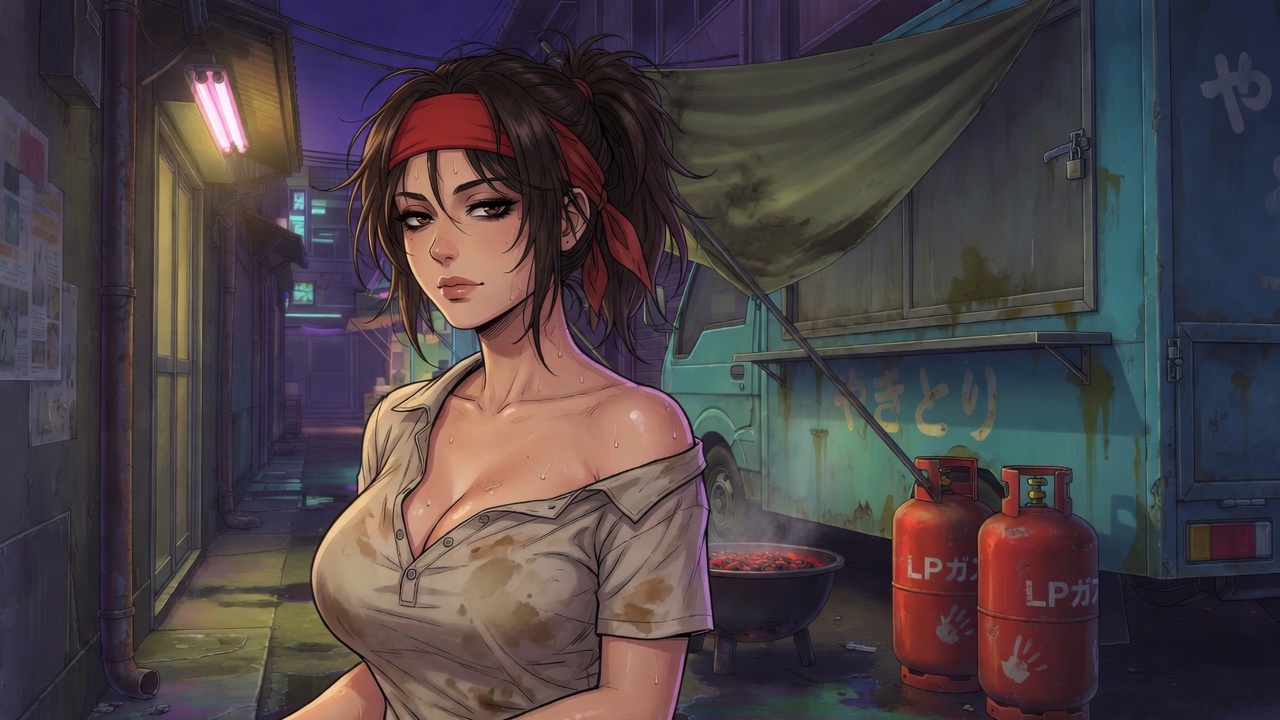
Her truck sits two meters in from the alley mouth, and the tent is only half down — one side still rigged, throwing a strip of shade across the asphalt that has no business existing at this hour. I have watched that truck from the next alley for months. I know her rhythm better than my own takings: when she kicks the chock free, when she folds the counter in one practiced shove, when she stands at the valve with both hands and lets the hiss run down to nothing.
Seoyul. Twenty-seven, the other vendors say. Married. Her husband runs the stall in the other alley, which is exactly why my stall is where it is. She folds this truck alone every night — no helper, no small talk, just the work and the radio she never turns on.
Tonight I stayed late too. Neither of us has bothered to call it a coincidence.
She is still in front of the propane valve. Headband pushed back off her face, oil on her forearms where the fryer spat at her — it shines there like gloss, catching light in a way the dying lamps shouldn't allow. The hem of her shorts cuts across her thigh as she crouches into the shade. Her face is hot from the work, flushed through, a shine at her temple. She has the valve in both hands and she will not let go of it. Not to stretch. Not to wipe her arms. She holds it the way you hold a door you have decided not to open yet.
“You're blocking my light,” she says, without turning.
There is no light to block. A till lamp behind her, one street lamp at the mouth of the alley, and between them the half-dropped tent, keeping its shade like a secret.
“Then I'll take the tent down,” I say.
“Don't.”
The word sits there among the folded tables and the coal smell. She straightens, drags a forearm across her brow, and looks at me the way a vendor looks at a customer she has already decided to overcharge — the decision made; now she is only checking whether I'll pay it.
“Drop the tent.”
It takes me a moment to understand that this isn't teardown talk. If the tent comes down and we walk out to the alley, this is just two vendors closing up. Ordinary. Deniable. The kind of hour her husband's stall would recognize from across the way. The whole night folds itself into a truck and drives home.
But if the tent stays up—
“If the tent stays up,” she says, reading the rest of it off my face, “then it stops being pack-out.”
Continue this scene in Stall →
What the shade keeps
I don't walk out to the alley. I don't insult either of us by pretending I was going to.
She lets go of the valve at last, and the small hiss dies like something exhaling. Under the half tent the shade is warmer than the night has any right to be, close with grease and coal and the salt of her workday. Her headband comes off with one pull of her wrist. Her hands smell of fryer oil and clementine peel — she has been eating them out of her apron pocket since nine, apparently, and she tells me this against my collar like it is the funniest thing anyone has ever confessed in an alley.
Whatever else gets said there stays under the shade with the coal smell. The street lamp buzzes through one long amber minute. Somewhere a table folds; somewhere a shutter rolls down; the market carries on its teardown without us, patient as tide.
When the tent finally does come down, it comes down in the dark, and we take it down together, and neither of us is in a hurry about it. She pulls the truck out at two. I watch the taillights take the corner she always takes, and the alley smells of grease and coal and, faintly, clementine.
Her husband's stall opens at six the next evening. Mine opens at seven. Her truck rolls past my alley at half past, slows — a half second, no more — and finds its corner like it always does.
Some teardowns take all night. Ours, I suspect, is going to take the whole season. If you have ever stayed past last call at a market, you already know the hour I mean — the one the vendors don't name, and the night keeps folding up anyway.
Stall
Just before pack-out, behind a night-market stall truck. Seoyul will not let go of the propane valve. “Drop the tent.” Walk out to the alley here and it is just teardown.
Every story is completely free to read. No paywall, no account.